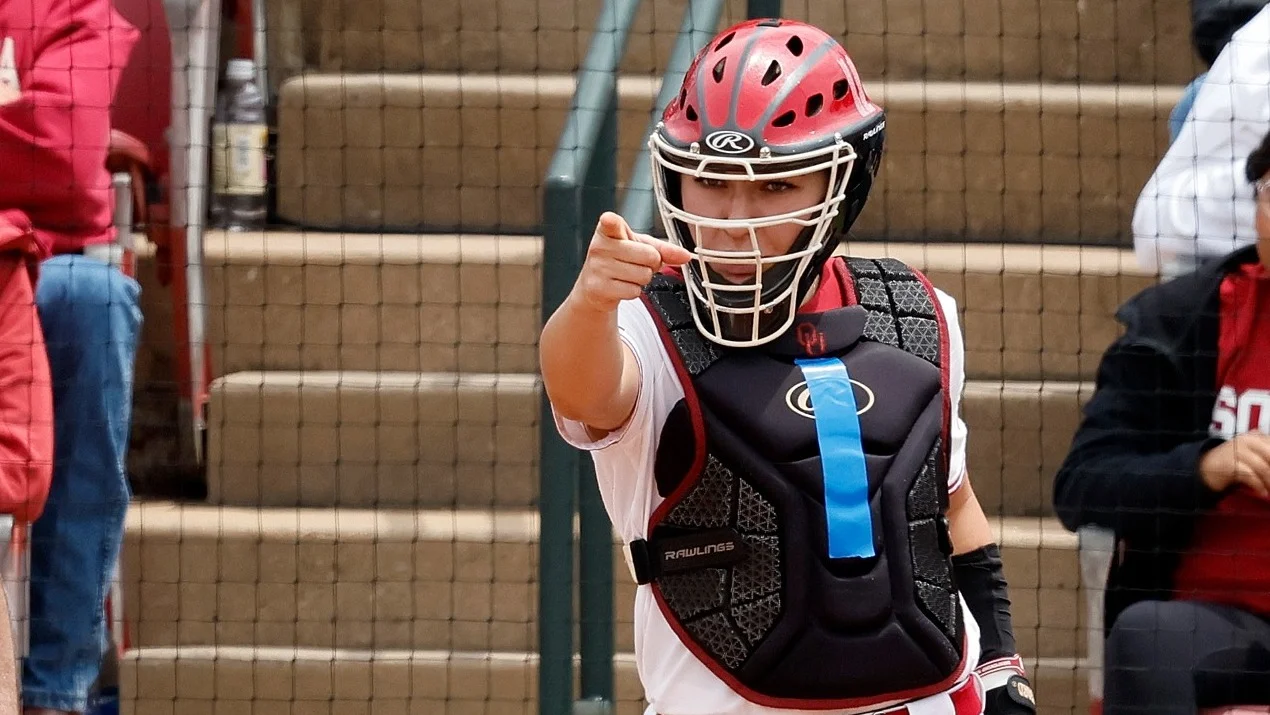
The best college softball catchers combine an influential bat with the demands of a position that touches nearly every pitch. Stacey Nuveman, Jenny Topping, Chelsea Goodacre and Kinzie Hansen each offer a strong, different case. This editorial Division I shortlist compares their documented college careers rather than turning Olympic fame, professional success or a recent award into an official all-time ranking.
What makes an all-time college catcher
A catcher can change a game without taking a swing. Receiving, blocking, controlling the running game and working with pitchers shape the defense around her. At the same time, an elite hitter at catcher gives a lineup production from a demanding defensive position. A useful historical comparison needs both sides of that contribution.
The challenge is that the available evidence is uneven. Career batting lines are usually easier to recover than every season's catching starts or opponents' stolen-base attempts. Older players may have extensive school records but little accessible pitch-level defensive data. A responsible evaluation acknowledges those limits instead of assigning an invented framing score or pretending that one fielding statistic measures the whole job.
College achievements and positional workload come first
The NFCA's Diamond Sports catcher award procedures provide a useful modern reference: the selected first-team All-American catcher must have played at the position in at least half of her school's games, and offensive and defensive statistics receive equal weight. That is an award's eligibility and selection framework, not a formula for deciding the greatest catcher across every era.
For this comparison, documented college production, a substantial catching role, sustained recognition and postseason contribution form the case. International and professional careers can explain why a name is familiar, but they do not add college home runs, college catching innings or college championships. The boundary matters particularly for players whose later achievements became more famous than their university careers.
Defensive statistics also need context. A caught-stealing total means more when the number of attempts is known. Pitchers' delivery times and their attention to runners affect the catcher's opportunity to make the throw. Fielding percentage describes recorded errors and chances; it cannot, by itself, quantify every pitch received or every ball blocked.
Team titles matter as evidence of playing on the biggest stage, but they are shared achievements. A catcher should not receive sole credit for a championship, and an excellent player on a team that fell short should not disappear from the conversation. The four careers below are selected to show contrasting forms of excellence, with each case built from its own college record rather than a manufactured points system.
Stacey Nuveman set a demanding offensive standard
Stacey Nuveman's UCLA career is an obvious starting point because the offensive case is broad and sustained. UCLA's historical record book documents her four playing seasons in 1997, 1999 and 2001-02. The completed line includes 90 home runs, 299 RBIs and a .466 batting average. Those figures describe a career, not a partial biography published before her senior season.
Power and on-base production behind the plate
Nuveman paired that power with a .600 career on-base percentage and .945 slugging percentage. The combination is more revealing than the home-run total alone. Slugging describes the bases generated by her hits; on-base percentage shows how often she avoided making an out through the outcomes included in that statistic. A lineup could benefit from her even when opponents did not give her a pitch she could drive.
The same UCLA reference records 240 career walks. Those walks should not be treated as failed chances to add another homer. Reaching base changes an inning's possibilities and forces the defense to deal with the next hitter. It is also a reminder that a dangerous bat's counting totals can be shaped by opponents' decisions to avoid her.
The recognition was sustained: her San Diego State coaching biography confirms four first-team NFCA All-America selections and three Pac-10 Player of the Year honors during her UCLA playing career. That repeated recognition supports a multi-season case. It does not substitute for a defensive analysis, but it is stronger evidence of sustained excellence than one exceptional spring viewed in isolation.
At catcher, the offensive contribution carries positional significance. Teams need someone to handle the defensive work regardless of how deep the lineup is. Getting this level of production from that role makes the batting order harder to navigate. The available career totals establish the offensive standard without requiring a claim that every one of her games was spent catching.
Why her college record survives beyond a home-run leaderboard
Nuveman's case also includes UCLA's 1999 national championship. Her season featured 31 home runs and 91 RBIs, with recognition on the all-WCWS team. That championship contribution connects the career line to a successful postseason rather than leaving the discussion entirely in a cumulative statistics table.
Her last college season adds another example. UCLA's May 28, 2002 report identifies the senior catcher as the hitter whose home run supplied the winning RBI in a 2-0 WCWS elimination victory over Oklahoma. The Bruins did not win that year's title, but a meaningful individual contribution remains meaningful in a season that ended short of the championship.
Record labels change as later players surpass earlier totals. That does not erase the production or the standard a player established during her era. Nuveman belongs in this conversation because of her completed college performance, recognition and postseason evidence. Her Olympic career adds to her wider softball legacy; the university case already stands on its own.
Jenny Topping and Chelsea Goodacre belong in the conversation
An all-time discussion becomes more useful when it includes careers with different shapes. Jenny Topping's college story spans Washington and Cal State Fullerton. Chelsea Goodacre's Arizona career offers a clear run-producing peak and an important reminder to distinguish college honors from later professional awards. Neither case needs to be forced into Nuveman's statistical mold to deserve attention.
Topping's college career needs both schools in view
Cal State Fullerton's official Topping biography records her Titan seasons from 2001 through 2003 and a .443/.573/.771 batting, on-base and slugging line. It also documents 137 walks, 33 home runs and 128 RBIs at Fullerton, along with Big West Player of the Year recognition in each of those three seasons.
Those are Fullerton totals, not a complete accounting of every college season. Her Washington production came before the Titan years. A comparison that labels Fullerton's 33 home runs as her whole university career would understate the offensive record. The simplest accurate presentation keeps each school's statistical boundary visible rather than adding figures from different pages without verifying what they include.
Her case centers on sustained offensive quality across the college career and a documented catching role, but positional honors require care. The NFCA's 2003 first-team list identifies Topping as an at-large selection at first base. That All-America recognition supports her excellence as a player; it should not be relabeled as an award for the nation's top catcher.
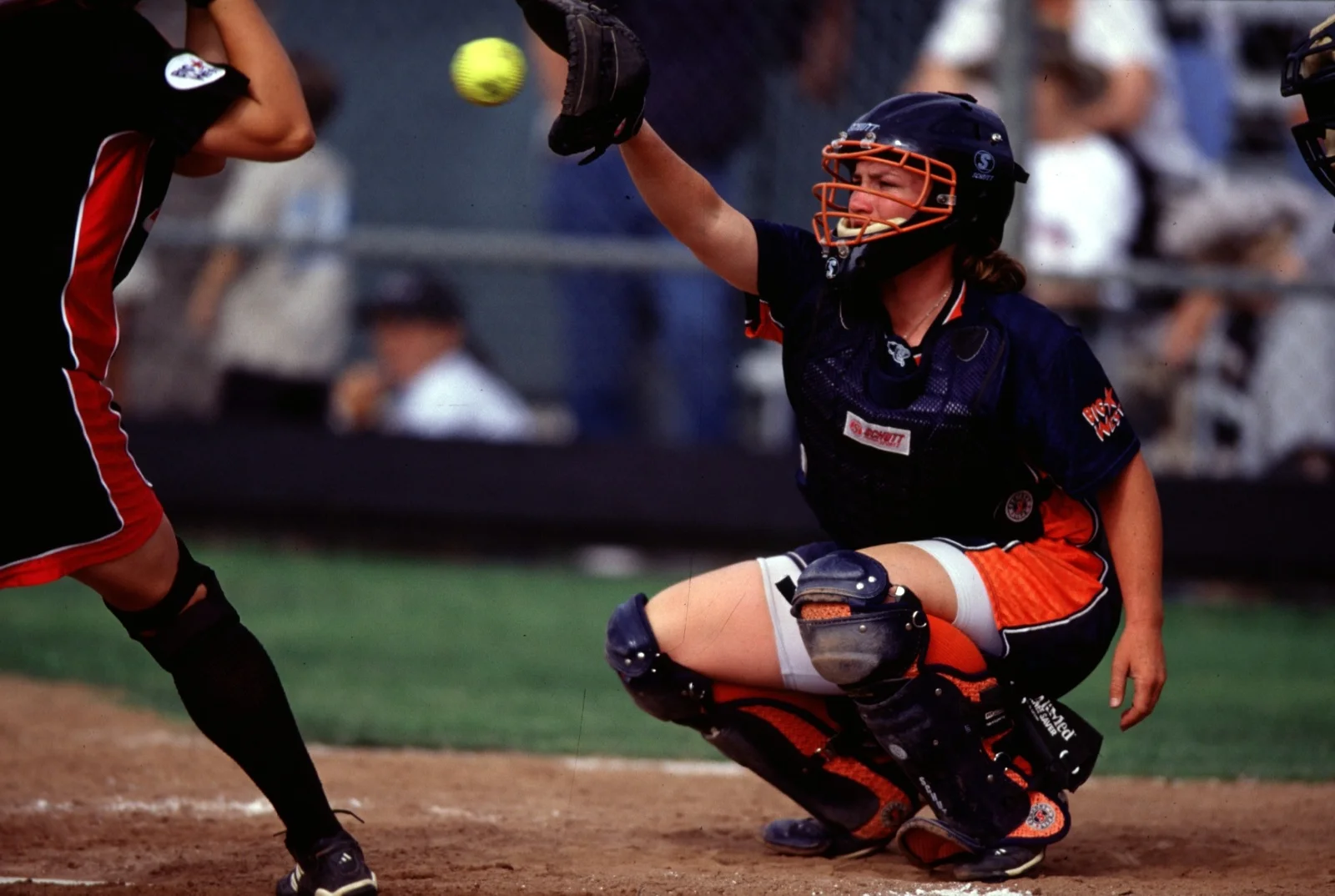
This is why a historical catcher discussion should describe roles instead of assuming that every season, appearance and award belonged to the same position. Topping's Fullerton catching photograph documents the role, while her college batting line and conference honors establish a substantial offensive case. Her later Olympic and professional accomplishments belong to the broader legacy and remain separate from these university totals.
Goodacre paired a run-producing bat with the catching role
Arizona's completed Goodacre biography records 71 career home runs and 240 RBIs. In 2015, she led the NCAA with 86 RBIs and hit 24 home runs. She earned second-team NFCA All-America recognition that season and first-team All-Pac-12 honors in three consecutive years from 2013 through 2015.
RBI totals partly reflect the runners a lineup puts on base, so they are not an independent measure of hitting quality. Even with that limitation, leading the country in a completed season is significant evidence of converting opportunities into runs. Her career power supports the interpretation that this was more than one favorable batting-order situation.
Goodacre's role also developed. Arizona's early career biography lists 22 freshman starts at catcher and 32 as designated player. It would be inaccurate to turn every freshman start into catching workload. Recognizing that split makes the later catching career easier to assess without manufacturing extra defensive experience.
The final biography's .990 career fielding percentage adds a recorded-chances indicator, but it does not settle the whole defensive comparison. Nor should a professional Gold Glove be counted as a college award. Goodacre belongs on this shortlist because of her college production and actual positional history, with those boundaries stated plainly.
Kinzie Hansen showed how a catcher can shape a dynasty
Kinzie Hansen's Oklahoma career brings the comparison into a more recent era. Her professional league biography's college section records 60 home runs and 219 RBIs across 243 games from 2020 through 2024. Those completed university totals are separate from the professional statistics elsewhere on the same page.
Hansen was part of Oklahoma's four consecutive national championship teams from 2021 through 2024. That puts repeated postseason success at the center of her case. The titles were earned by entire rosters and a coaching staff, so they should accompany her individual evidence rather than replace it. A championship count alone cannot show how she contributed at catcher or at the plate.
Championship contribution and positional honors
The individual evidence includes the 2023 Johnny Bench Award for college softball's top catcher and 2024 Big 12 Defensive Player of the Year recognition. These are different awards with different scopes. Together, they support a positional case that goes beyond adding a strong bat to a successful team.
Her Oklahoma biography also documents the three-run home run with two outs in the seventh inning of the 2023 super regional's second game against Clemson. A postseason moment like that matters because it occurred with the season's path at stake. It complements the career line without requiring the claim that one swing explains an entire championship.
Hansen's positional history needs the same care applied to Topping and Goodacre. In the shortened 2020 season, 22 of her 24 starts came at first base. Later seasons established her substantial catching role. Her college batting totals remain valid across those assignments, while an assessment of catching workload should describe the later role instead of calling every career start a start behind the plate.
The career also illustrates why team success is a useful setting for individual analysis. A catcher in repeated postseason runs must keep doing the defensive work while preparing to contribute offensively. Recognition at the position and documented decisive production offer evidence for that contribution; the team's final trophy supplies the competitive context.
For fans who prize championship performance, Hansen offers a particularly persuasive modern case. For fans who prioritize career offensive rates, Nuveman's line raises a different argument. The value of comparing the two is in identifying which evidence supports each preference. There is no need to hide those preferences behind a score that appears more objective than it is.
Compare eras without inventing a universal ranking
Start any all-time comparison by defining the career you are evaluating. Keep college seasons separate from professional and international play, then distinguish school-only totals from a career that spans multiple universities. The numbers become easier to compare once those boundaries are explicit. They can otherwise make one player appear to have less experience or less production than she actually did.
Next, read offensive totals alongside rates and opportunity. Career home runs show accumulated power, while on-base and slugging percentages explain another part of the hitting profile. Games and at-bats supply the sample. Schedule length, missed seasons and differences in how a team deployed a player are relevant context, but an unsupported adjustment should not be disguised as an official record.
At catcher, verify the role and the award category. Topping's first-base designation on the 2003 NFCA list is a concrete example of why “All-American” and “All-American catcher” should not automatically become interchangeable. A player's reputation can span positions, and a valid overall honor can support her greatness without proving a specific year's catching workload.
For defense, favor evidence with a clear season, role and denominator. A runner-control percentage from a dated midseason report is a snapshot, not a final career rate. A fielding percentage can be useful while leaving receiving and blocking questions unresolved. Historical evidence is sometimes incomplete; state what it establishes and leave the unmeasured portion unmeasured.
Postseason contributions deserve the same precision. A documented important hit and positional recognition make a stronger individual argument than assigning every team championship to one catcher. Equally, the absence of a title should not erase a sustained college career. Team results and individual performance inform one another without being identical.
This shortlist, reviewed on October 1, 2026, offers four defensible cases rather than an exhaustive canon. Nuveman supplies a remarkable offensive standard, Topping a multi-school career requiring careful boundaries, Goodacre a powerful run-producing case, and Hansen sustained championship-era contribution with positional honors. Fans can reasonably weigh those strengths differently. The strongest disagreement is one grounded in the actual college record, with the position and era kept in view.
Join the conversation
Share a question or a thought about college softball. Comments are reviewed before they appear. Keep it friendly and on topic.
No comments yet. Start the conversation.
Sign in with Google to leave a comment. Your email address is not displayed.