
Cat Osterman and Monica Abbott have exceptionally strong cases as the best college softball pitchers of all time. Osterman's argument centers on extraordinary dominance per inning; Abbott's combines elite pitching with a staggering career workload. Jennie Finch and Danielle Lawrie make championship-centered arguments that deserve their own hearing. This is a pitching-focused editorial comparison of NCAA Division I women's careers, with four detailed examples, rather than a supposedly official all-time order.
What makes an all-time college pitching case persuasive
Start with three questions. How difficult was the pitcher to score against? How much high-quality work did she sustain? What did she do when the strongest opponents and elimination stakes arrived? These questions overlap, but do not produce identical answers. A pitcher can have the greatest career strikeout total without the greatest strikeout rate. Another can author an unforgettable championship season without leading every career category.
The NCAA softball records portal separates Division I, Division II and Division III records, championship material and earlier AIAW results. That separation matters. “Best softball pitcher” is a broader question than “best NCAA Division I college pitcher.” Professional wins, Olympic medals and national-team performances can explain an athlete's wider importance, but they should not be quietly added to her college statistical line.
The record book used here is the NCAA Division I edition through 2025. Its introduction dates official NCAA softball records from the 1982 season. That is a defined statistical scope, not a claim that outstanding college softball began in 1982. Readers comparing careers from an earlier organizational era need the corresponding historical records rather than a modern NCAA table with part of the athlete's work missing.
Career accumulation and per-inning dominance answer different questions
A career strikeout total rewards both the ability to miss bats and the opportunity to pitch. A strikeout rate asks how frequently that happened relative to innings. ERA asks a different question again: how many earned runs a pitcher conceded for a regulation game's worth of work. The NCAA record book maintains separate categories because each captures a different part of performance.
Consider the evaluation problem without choosing a winner yet. If one ace throws many more innings, she has more opportunities to accumulate strikeouts and wins. Those innings are themselves valuable: somebody has to get the outs across the schedule. But the larger total does not demonstrate that she was harder to hit on every trip through the lineup. A fair comparison keeps durability and effectiveness visible together, instead of allowing one to impersonate the other.
Wins also involve teammates. A pitcher cannot supply all of her own run support, and a ball in play brings fielding into the result. A title adds powerful evidence of a successful postseason, but a team's elimination does not prove that its ace was inferior to every pitcher still playing. The score, the assignment and the innings tell us more than an argument that simply counts rings.
This article gives particular weight to sustained run prevention, strikeout production, substantial responsibility and documented championship performances. It does not assign invented mathematical weights or reproduce somebody else's list as objective truth. The profiles make the evidence explicit so a reader can disagree with the preference while understanding the case. An all-time debate becomes more interesting when its criteria are clear enough to test.
The strikeout specialists who changed the standard
Osterman and Abbott are a useful starting pair because they make the statistical debate concrete. Both carried major responsibilities over several seasons, and both were much more than a one-week postseason sensation. Yet their strongest numerical arguments differ. Looking at them together shows why an all-time discussion needs both rates and totals rather than whichever number favors the preferred player.
Cat Osterman's combination of volume and swing-and-miss pitching
Texas's number-retirement account records Osterman's college career at 136–25 with a 0.51 ERA and 2,265 strikeouts. She won USA Softball's collegiate player award three times, earned four NFCA All-America selections and helped Texas reach three Women's College World Series. That is a sustained college résumé, not a case built from later Olympic fame.
The rate is what makes her argument especially forceful. In the NCAA book through 2025, Osterman owns the career strikeout-per-seven-innings mark of 14.34. Her 2006 season produced 630 strikeouts in 286 innings, a rate of 15.42. Put the career rate beside a regulation game's 21 outs: she averaged enough strikeouts to account for more than two-thirds of that total. It is an arithmetic illustration of how often her pitching removed the need for a defensive play, rather than a claim that every outing followed the same script.
That combination makes a strong pitching-only case. The career total demonstrates that the rate was sustained through substantial work, while the ERA indicates that missing bats translated into preventing earned runs. A lower-volume specialist can post a spectacular stretch; Osterman's record asks opponents to explain an entire collegiate body of work. Her case does not need an imagined pitch-by-pitch scouting report or a fictional account of what hitters were thinking.
Her reputation has also attracted public honors, including selection as the left-handed pitcher on an ESPN all-time team chosen through fan voting. The voting method matters: that recognition illustrates public esteem, rather than supplying an independent numerical ranking of every college pitcher. The statistical case above stands even if a reader prefers a different fan ballot.
A title-only test would shrink the discussion too far. Pitching can dominate without a lineup delivering the necessary runs in the last game. It is fair to examine what an ace did in elimination play; it is much less persuasive to discard years of run prevention because a team did not finish with the trophy. Osterman's argument is strongest when college pitching is evaluated as an individual contribution within a team sport.
Monica Abbott's unmatched career strikeout total
Abbott's college numbers take a different route to greatness. Tennessee's career table gives her 189 wins, a 0.79 ERA, 2,440 strikeouts and 1,448 innings. The NCAA book through 2025 places that strikeout total first. Tennessee also records 112 solo shutouts and more than 500 strikeouts in each of her four seasons. Volume was not an incidental feature of her career; it was central to her value.
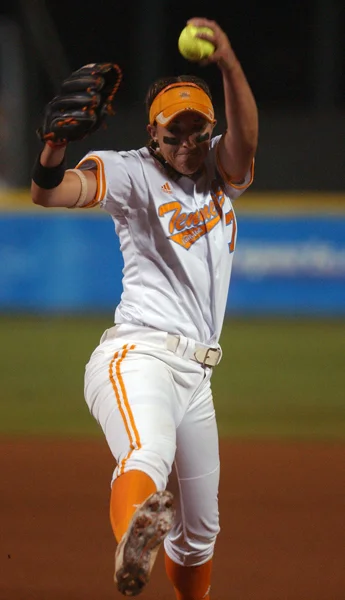
Her senior season provides a peak within that long record: 50–5 with a 0.68 ERA and 724 strikeouts. Tennessee's retirement announcement identifies her 2007 USA Softball and Honda honors. Those awards reinforce the contemporary assessment, while the innings and strikeouts explain the work behind it. Abbott did not simply remain available; she kept producing outs at a level that justified the repeated assignments.
The postseason makes the résumé more substantial still. Tennessee reached three consecutive WCWS during her career, finishing runner-up in 2007, and her school credits her with ten WCWS wins. Those facts prevent the workload discussion from becoming an argument about easy accumulation alone. Her college team repeatedly reached the sport's toughest final stage, where opponents had few reasons to offer an ace a comfortable assignment.
Abbott's career strikeout rate of 11.80 per seven innings, listed in the NCAA book, is below Osterman's 14.34. That does not turn Abbott's higher total into an illusion. It identifies the actual tradeoff: Osterman missed bats more frequently per inning, while Abbott delivered far more innings and accumulated more strikeouts. An evaluator who values the capacity to carry a staff across the longest stretch of a career has a principled reason to favor Abbott. One who prioritizes overwhelming effectiveness per inning has a principled reason to favor Osterman.
Why championship performances carry a different kind of weight
A national title can make a pitching performance easier to remember, but the useful evidence is what happened inside the games. The margin, the opponent, the workload and the response to traffic tell us how the pitcher helped the team win. Finch and Lawrie offer particularly clear examples of greatness expressed through different championship assignments.
Jennie Finch and the unbeaten championship season
Finch's 2001 season is a compelling answer to the question of the greatest championship year. Arizona's retrospective records a 32–0 pitching record and 0.54 ERA, capped by a 1–0 victory over UCLA in the title game. Arizona's 65–4 team record is a separate figure. An undefeated pitcher record also means something different from a perfect game: it concerns winning decisions across a season, not retiring every batter in a particular outing.
The championship illustrates why that season deserves more than a passing mention in a celebrity list. The contemporary NCAA report describes Finch's four-hit shutout and Lindsey Collins' fourth-inning home run. One swing supplied Arizona's only run. Finch had to preserve that margin against a UCLA lineup that continued to have opportunities to put the tying run in play.
A 1–0 final is a useful antidote to an overly tidy “pitcher wins the championship alone” story. Without Collins' homer, the same shutout would not have produced a regulation victory. Without Finch's run prevention, that homer might not have been enough. Championship pitching lives in that relationship between individual excellence and the team's ability to convert it into a result.
Finch's year also shows why the best career and the best season need not be the same choice. A reader can favor the sustained strikeout cases of Osterman or Abbott while regarding Finch's unbeaten title season as a special achievement. That is a coherent distinction. It recognizes a particular combination of consistency and final-game execution without pretending that a single year answers every statistical question.
The decisive performance came in a single championship game. Applying today's best-of-three finals language to that 2001 result would distort the assignment. The historical setting matters because the pitcher had one title-game opportunity to protect the run. Her case is more persuasive when the actual format remains visible.
Danielle Lawrie and Washington's breakthrough
Lawrie's 2009 championship provides a different model: an ace carrying an entire WCWS pitching workload. Washington's championship game notes credit her with all 44⅔ innings of its six games in Oklahoma City. The Huskies beat Florida 3–2 in the clincher and completed a two-game sweep of the best-of-three finals. Those innings describe an unusually concentrated responsibility at the last stage of the season.
The final series itself offers contrasting tests. In the opener, Washington's game report records an 8–0 victory with Lawrie allowing two hits and striking out 12. The clincher was much tighter. A big lead allows a pitcher more room for an isolated mistake; a one-run game places greater importance on every baserunner. Evaluating both outings gives a fuller picture than replaying only the comfortable shutout.
Her full season supports the championship rather than leaving it as an isolated hot week. Washington's career tribute lists a 42–8 record, 0.97 ERA and 521 strikeouts in 2009, and career totals of 136 wins and 1,860 strikeouts. It also identifies two USA Softball collegiate player awards. Those are strong credentials for a pitcher whose legacy includes both sustained performance and the program's first national title.
Lawrie's comparison with Finch becomes especially interesting when the task is specified. Finch protected a one-run championship-game margin at the end of an unbeaten season. Lawrie delivered every Washington pitching out across a six-game WCWS and closed a championship series. Their assignments were different enough that simply counting one title apiece misses the substance.
For a fan building an all-time staff, Lawrie supplies an argument about concentrated tournament responsibility: a pitcher repeatedly trusted to return and get the next set of outs against contenders. That is not an instruction for today's coaches to replicate the workload. It is an assessment of what she actually delivered in her college era, with the score and innings available to test the claim.
How to choose between different kinds of greatness
For a pitching-only choice that emphasizes dominance per inning over a substantial college career, Osterman is my starting point. A 14.34 career strikeout rate and 0.51 ERA create a demanding combination to argue against. That preference has a clear weakness: prioritizing rates gives less weight to the additional innings Abbott supplied. Abbott's 2,440 strikeouts and 1,448 innings make the best case for valuing elite performance delivered across the greatest volume in this comparison.
The difference is practical. Imagine choosing an ace for a single game against a dangerous lineup. You would care intensely about how often she prevented contact and runs. Now imagine assigning a pitcher the task of carrying the largest possible share of a four-year schedule. Availability and repeated high-quality innings become more central. These hypothetical assignments cannot prove how a game between eras would end, but they reveal why intelligent fans can start from the same evidence and choose differently.
Finch and Lawrie change the assignment again. Finch's unbeaten 2001 season culminated in a shutout with just one run of support. Lawrie's 2009 WCWS demanded every Washington pitching inning across six games. A championship selection favors their documented ability to complete those specific tasks. It should not automatically turn into a claim that either owned the superior career strikeout record.
There are strong cases outside these four profiles. The NCAA book through 2025 lists Lisa Fernandez's collegiate career ERA at 0.22. Her presence alone demonstrates why a compact comparison should not masquerade as an exhaustive list of every deserving pitcher. A broader ranking would also need to assess additional contenders in comparable depth. Naming a famous athlete in passing is not equivalent to giving her career the scrutiny applied here.
Cross-era comparisons should resist false precision. An ERA records earned runs within the schedule and scoring environment a pitcher faced. It does not tell us exactly how she would perform against a different decade's opponents. Nor can a highlight video supply a complete record of command, defensive support or the weaker outings that never became a popular clip. Institutional totals and contemporary game accounts anchor the discussion; the hypothetical matchup remains an editorial judgment.
For viewers learning to evaluate current pitchers, the historical comparison offers useful habits. Watch which outs come through strikeouts, how the pitcher handles walks and whether a coach uses her to start, finish or both. Then compare that observation with the workload and opponents in the actual season. Our college softball TV schedule can help locate games, while scores supply the result. Neither replaces watching how those outs were earned.
The defensible choices are therefore specific: Osterman for the strongest combination of career rate dominance and substantial accumulation among these profiles; Abbott for extraordinary total work at an elite level; Finch for an unbeaten championship season; Lawrie for an exceptionally concentrated title-winning tournament assignment. Prefer one, but keep the opposing case intact. That makes the all-time debate a discussion of softball rather than a contest to remember the most recognizable name.
Join the conversation
Share a question or a thought about college softball. Comments are reviewed before they appear. Keep it friendly and on topic.
No comments yet. Start the conversation.
Sign in with Google to leave a comment. Your email address is not displayed.