The best college softball players of 2026 cannot be judged with one number. A two-way star can influence the score with her bat and prevent runs in the circle; an elite pitcher can carry a heavy share of a team's innings; a hitter can force opponents to change how they attack an entire lineup. This is a selective Division I season review, with the reasons behind the choices, rather than an official NCAA ranking.
What makes a player one of the best in 2026?
The first requirement is the right season. A January prediction, a May award shortlist and a completed-season statistical line answer different questions. Recruiting rankings add another distinction: a 2026 recruiting class is not automatically a ranking of athletes who played Division I softball in spring 2026. Evaluate a player's actual college performance before allowing a familiar name or a future projection to settle the argument.
Our criteria begin with production and its scale. Rate statistics tell you how efficiently a player performed; appearances, innings and plate appearances tell you how often she had to maintain it. Role matters as well. A pitcher who can handle extended use gives a staff options, while a productive hitter at a demanding defensive position contributes in more than one part of a game. Those contributions cannot all be converted into a meaningful shared leaderboard by adding unrelated statistics.
The comparisons below also consider the strength of the evidence. A school statistical line can establish a player's output. An award supplies another informed assessment. A postseason result provides a pressure-tested sample, but it does not erase months of play. The task is to make those pieces fit, with their limits visible, instead of treating whichever number is most impressive as a complete account of the athlete.
Awards are evidence, not interchangeable rankings
USA Softball's May 13 top-10 finalist announcement recognized regular-season achievement and came before the Women's College World Series. That timing is central to reading it fairly. A later tournament performance can inform a completed-season review without retroactively changing what a May selection was intended to recognize.
The same organization also presents the ESPN.com/USA Softball collegiate team poll. A team's position there does not rank its players individually. The team rankings are useful context for following the season, but this discussion asks about individual value. Neither a team poll nor an award finalist list is permission to label an editorial athlete comparison an official NCAA ranking.
Finally, the best season and the best career are separate arguments. This review gives the 2026 work priority. It does not use professional promise, social-media prominence or earlier college honors to fill a gap in this year's evidence. Fans can reasonably disagree about how to weight pitching against hitting; the useful disagreement starts with a clear explanation of which achievements are being compared.
The two-way standard: impact in both halves of an inning
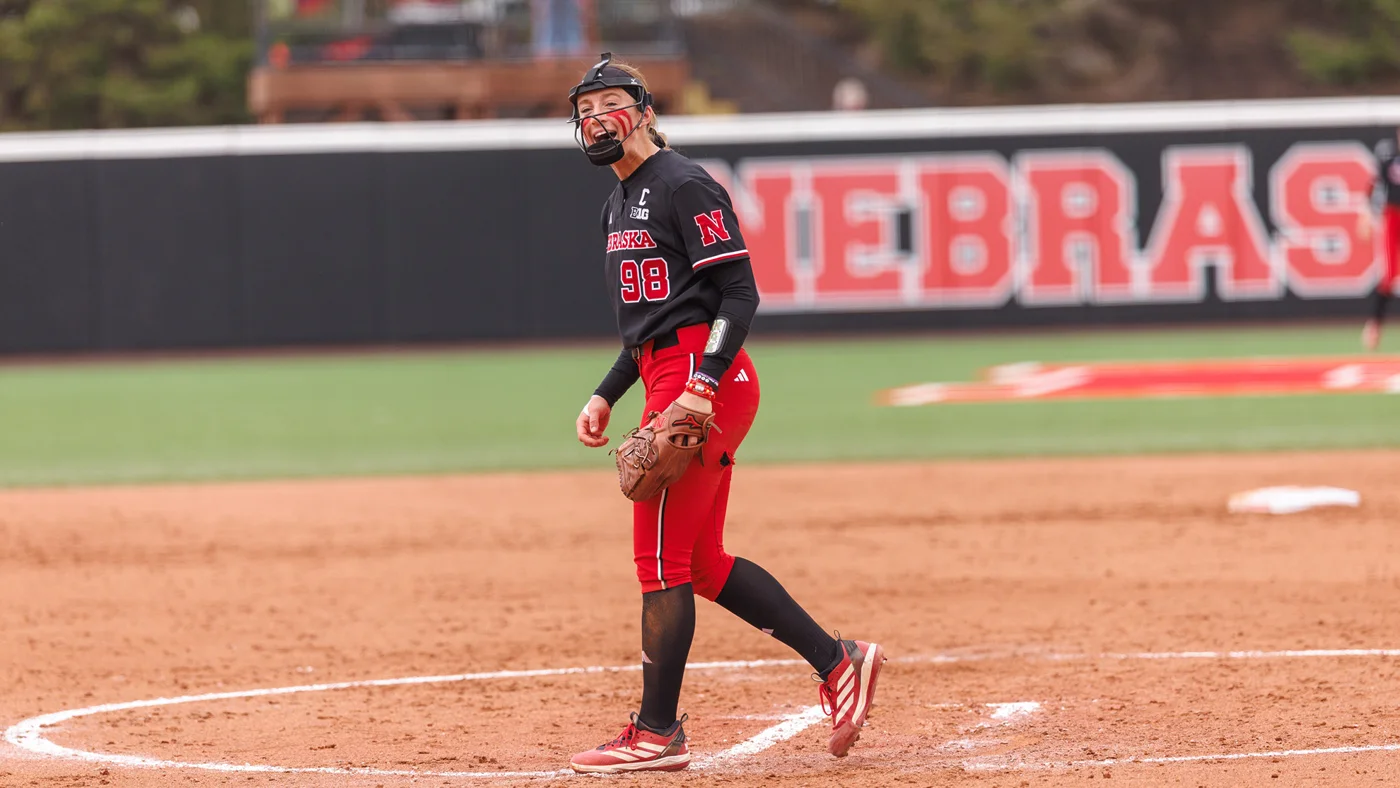
Jordy Frahm is the starting point for this review. The Nebraska senior won the 2026 USA Softball Collegiate Player of the Year award. Her case rests on serious contributions with both the bat and the ball, rather than on treating a pitcher with occasional plate appearances as a full two-way force.
Nebraska's May 26 award announcement supplies a useful dated snapshot: a .416 batting average, 19 home runs, 50 RBI and a .511 on-base percentage. In the circle it listed a 20–4 record, a 1.14 ERA, 12 saves and 234 strikeouts against 30 walks. Those were numbers entering the World Series, not final-season totals.
The batting line matters independently of the pitching. A .511 on-base percentage in that snapshot put her above the one-half mark, while the home runs showed the capacity to do more than extend an inning. A two-way player can be valuable without being an elite hitter; this was a case where the offensive evidence itself demanded attention. For an opponent, getting through her place in the order and generating runs against her pitching were separate problems.
The pitching role adds another layer. The combination of starts and saves demonstrates more than a simple win-total argument. Nebraska's 2026 player biography records 23 starts in the circle. A staff that can use the same high-level arm to begin games and finish others has options; the exact advantage in a particular game still depends on availability and the rest of the staff, rather than the save number alone.
The same biography places her at first base for 35 starts and documents a ten-inning complete-game win over Arkansas at the WCWS with nine strikeouts. It also records a solo home run against Texas in Oklahoma City. Those are concrete postseason additions to the regular-season picture. The extended pitching appearance is evidence of taking the game beyond regulation; the home run is another reminder that her influence did not end when she left the circle.
That combination is why she anchors an individual-value discussion. It is tempting to make an unsupported arithmetic shortcut, adding pitching and hitting statistics into a supposed universal score. The stronger argument is simpler: she had an award-winning two-way body of work, a major offensive role and documented postseason contributions in both disciplines. Opponents had to account for her in each half of the inning.
Her selection does not mean every elite specialist loses the comparison automatically. A pitcher carrying more innings or a hitter producing at an exceptional level can make a different case. It does mean that judging Frahm only by pitching wins, or only by home runs, would discard much of what made her 2026 season distinctive.
The pitchers who changed an opponent's game plan
NiJaree Canady and Karlyn Pickens belong in the leading-pitcher discussion. Their completed 2026 school biographies provide a more useful comparison than simply repeating preseason reputations. Both supplied substantial work in the circle and documented postseason contributions, but they did so with different appearance and starting patterns.
Dominance has to survive a workload test
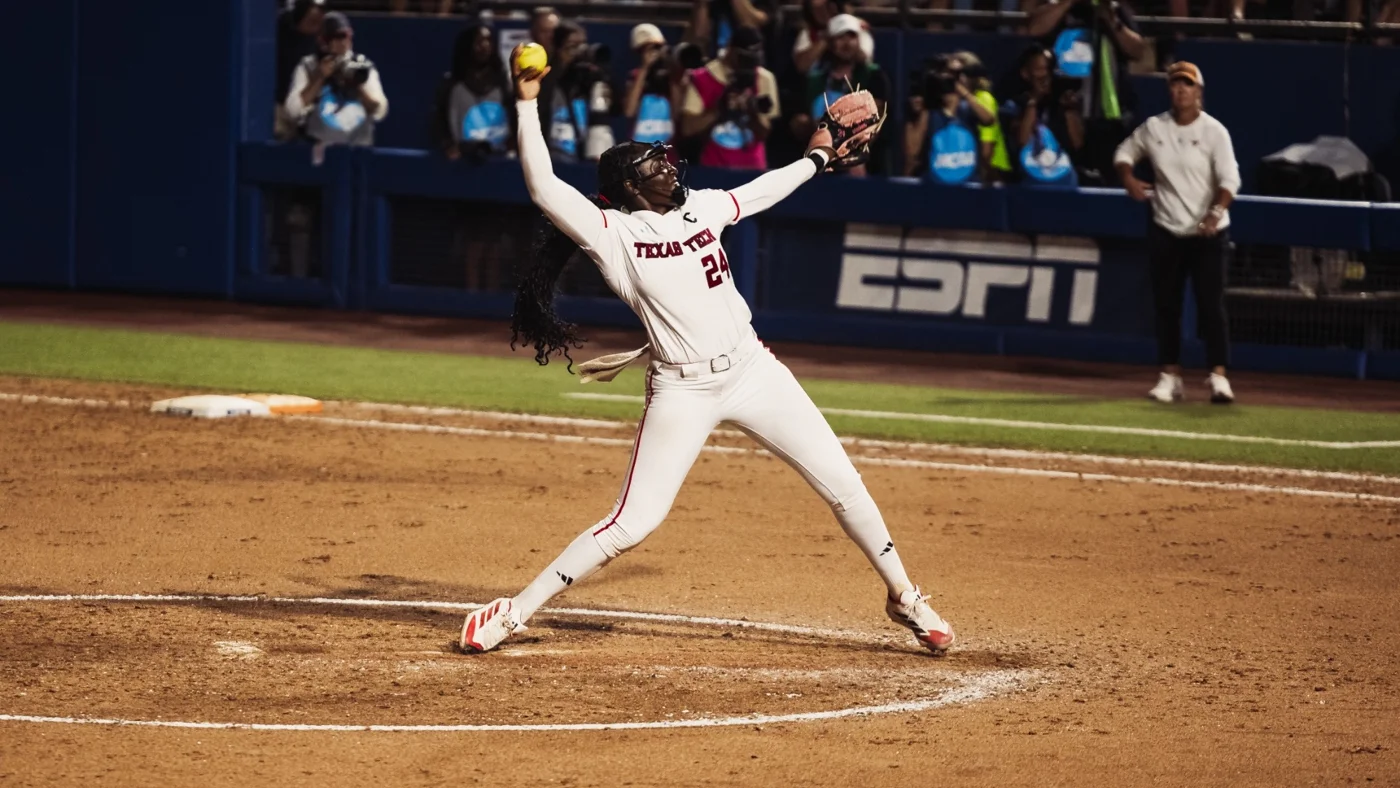
Texas Tech's senior-season summary for Canady records 46 appearances, 31 starts, a 29–7 record, a 1.87 ERA and 253 strikeouts, with opponents batting .169. It also lists Big 12 Co-Pitcher of the Year and WCWS All-Tournament recognition. Those numbers describe a substantial season of facing hitters, not merely a brief dominant stretch.
For an opposing offense, that low batting average is a meaningful part of the challenge, though it is not a complete measure of run prevention. Walks, extra-base damage and the sequencing of baserunners still matter. For evaluating the season, the 31 starts add context: she was repeatedly taking responsibility for the opening shape of a game, with additional appearances beyond those starts.
Tennessee's completed senior-year summary gives Pickens 148 innings, 194 strikeouts and a 1.70 ERA across 34 appearances and 17 starts. Her strikeout total divided by innings and scaled to seven innings is about 9.18. That calculation helps describe how frequently she got outs without a ball being put in play, rather than relying on the strikeout total alone.
The Tennessee biography also documents a seven-inning regional appearance with nine strikeouts against Virginia and a complete-game super regional win over Georgia with ten. Those are specific examples of carrying a game through its full length. The comparison with Canady should therefore consider both efficiency and usage. A lower ERA does not by itself settle who created more season-long value when the workloads and roles differ.
October hindsight is different from a May award ballot
Pickens provides a clear example of why timing matters. Tennessee's May 26 announcement of D1Softball first-team honors listed her at a 1.53 ERA and 180 strikeouts. Her final school biography lists 1.70 and 194. Both can describe the same excellent season at different points; the earlier line should not be displayed as the completed total.
Canady's final biography includes wins over UCLA and Alabama in Oklahoma City. Those later games strengthen the postseason part of her case, while the full aggregate keeps the discussion from becoming a highlight reel. A review should neither ignore those games nor pretend that a tournament honor is the same award as a regular-season player-of-the-year selection.
These two pitchers illustrate the value of asking a better question than who owns the smallest familiar ERA. How much work did the pitcher handle, what happened over the complete season, and what evidence explains the opponent's difficulty? Keep those questions together and the case for an elite arm becomes clearer, even when the final ordering remains an editorial judgment.
The hitters who made a lineup harder to escape
The strongest offensive cases combine damage with the ability to keep an inning moving. Home runs are an obvious starting point, especially in a record season, but they do not capture what happens when an opponent stops offering hittable pitches. On-base production, defensive position and the players around a hitter make the comparison more revealing.
Power with plate discipline
Megan Grant finished with 42 home runs, the NCAA Division I single-season record. UCLA's updated 2026 biography also records a .455 average, a .639 on-base percentage and 76 walks. The power is historic; the on-base line explains why avoiding her bat did not remove her influence from the offense.
Consider the UCF super regional, where the same biography records six walks and only one official at-bat. That is a concrete example of the difference between a quiet hit column and a quiet contribution. A walk does not produce the immediate damage of a home run, but it gives the next hitter another baserunner to work with. Evaluating the weekend only through hits would miss much of what Grant added.
Behind her in UCLA's batting order was Jordan Woolery. Her completed season summary records 36 home runs, 117 RBI and a .497 average, with all 63 starts at first base in the third spot. She also hit two home runs against Texas Tech in the WCWS. A pitcher choosing caution against Grant still faced another hitter capable of turning traffic into a crooked number.
That interaction helps explain why a lineup can be harder to escape than a collection of individual averages suggests. It does not prove that every Woolery RBI came from Grant, or allow a precise bonus to be assigned to either hitter. It does make their production more intelligible: Grant's power and willingness to accept a walk, followed by Woolery's damage, gave an opponent difficult consecutive decisions.
Production at a demanding defensive position
Reese Atwood deserves a separate look because her offensive contribution came with catching responsibilities. Texas's final 2026 statistics list a .326 average, 19 home runs, 61 RBI and a .424 on-base percentage over 65 games. Those numbers should stand as her completed-season line, rather than being replaced with a more flattering earlier snapshot.
The Longhorns' May 8 conference honors announcement identifies her as a senior catcher and lists both All-SEC second-team and All-SEC Defensive Team recognition. The combination gives a firmer basis for discussing her all-around role than citing offense and simply assuming the defensive work was excellent.
A catcher also receives, blocks and manages the running game. The batting line cannot measure those tasks, and a defensive honor cannot supply a missing numerical estimate of framing or runs saved. That limitation matters when comparing Atwood with first basemen or outfielders. Her offensive season belongs in the discussion; its context includes a demanding defensive assignment, with the unmeasured parts described honestly rather than converted into an invented statistic.
Lineup context changes the comparison
Isa Torres supplies a different elite offensive profile. Florida State's final season statistics give her a .530 average, 98 hits, 16 home runs and 56 RBI in 54 games. The junior shortstop was named D1Softball's National Player of the Year. That award has its own identity; it does not replace Frahm's USA Softball honor.
Torres's season should not disappear behind a home-run-only comparison. Getting a hit in such a high proportion of at-bats creates another kind of pressure, while playing shortstop adds positional context. Katie Stewart presents another compelling Texas case: the final team statistics list a .429 average, 31 home runs, 79 RBI and a .555 on-base percentage. The May 8 Texas announcement identifies the first baseman as the 2026 SEC Player of the Year.
These are different ways to make an offense dangerous. RBI partly reflects who is on base when a hitter comes up; batting average describes a narrower set of plate appearances than on-base percentage. A thoughtful comparison keeps those distinctions visible. Grant's record power, Woolery's production, Torres's hitting and Stewart's combination of power and on-base success each explain a real season, rather than competing for one statistic's approval.
Read the season without reducing it to one leaderboard
The final championship result belongs in a completed-season review. Texas swept Texas Tech in the WCWS Championship Series on June 3-4 to win its second consecutive title, as the Longhorns' postseason summary confirms. Stewart and Atwood were therefore important contributors to a championship team. The title is meaningful evidence of what that team accomplished, while their individual cases still require their own offensive and positional records.
Teagan Kavan's contribution to the deciding game gives another example of why roles matter. Texas Tech's June 4 game report identifies her as WCWS Most Valuable Player and records a two-inning save with five strikeouts in Texas's 4-1 victory. Citlaly Gutierrez was the winning pitcher. The distinction is useful: the pitcher receiving the win and the pitcher completing the decisive late outs can both be central to the result.
Kavan's tournament award should be part of a fan's understanding of 2026. It describes an achievement over a particular stage of the season, with a different scope from a regular-season player award. Treating one honor as interchangeable with another would make the discussion less precise. The same applies to overlooking the finalists' strong seasons because their teams did not lift the trophy.
The deeper comparison is between different ways of affecting games. Frahm combined run creation with work in the circle. Grant made history through power while continuing to reach base when pitchers avoided her. Torres paired a remarkable batting average with shortstop responsibilities. Canady and Pickens supplied high-level pitching with different usage patterns. Their records explain why more than one answer can be defensible, depending on the value placed on volume, position and tournament performance.
Use this review as a guide to those arguments. Check whether a statistic is final, whether an award recognizes a team or a player, and whether the comparison includes the athlete's full role. For following games beyond this completed season, the college softball schedule and scores page provide a separate, current view. A great 2026 season is evidence to remember; future availability and performance still have to earn their own assessment.
Join the conversation
Share a question or a thought about college softball. Comments are reviewed before they appear. Keep it friendly and on topic.
No comments yet. Start the conversation.
Sign in with Google to leave a comment. Your email address is not displayed.