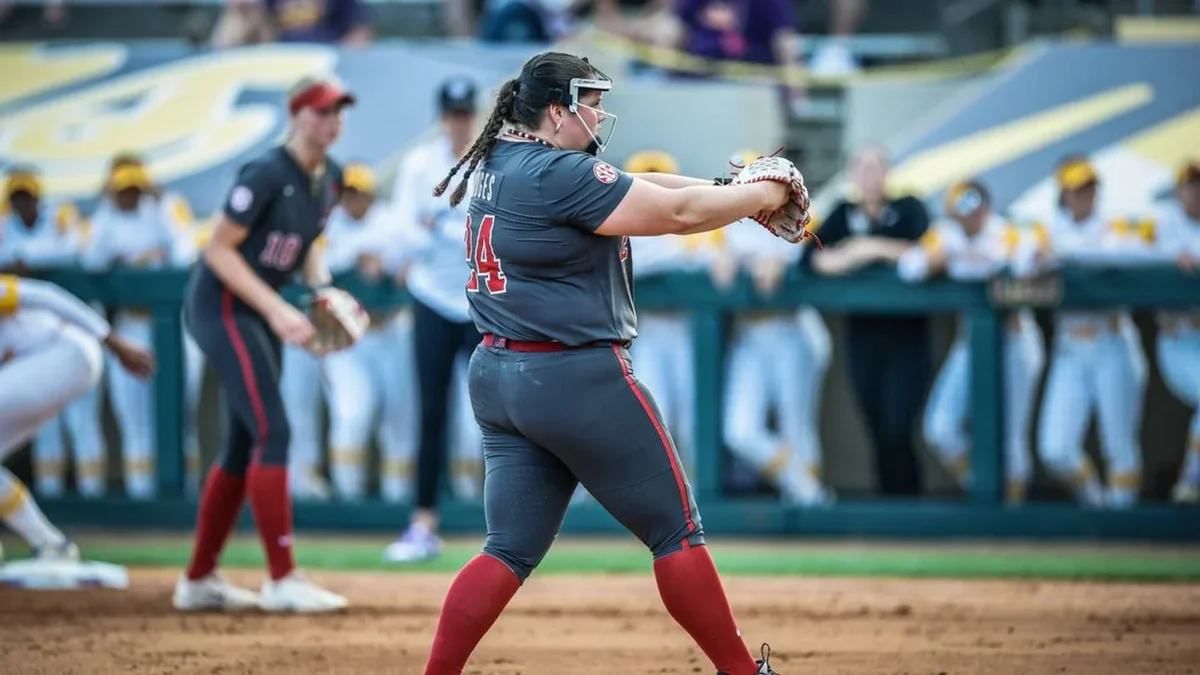
Braya Hodges is stepping away from playing softball after two seasons at Alabama. The immediate effect is a change in the Crimson Tide’s pitching depth before spring 2027. Assessing the competitive impact requires a closer look at her actual role, the innings Alabama already entrusted to other pitchers and the options still on the roster.
This analysis reflects the announcement and publicly available team information checked on October 15, 2026. It separates the confirmed news from projections about how Alabama might distribute its pitching next season.
What Braya Hodges announced
Hodges announced her decision on Instagram on Monday, October 12, according to Katie Windham’s BamaCentral report. The report reproduced a statement in which Hodges said she had decided to stop playing after 16 years in the sport and two years with the Crimson Tide. She expressed appreciation for her experiences, teammates and coaches. The Tuscaloosa News’ account, republished by Yahoo Sports, also reported the Monday announcement.
The relevant distinction is between leaving the sport and changing teams. These reports describe a decision to step away from playing. They do not announce a transfer destination or say that Hodges is entering another program’s pitching competition. Treating the news as a portal move would change what she actually communicated. For the same reason, a future Alabama pitching projection should remove her from the group being evaluated for spring rather than presume she is simply unavailable for a particular fall exhibition.
The statement as reproduced also does not establish a medical explanation, a disagreement with the staff or any other private cause. Limited innings can be relevant when evaluating the team’s competitive loss; they do not reveal why a person has chosen to stop playing. Those are separate questions. A pitcher can have a small statistical share of a season and still have spent years training, traveling and preparing to be available for her team.
That leaves two useful questions for fans. What experience is Alabama losing, and how much additional work might the remaining pitchers need to absorb? The first can be answered through Hodges’ official season record. The second calls for comparing the entire staff and identifying the current alternatives. Neither requires speculation about her personal decision.
It is also premature to turn an October roster change into a definitive spring hierarchy. A departure changes the available choices immediately, but it does not by itself award someone else a starting assignment, a relief role or a fixed number of innings. The strongest assessment starts with the completed 2026 season, then considers what the verified 2027 roster adds or retains.
What Hodges contributed in two Alabama seasons
Hodges’ college record contains both limited opportunities and identifiable contributions. Adding Alabama’s final annual pitching totals gives her 16 appearances, two starts and 24 innings across 2025 and 2026, with 30 strikeouts. Those totals describe a pitcher used selectively, rather than someone carrying a regular weekend workload. They also show why summarizing her career as simply a name removed from the roster misses the games in which she helped finish the job.
Her freshman season and early opportunities
The final 2025 pitching table records 10 appearances and one start, 16⅔ innings, a 1–1 record and a 4.20 ERA. Hodges struck out 22 batters and walked 14. That combination deserves a measured reading: strikeouts were part of her contribution, while the walks meant additional runners and less margin for error. A short relief sample cannot establish how those numbers would translate into a full slate of conference starts.
Her official Alabama biography adds useful game context. She debuted against Drake on February 22, pitching the final two innings after entering as a pinch hitter. Later opportunities included 1⅓ scoreless relief innings against Georgia on March 29. Her first college win came in relief against Alabama State on April 1, followed by her first start at Alabama State on April 22.
These were different assignments: finishing a game, contributing in relief against an SEC opponent and taking the ball to begin a game. “One start” should not erase the other appearances. Equally, those appearances should not be converted into a claim that she had already won a permanent starting position. The record supports experience in several situations, with a relatively small amount of total college work.
How to read her 2026 pitching line
In the completed 2026 season, Hodges appeared six times, started once and pitched 7⅓ innings. She allowed four hits and two walks, struck out eight and conceded no earned runs. The table also records one run allowed. There is no contradiction: ERA counts earned runs, so a pitcher can have a 0.00 ERA without having allowed zero runs altogether.
Two appearances connected her to notable team pitching performances. Alabama’s February 5 opener against Villanova was a 17–0, five-inning victory with a combined no-hitter by Vic Moten and Hodges. Hodges supplied the final two innings. On March 25, she finished the combined perfect game against North Alabama, retiring three batters in the fifth after Jocelyn Briski and Alea Johnson handled the first four innings.
Those are real contributions to shared achievements. They are not individual complete-game no-hitters or evidence that a seven-inning scoreless sample predicts an entire future season. The more useful interpretation is that Hodges completed short assignments successfully in 2026, including innings in which preserving a team pitching milestone mattered. Her departure removes that experienced option, while the scale of the innings helps define the size of the competitive gap.
Why Alabama’s innings distribution matters
Alabama’s 2026 pitching was heavily concentrated in three arms. That makes Hodges’ departure materially different from losing the pitcher who opened most of the team’s important series. The relevant measure is the share of work and the kinds of assignments being removed, alongside the flexibility an additional pitcher provided. Roster head count alone cannot answer either question.
The established workload at the top of the staff
The following figures come from Alabama’s final 2026 cumulative statistics. In softball notation, 71.2 means 71⅔ innings and 7.1 means 7⅓; the percentages use thirds correctly.
| Pitcher | Appearances / starts | Innings | Share of team innings |
|---|---|---|---|
| Jocelyn Briski | 37 / 29 | 179 | 42.7% |
| Vic Moten | 33 / 23 | 144 | 34.4% |
| Kaitlyn Pallozzi | 25 / 11 | 71⅔ | 17.1% |
| Alea Johnson | 11 / 1 | 17 | 4.1% |
| Braya Hodges | 6 / 1 | 7⅓ | 1.8% |
Briski and Moten supplied 323 of Alabama’s 419 innings, approximately 77.1%. Adding Pallozzi raises the share to 94.2%, and those three started 63 of 65 games. Replacing Hodges’ previous workload therefore does not require rebuilding the staff’s entire foundation. It requires accounting for a smaller set of innings while deciding whether the remaining group can offer enough options for different situations.
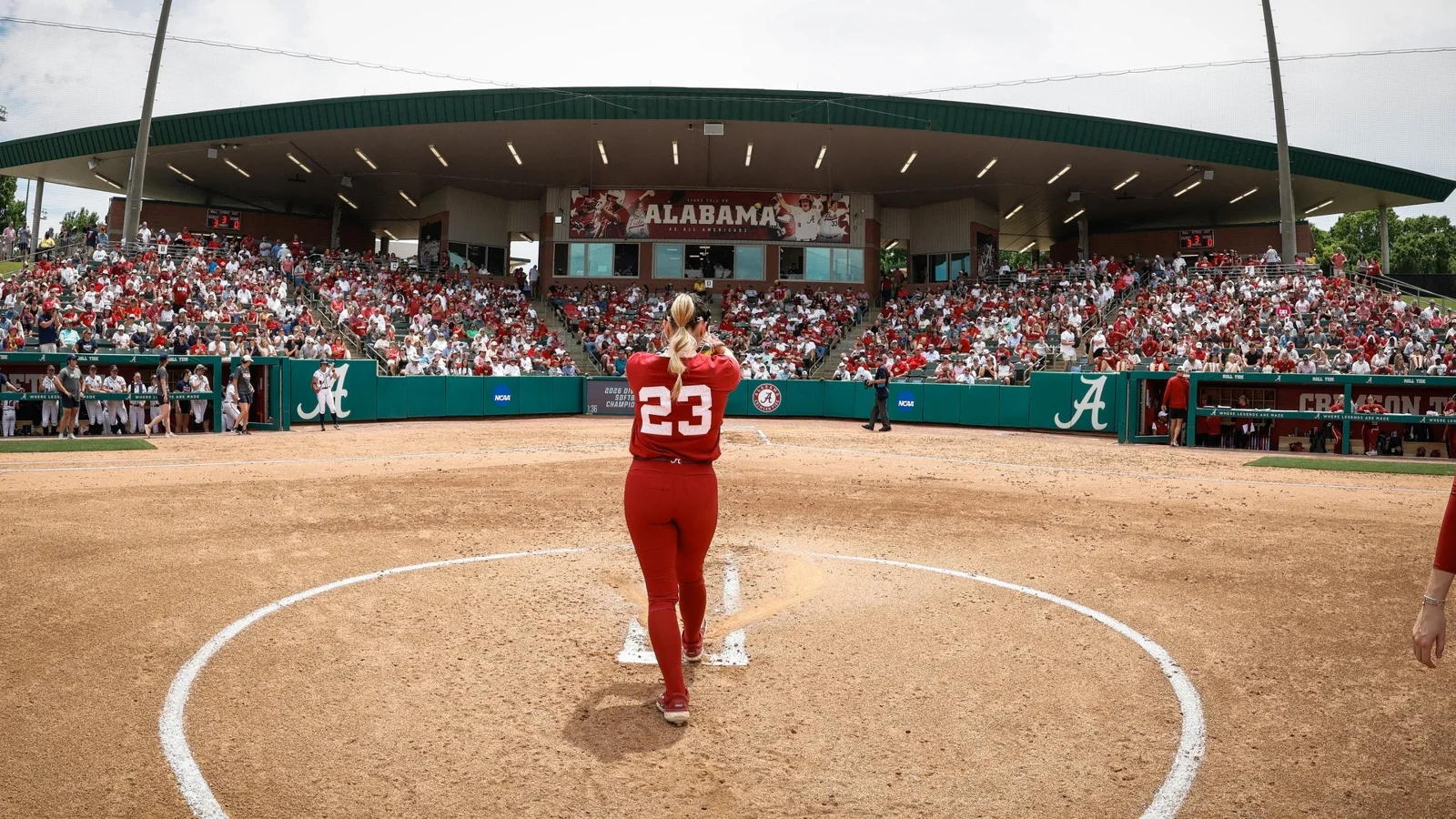
Nor were all of the leading pitchers’ statistical profiles identical. Briski’s 220 strikeouts and 22 walks produced a 10-to-1 ratio. Moten recorded 175 strikeouts and 56 walks. Both produced outs and substantial innings, with different balances between strikeouts and free passes. That is more useful for assessing a staff than assuming every returning pitcher offers an interchangeable version of the same performance.
The value of another available arm
The March 25 schedule illustrates the practical use of depth. Alabama played two different opponents that Wednesday: Jacksonville State, then North Alabama. Its official recap records Moten working five innings in the first game, while Briski, Johnson and Hodges combined in the second. Another available pitcher creates a choice about who finishes such a day, even when that pitcher is not starting a weekend opener.
Role flexibility also existed at the top. Briski’s official season summary records a complete-game win to open the LSU super regional, followed by three scoreless relief innings for a save in the second game. Starting and relieving are therefore not rigidly separate jobs in Alabama’s recent record. A pitcher used to begin one game can be an option to close another.
The analytical question for 2027 is how many workable choices remain when the preferred plan changes. An early exit, an extended game or consecutive contests can require a different distribution than the season average. That does not imply a particular injury risk or a universal safe workload; no such conclusion follows from these tables. It means another reliable arm can preserve tactical choices. Losing Hodges reduces that flexibility, even though her 2026 innings were a small part of the total.
Who remains in the 2027 pitching mix
As checked on October 15, Alabama’s 2027 official roster lists four pitchers: Jocelyn Briski, Vic Moten, Kaitlyn Pallozzi and Kailey Plumlee. The first three throw right-handed; Plumlee is left-handed. That is a verified list of available roster options, rather than an announcement of who will start each day of a future series.
The distinction matters because a roster is not a rotation. Four names do not mean four equal shares of innings, just as five pitchers did not receive equal work in 2026. Alabama can retain a concentrated approach, expand another pitcher’s assignments or change the balance as the season progresses. Those are possible choices; the October list does not establish which one the staff will make.
Returning experience and developing options
Briski returns with the strongest combination of established volume and high-leverage experience in this group. Her school biography credits her with the 2026 SEC Pitcher of the Year award. That is specifically a conference honor, not a generic NCAA award. Her recent starting and relief assignments provide a more concrete foundation for a spring projection than simply her senior class designation.
Moten and Pallozzi enter their second college seasons with substantive experience of their own. Moten’s documented assignments include two starts in the Texas series and a one-batter save at Ole Miss with the tying run in scoring position. Those examples show why it would be misleading to describe her only as a pitcher who accumulated innings in comfortable nonconference victories. She already has evidence of being used in demanding league situations.
Pallozzi’s official biography records a scoreless first SEC start against Kentucky on April 19, followed by a complete-game shutout in the NCAA regional opener against USC Upstate. Her perfect game against Elon was a memorable early-season result, but the later starting assignments are also relevant to depth. They provide examples of the staff using her to begin meaningful games, rather than requiring her to establish that capability for the first time in 2027.
Plumlee presents a different evaluation question. Alabama’s June 12 transfer announcement says she arrived from Tennessee after redshirting the 2026 season. Her school-level honors and prospect reputation are part of her background; they are not a demonstrated SEC college pitching record. Her left-handed delivery adds a different look to the listed staff, but handedness alone does not establish which opponents she should face or guarantee a particular matchup advantage.
There is also an offseason change beyond the Hodges announcement: Alea Johnson is not on the current list. Her previous innings belong in the wider comparison of staffs, but should not all be attributed to Monday’s news. The fair assessment is that Alabama retains its three most-used 2026 pitchers and adds a developing transfer option, while having fewer alternatives behind that established group. How far Plumlee advances, and how broadly the returning pitchers can be deployed, will shape the practical significance of that smaller group.
What fans should watch before spring
There is already some current fall evidence. Alabama’s October 11 exhibition recap says all four pitchers worked in an 11–1 victory played over 10 innings. The group combined for 19 strikeouts, and Briski struck out all six batters she faced in two innings. That establishes that multiple pitchers received work; it does not establish a spring rotation or a regular-season statistical baseline.
The context is essential when reading that result. A 10-inning fall game against community-college opposition is a different test from a spring SEC series. The staff’s shared strikeout total should not be assigned to one pitcher, and a strong team result does not tell us the exact quality of every individual outing. Where official coverage provides only aggregate pitching figures, leave the missing individual details unresolved rather than filling them in from assumptions.
The next useful evidence is how those assignments develop. Look for who begins games, who enters with runners already aboard and who is asked to continue beyond a short outing. Compare strikeouts with walks, rather than following only the run column. A scoreless inning with multiple free passes and an inning with a clean sequence of outs can produce the same ERA result while raising different questions about repeatability. Over time, the combination of opportunity, execution and opponent will say more than one exhibition score.
Alabama’s published fall slate gives fans more chances to watch: October 17’s home doubleheader is scheduled to begin at 1:30 p.m. Central, followed by another home doubleheader on October 18 at 1 p.m. Central. Auburn is scheduled to visit on November 13 at 6 p.m. Central. Recheck the school’s schedule before traveling; those listings do not themselves guarantee a television broadcast or live stream.
The spring schedule will eventually supply a more demanding test. Alabama’s announced SEC calendar begins with Texas A&M at home on March 19–21 and a trip to Texas the following weekend. Those are conference dates, not confirmation of the full nonconference schedule or opening day. Our Alabama softball schedule tracks the published games; use the scores page for completed results as the season develops.
For now, the evidence supports a specific assessment: Hodges’ decision removes a pitcher with two years of college experience and a small recent innings share. Alabama retains the pitchers who handled nearly all of its 2026 work, while the fourth option has a different experience profile. The important spring question is whether that group can provide dependable choices across a full schedule. Actual assignments and performances will answer it more convincingly than either dismissing the departure or treating it as the loss of an entire rotation.
Join the conversation
Share a question or a thought about college softball. Comments are reviewed before they appear. Keep it friendly and on topic.
No comments yet. Start the conversation.
Sign in with Google to leave a comment. Your email address is not displayed.