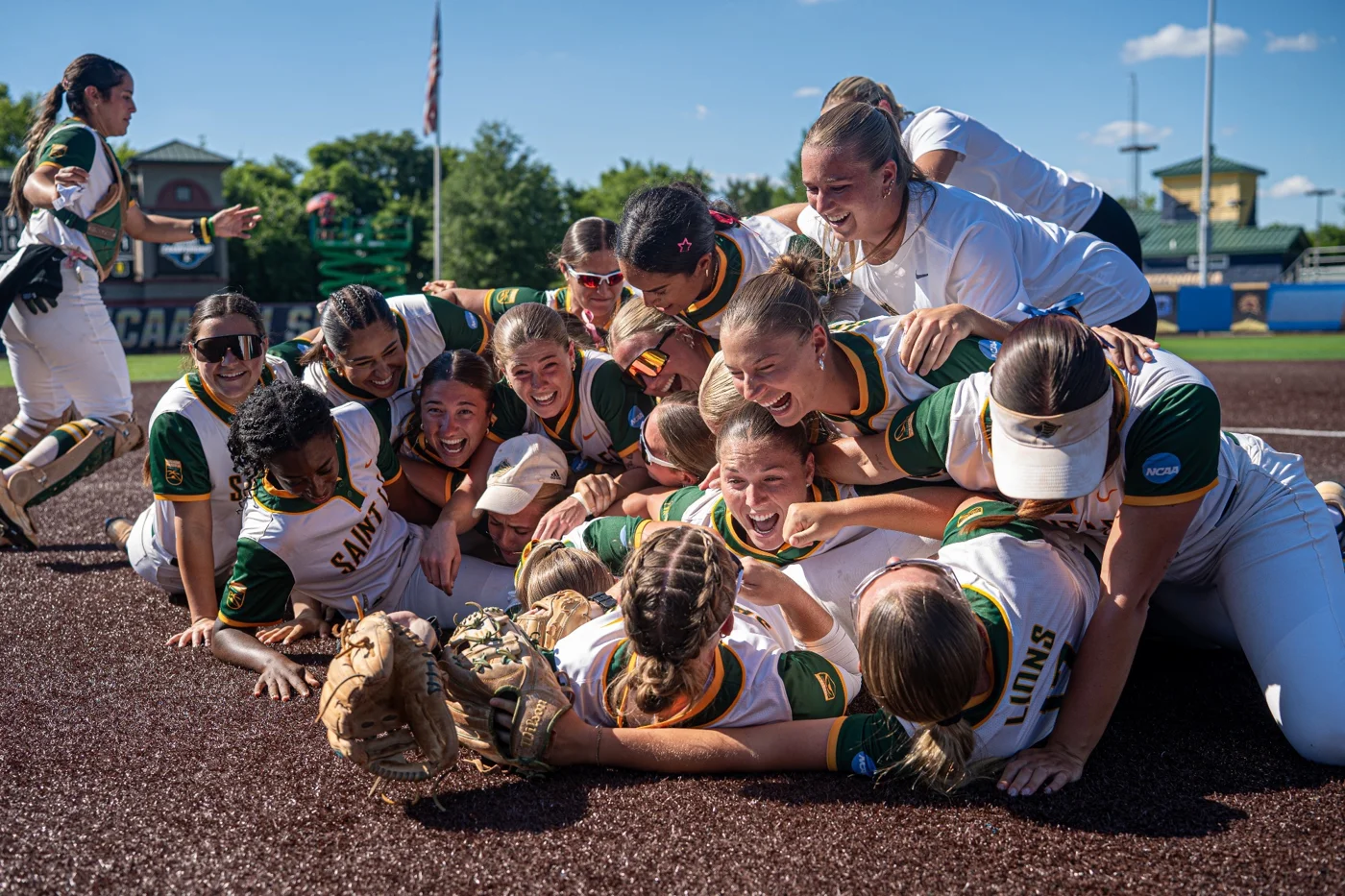
The 2026 NCAA Division II softball tournament ended with Saint Leo as national champion. This is a completed-season guide to the bracket, dates and results, with the Lions’ national-stage games collected below. For a particular regional’s entire game list, use the linked NCAA archive rather than treating the selected results here as every game played across the country.
The 2026 championship at a glance
Who won and where the finals were played
Saint Leo defeated McKendree in the championship series in Chattanooga, Tennessee. The Lions finished the sweep with a 5–2 victory on June 3. It was their first softball national championship, and their final season record was 54–3–1, as the university’s season celebration report confirms. Those are the essential answers if you arrived looking for the winner or the last result on the bracket.
The location matters when searching old schedules. The national finals were at Frost Stadium at Warner Park, rather than the Oklahoma City site associated with the Division I Women’s College World Series. A search for “college softball World Series” can bring up several divisions at once. Keep DII, 2026 and the school name together when locating a box score or replay; otherwise an apparently relevant result may belong to a different championship.
Likewise, the word “finals” can describe the entire eight-team national stage or the last best-of-three series. Saint Leo reaching Chattanooga and Saint Leo reaching the championship series were separate achievements. A team could qualify for the national site and still be eliminated before the last two teams were decided. This distinction makes the bracket much easier to read and prevents a national-stage appearance from being mistaken for a runner-up finish.
The dates that organize the archive
The NCAA selection announcement put the field reveal on May 11, regionals on May 14–16, super regionals on May 21–22 and the national finals on May 28–June 3. These are historical event windows. They are useful for locating the correct week, but they do not mean that every participating school played on every listed day.
When revisiting a team’s run, start at its regional rather than the first game shown on a national-finals graphic. A school missing from the eight-team panel might have played several earlier NCAA games. Conversely, a date printed next to an if-needed contest represents a contingency until the preceding result makes that game necessary. Do not count every available slot as an actual game.
As of October 21, 2026, the title has already been awarded. An archived “watch live” label or ticket button is part of an old event page, not a promise that this tournament is happening today. Our today page serves a different purpose; for the 2026 DII postseason, the season-specific bracket and school reports are the appropriate starting points.
How the 64-team bracket reached the national finals
The field began with 64 teams, arranged into 16 regional tournaments of four teams apiece. The 16 regional winners advanced to eight super regionals, and those eight winners earned places in Chattanooga. The 2025–26 NCAA DII prechampionship manual sets out that progression. Think of the bracket as linked competitions rather than one enormous chart in which every team immediately meets a national opponent.
This helps explain why a national seed is different from a regional position. The number printed beside a finalist in Chattanooga belongs to that stage’s seeding. It should not automatically be attached to the school’s earlier regional games. When quoting a result, identify the round as well as the numbers: “national-finals opener” is clearer than simply calling something Game 1 when several regional and series brackets each have a Game 1.
Regionals and super regionals were separate hurdles
Regionals used double elimination. A team that lost once still had an advancement route, but that route required surviving the elimination side and overcoming the unbeaten team if it reached the last matchup. The extra game marked “if necessary” protects that distinction. A regional ending without the extra game is complete; the blank slot does not signify that a result has gone missing from the archive.
The super regional changed the problem. Two regional winners met in a best-of-three series, so the objective became winning two games against one opponent. The championship could end after two games or require a third. Earlier regional losses did not carry into that series as a running tournament-wide tally. Reading “double elimination” as permission to lose only twice during the whole postseason would therefore produce the wrong interpretation.
Saint Leo’s South super-regional host page is a concrete example. It lists Saint Leo and Alabama-Huntsville for May 21–22 and includes space for a third contest. Its title identifies a super regional even though the URL contains “south-regional.” Follow the displayed event information, not an assumption drawn only from the address. Old host pages sometimes retain an earlier URL as their content is updated.
At the national site, the eight teams again had to work through their bracket groups before the two survivors met in a best-of-three championship series. The practical consequence is that three kinds of wins appear in the same title run: wins that eliminate regional rivals, wins that secure a two-team series and wins that move a finalist toward the last series. Each has a different place in the advancement story.
For fans comparing runs, record the stage and the opponent alongside each score. An unbeaten route preserves options and avoids an extra elimination game; a team coming through a longer route has shown a different sort of resilience. Neither observation requires inventing a pitcher’s fatigue level or a coach’s private plan. The bracket itself tells you which games were required and which additional games were avoided.
Saint Leo's road through the championship bracket
Saint Leo’s official 2026 schedule records ten NCAA postseason wins: three at the regional, two in the super regional and five at the national site. The regional began with a 1–0 win over Spring Hill, continued with a 6–1 victory over Auburn Montgomery and ended with another 1–0 win, against Tampa. Alabama-Huntsville then fell 6–3 and 13–1 in the super regional. The Lions reached Chattanooga without needing a recovery game at either earlier stage.
The national-site results below isolate the five games that took Saint Leo from the opening round to the trophy. They are the champion’s path, rather than a claim to list every game involving the other seven finalists. Use the full NCAA bracket when tracing another school or checking the elimination side.
| Date | Opponent | Saint Leo result | Stage |
|---|---|---|---|
| May 28 | Saint Thomas Aquinas | Won 4–2 | National-finals opener |
| May 29 | Cal State San Marcos | Won 5–3 | Winners’ bracket |
| May 31 | West Texas A&M | Won 5–4, 10 innings | Championship-series berth |
| June 2 | McKendree | Won 15–4 | Championship series, Game 1 |
| June 3 | McKendree | Won 5–2 | Championship series, Game 2 |
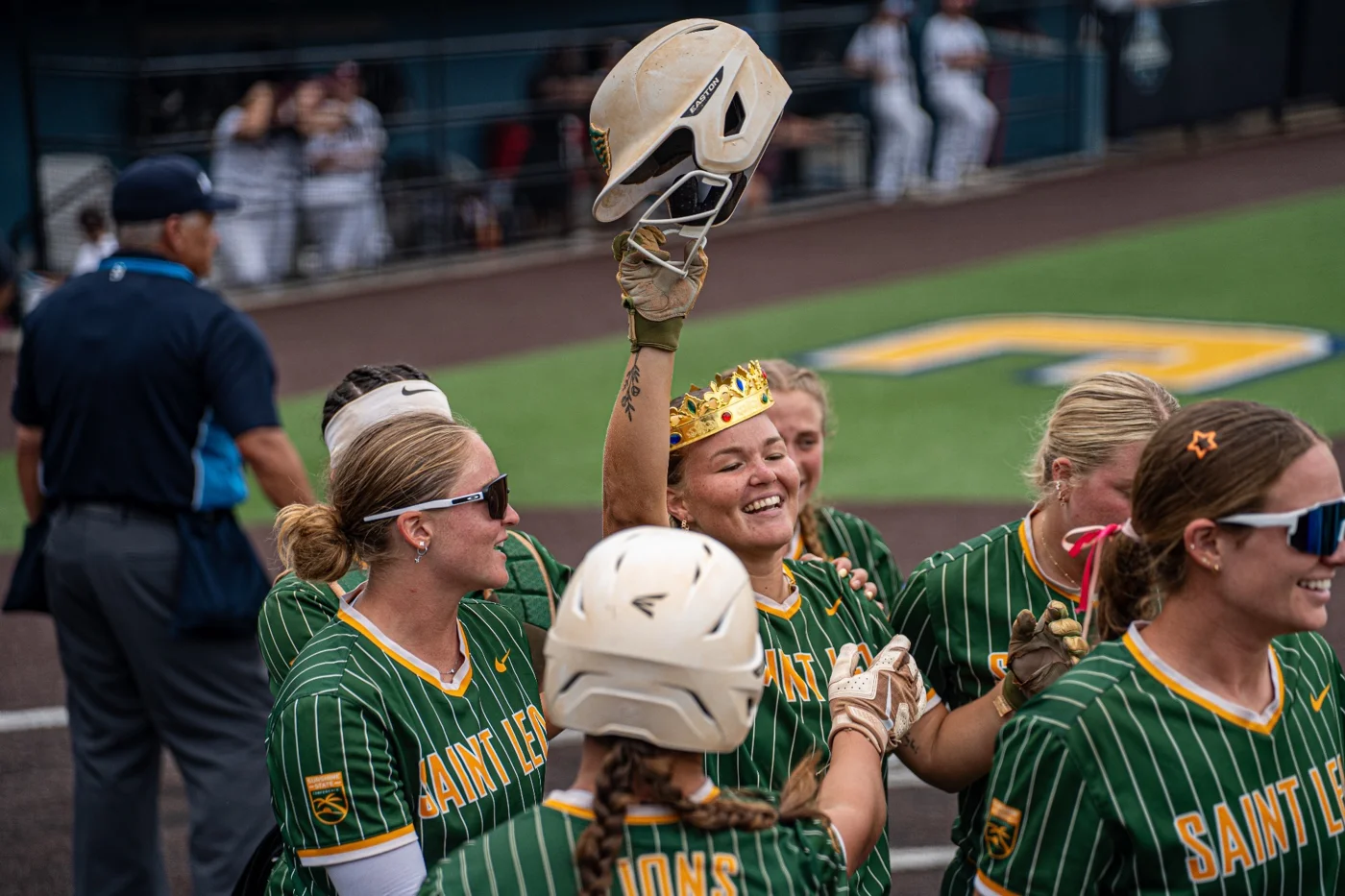
The most instructive score is the one that secured the series berth. Saint Leo’s May 31 game account describes Hailey Beuerlein’s three-run home run in the seventh, West Texas A&M’s answer in the bottom half and Alexis Barber’s go-ahead solo home run in the tenth. The final score alone leaves out two changes in the game’s direction: the Lions first moved ahead, lost that lead and then had to create another decisive run.
That sequence is a better explanation of postseason pressure than a broad claim that the No. 1 seed cruised. The champion’s bracket position was favorable because it kept winning, but the individual games still demanded late execution. A seed sets the bracket’s starting arrangement; it does not add an insurance run or finish the final inning. The one-run semifinal is direct evidence of the distance between being favored and having secured advancement.
The two 1–0 regional wins also put the championship-series opener in perspective. A team remembered for scoring 15 against McKendree had already advanced through games in which conceding one more run could have changed the entire route. Evaluating only the largest margin would miss that variety. The run required protecting tiny advantages as well as taking advantage of a productive offensive game.
Keep the opponent spellings and dates when saving these results. Saint Thomas Aquinas and Cal State San Marcos are separate national-stage opponents, while Alabama-Huntsville belonged to the preceding series in Florida. Mixing those rounds can accidentally give a school an extra finals appearance or erase the significance of the super regional. A useful postseason record preserves the route as carefully as the eventual winner.
What the final series tells us about the tournament
Read the deciding games before judging the whole run
The 15–4 opener was tied before it became a runaway. McKendree’s Game 1 report records Jasmine Myers’ third-inning grand slam after Saint Leo had scored twice in each of the first two innings. Saint Leo answered with three runs in the fourth and eight in the fifth. The scoring sequence matters: the Lions did not simply build an early lead and watch it survive. They had to respond after the Bearcats erased it.
That is why an aggregate score is a blunt description of a series. It can summarize production, but it hides when the game became lopsided. A tied game entering the middle innings presents different choices from a game already separated by double digits. The inning line gives a reader a more useful picture than assuming the final margin described every at-bat.
Game 2 demanded another kind of finish. The Bearcats’ final recap shows a one-run contest through six innings, with Saint Leo ahead 3–2, before two seventh-inning runs created the 5–2 final. A sweep says that one team won both games; it does not establish that both wins were equally comfortable.
McKendree’s runner-up finish also deserves its own context. Its school report identifies a program-record 51 wins and a first appearance in the national championship series. That achievement is not diminished by acknowledging the title-series result. A useful tournament review can explain the champion’s superiority over two games while recognizing how far the opponent had advanced beyond its own previous postseason benchmarks.
Separate an individual box score from a tournament award
Saint Leo used Tierney Hocquard for four innings and Alex Wright for three in the clincher. The official Game 2 box score credits Hocquard with the win and Wright with the save. That division of work illustrates why the winning pitcher column does not describe the whole pitching contribution. A reliever can protect the outcome through the last nine outs without receiving the win.
The university’s championship account names Alexis Barber the tournament’s Most Outstanding Player. That is a tournament honor, distinct from the pitching decision in the last game and from any season-long national player award. Keep the awarding context attached to the honor rather than converting every postseason accolade into the same generic title.
For your own analysis, separate three questions: who produced in the decisive game, who contributed across the event and what the full season says about the team. The box score, tournament awards and season record answer different parts of that exercise. Using them together gives a fuller account; using any one as a substitute for all the others tends to erase the supporting players or exaggerate the significance of a single performance.
Find the complete bracket and use historical scores correctly
For the complete tournament layout, start with the NCAA’s 2026 DII interactive bracket and printable bracket archive. Keep the division and year in the address when returning from a search result. A generic softball landing page may already feature another season; its current event banner does not change what happened in 2026.
A saved bracket is useful even when it predates the first game. Saint Leo preserves an NCAA national-finals bracket PDF showing the eight qualifiers and their opening pairings. It is a starting-field document, so the absence of a champion’s name in a blank progression slot is not evidence that the tournament remained unfinished. Use the completed game reports to fill in the historical outcome.
Read any archived sheet in a consistent order. First confirm DII and 2026. Next identify the region or national stage. Then follow the line from the actual matchup to its winner or loser destination. Finally look for a final score, rather than assuming that a printed start time means a contest was played. This method works particularly well when separate regional and super-regional files are linked from the same page.
The national-finals PDF specifies Eastern time. If an old school widget shows another clock time, check whether it displays the school’s home zone before concluding that first pitch changed. For historical comparison, the calendar date, opponent and completed result are usually more reliable identifiers than an isolated time copied from a social post. Do not silently combine Eastern and Central listings into one apparently contradictory schedule.
For a missing individual result, open the participating school’s season schedule and the linked box score. A recap can still display a “next game” panel that was correct when published, while the score and game date describe the event you actually want. Read those elements separately. The dated 2026 schedule is also preferable to a team’s default schedule if that default has moved on to the following spring.
Our scores page is convenient for the competitions it covers, but it should not be treated as a complete DII postseason archive. Use this guide for the tournament’s structure and Saint Leo’s verified path, and the official bracket and school boxes for the wider field. That combination preserves both the national picture and the detail behind a particular school’s final game.
Join the conversation
Share a question or a thought about college softball. Comments are reviewed before they appear. Keep it friendly and on topic.
No comments yet. Start the conversation.
Sign in with Google to leave a comment. Your email address is not displayed.