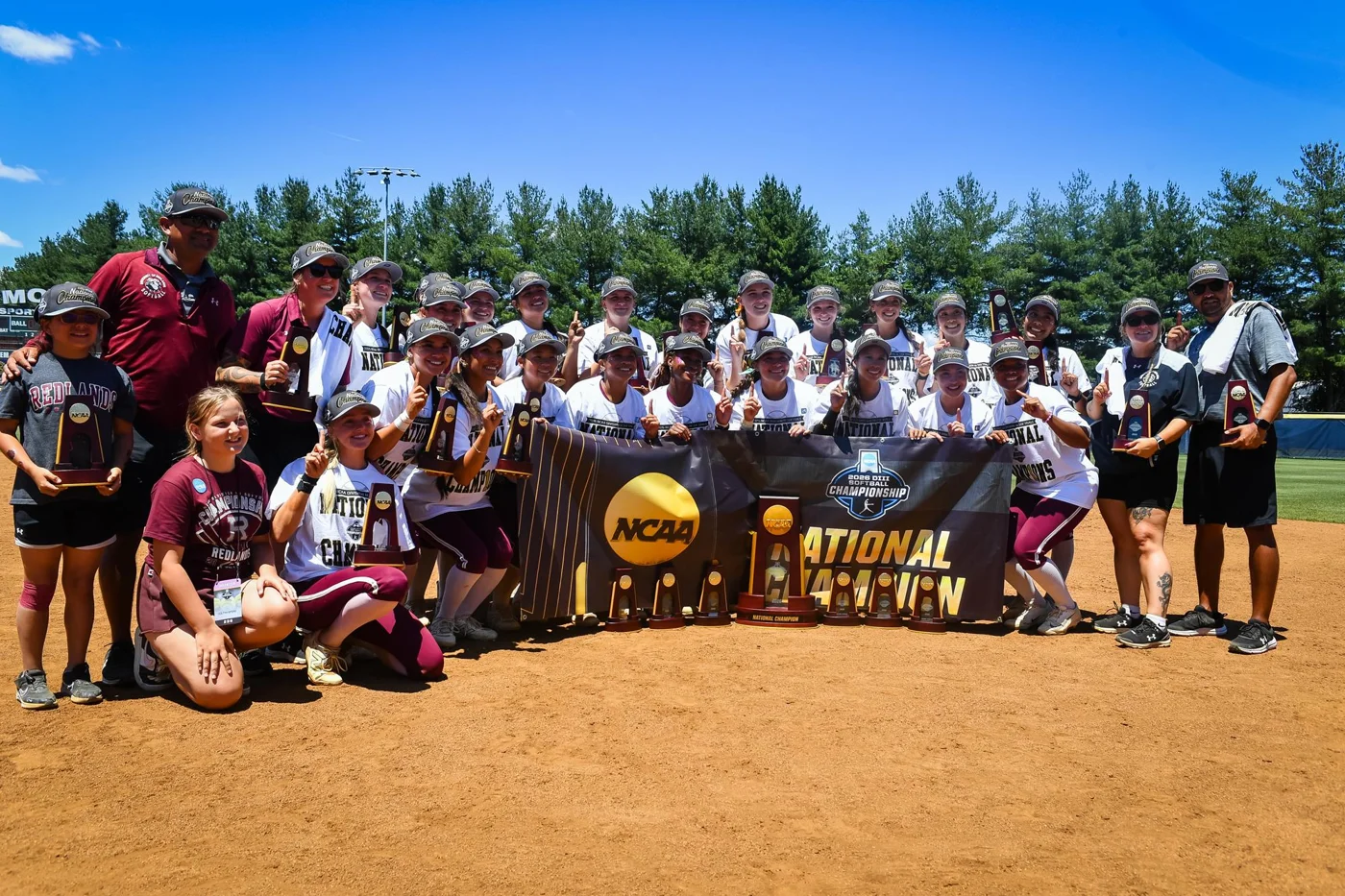
Redlands won the 2026 NCAA Division III softball championship, sweeping Trine in the final series. This guide collects the completed tournament’s dates, bracket structure and the Bulldogs’ actual national-stage results, then explains the comeback that finished the season. It is an archive for 2026, checked on October 21, rather than a live scoreboard or a preview of an unannounced field.
Who won the 2026 Division III softball championship?
The University of Redlands beat Trine 7–6 on June 3 to complete a two-game sweep and claim its first NCAA softball national title. The Bulldogs ended the season 48–6. Their official championship report identifies both the result and the significance: this was a new program achievement, earned in Salem, Virginia.
Keep the division attached to that answer. School reports sometimes call the national stage the Women’s College World Series, but the DIII championship at Moyer Sports Complex is a separate event from the Division I tournament in Oklahoma City. The shared language can make a search result look interchangeable even when its teams, dates and venue belong to another competition. “Redlands, DIII, 2026” is a useful combination when looking for a specific game.
The title also had conference significance. The Southern California Intercollegiate Athletic Conference describes it as the first softball national championship won by a SCIAC member. Its report carefully distinguishes Chapman’s 1995 championship, which came when Chapman was an independent. That qualification matters: conference history and a state’s softball history are different measures, and a first for one should not be inflated into a first for the other.
A sweep answers how many games the final series needed, but it does not describe how difficult each victory was. The one-run clincher is already a reason to look beyond the series count. In a best-of-three format, two wins end the contest regardless of whether the margins are large or small. The game accounts later in this guide show why the final inning deserves as much attention as the trophy photograph.
For a fan arriving through a bracket search, the practical starting point is simple: Redlands is the champion, Trine the runner-up and June 3 the deciding date. From there, choose whether you need the entire NCAA layout or one school’s route. A national-finals panel will not show every regional game, and a team recap will naturally center its own players. Combining those views gives a more complete understanding than treating either one as a substitute for the whole tournament.
The linked 2026 reports remain useful after the season, but their “next game,” streaming and ticket panels may retain information from publication day. Read the dated result before acting on an old event label. For current competitions, check our daily schedule and the participating school’s current season page; for this championship, stay with the 2026 archive.
The 2026 tournament calendar and bracket structure
The 2025–26 DIII prechampionship manual scheduled the selection show for May 11, regionals for May 14–16, super regionals for May 21–22 and the Salem finals for May 28–June 3. That sequence separates the field announcement, campus rounds and national event. A team could begin its NCAA run two weeks before the opening national-finals game.
The field contained 64 teams. Qualification involved automatic access and at-large selection; the manual specifies the NCAA Power Index, or NPI, for the latter. NPI considers winning percentage, strength of schedule and a quality-win bonus. It is separate from a coaches poll. A Top 25 label in a newspaper report should therefore not be read as the actual mechanism that awarded an at-large place.
Once games begin, a different question takes over. Selection evaluates who gets into the field; the bracket determines who advances. A school’s poll number, NPI standing and eventual finishing round can all differ without any contradiction. If you are comparing an old prediction with the result, identify which measure the prediction used before deciding that the bracket has somehow recorded the wrong seed.
Regional games and the super-regional series
Sixteen four-team double-elimination regionals produced 16 winners. They entered eight best-of-three super regionals, with the winners qualifying for Salem. At the national site, double-elimination bracket play produced the two championship-series opponents. The title itself was settled in another best-of-three series. These are successive stages, not a single tournament-wide allowance of two losses.
The change in format changes what a fan should track. In a regional, identify whether a school remains unbeaten or is playing to avoid elimination. In a super regional, track the series score against one opponent. At the national site, establish which side of the bracket a game belongs to before calling it a semifinal. Two schools meeting for a place in the last series are playing for something different from two schools contesting the series itself.
What an if-needed game means
An if-needed slot is a conditional part of the schedule. In the regional final, it becomes necessary when the team coming through the elimination side defeats the previously unbeaten team. In a best-of-three series, the third game is necessary when the first two are split. The same words appear in both settings, but the bracket situation that activates the game is different.
That distinction helps with historical searches. An unused third-game slot after a sweep is not a cancelled competition that needs a score; it is a contingency that never became necessary. Similarly, the event’s closing date is not a guarantee that every school played until then. When saving an archive, keep actual completed contests separate from potential games so that you do not accidentally increase a team’s appearance count or invent a missing result.
Dates also describe the intended schedule before weather and other approved adjustments. A regional box score dated outside the initial three-day window needs to be read in its own event context. Check the host’s completed schedule instead of rejecting a result solely because an early announcement printed another date.
The champion's verified path through the national finals
Redlands won all five games it played at the national site. Its completed 2026 schedule shows wins over Linfield, Rowan and Simpson before the two victories over Trine. That is an unbeaten Salem run, a precise description that should not be expanded into a claim that the Bulldogs never lost anywhere in the NCAA tournament.
The earlier super regional explains the distinction. Redlands lost 5–3 to Texas Lutheran on May 21, then won 3–1 and 5–4 the following day to take the series. A team can recover from a series-opening defeat, qualify for the national finals and finish the season with an unbeaten run there. Stage-specific records tell that story accurately; a loose “undefeated postseason” label would erase the recovery that made the title possible.
| Date | Opponent | Redlands result | National-stage context |
|---|---|---|---|
| May 28 | Linfield | Won 9–7 | Opening game |
| May 29 | Rowan | Won 10–2, five innings | Winners’ bracket |
| May 31 | Simpson College | Won 6–3 | Series berth secured |
| June 2 | Trine | Won 11–3, six innings | Championship series, Game 1 |
| June 3 | Trine | Won 7–6 | Championship series, Game 2 |
This table is the champion’s national-site path, not every game in the 64-team field. It is useful for following Redlands chronologically. To reconstruct a different qualifier’s route, return to the relevant regional and follow that school’s advancement lines. A national-finals graphic alone begins after most of the field has already been eliminated.
The result that secured the championship-series berth
The Bulldogs defeated Simpson 6–3 on May 31. Their official semifinal report centers the five-run second inning that established control. Avery Provenzano’s two-run double was part of that rally. Simpson then scored once in each of the third, fourth and fifth innings, so the early lead still had to be protected rather than merely admired.
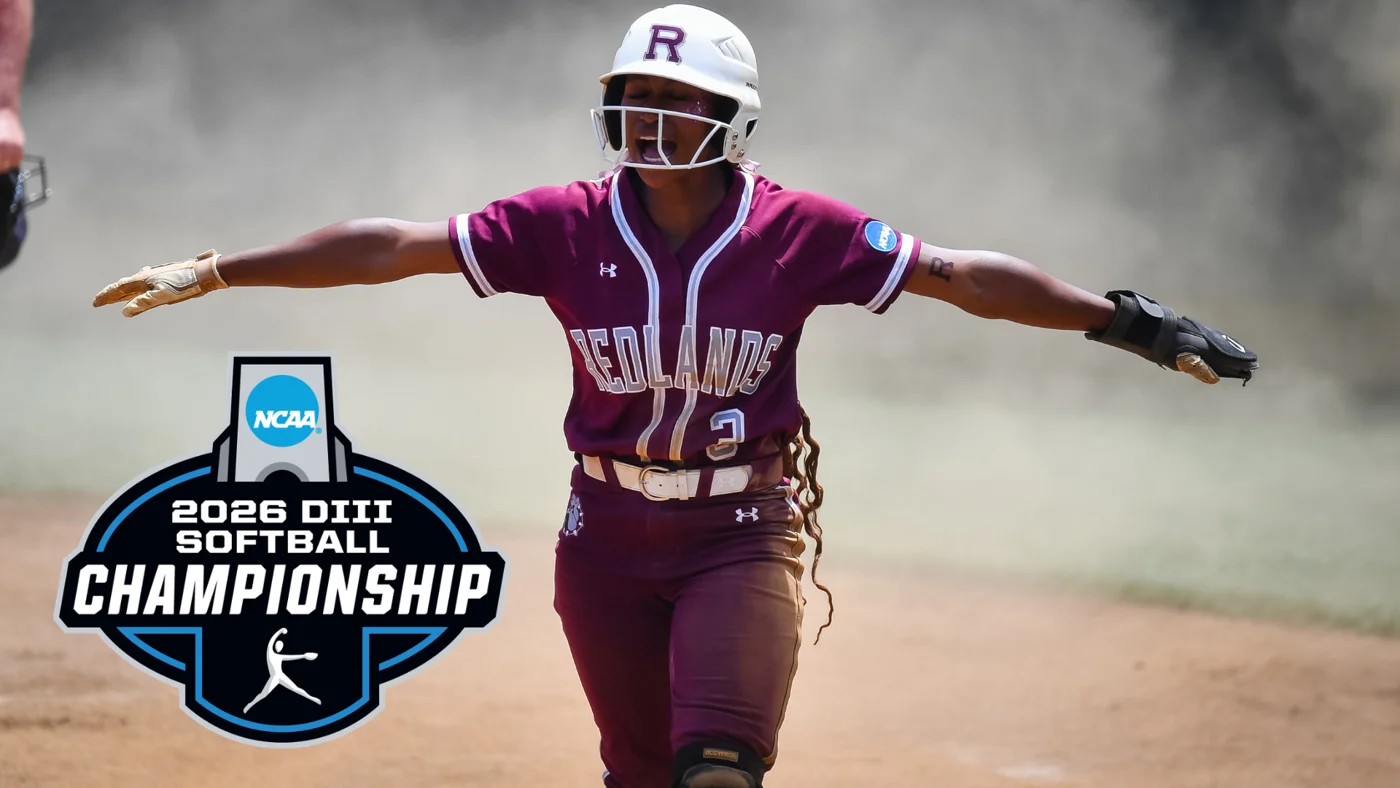
The game’s official box credits Paige Ellinger with the win and Katlyn Gandara with the save. That is a reminder to read beyond the winning pitcher’s name when assessing a tournament performance. The final outs can belong to another pitcher whose contribution matters directly to advancement.
The analytical value of that game is its shape: Redlands created a substantial inning, Simpson reduced the margin and the Bulldogs completed the job. You do not need to invent a dugout conversation or claim to know when a pitcher felt tired to explain the pressure. The inning line and the final result establish what was at stake. The win earned the last-series opportunity; it did not yet award the championship.
How the championship series was decided
Redlands had to overturn an early deficit in both games against Trine. In the opener, the Thunder scored three in the first inning, but the Bulldogs answered with six in the third and eventually won 11–3 in six innings. The school’s June 2 account makes that chronology clear. The final margin records the outcome; the scoring sequence explains why the game still required a substantial response.
Game 2 was tighter. Trine led 4–0 after one inning and 6–3 after five. Redlands tied the score in the sixth and produced the go-ahead run in the seventh. The SCIAC’s championship recap identifies Natalie Lowthers’ two-run double during the tying rally and Avery Provenzano’s hit to bring home the winning run. A sweep can contain a comeback that remains unresolved until the final inning.
The reason to separate those two rallies is analytical as well as chronological. In Game 1, the decisive offensive response came early enough to change the shape of several subsequent innings. In Game 2, Redlands was still chasing the score late. Calling both contests comfortable because the series finished 2–0 would erase the conditions the players actually faced. The same series result can be reached through very different game situations.
Pitching and defense were central to making the last rally sufficient. The conference report credits Brianna Garcia with 2.1 hitless relief innings and highlights Jenay Scott’s diving catch. In softball notation, 2.1 means two innings and one out, not 2.1 decimal innings. Holding the opponent scoreless after taking the lead is the other half of a comeback; the winning hit only becomes decisive when the remaining outs are secured.
Scott also finished the championship series 5-for-6 at the plate, according to that report. Keep the sample attached to the number: two games against Trine are different from the full NCAA postseason. A short series can provide an extraordinary performance without becoming a season-long batting average. That precision is especially useful when discussing a player who contributed both an important defensive play and productive at-bats.
Katlyn Gandara was named the event’s Most Outstanding Player, an honor also recorded in San Bernardino County’s recognition of the champions. Treat that as a tournament award, rather than renaming it a universal season player-of-the-year prize. Individual honors recognize particular achievements within their stated setting.
Together, those details explain a title won through more than one route: a large inning in the opener, a late recovery in the clincher, relief pitching and a consequential outfield play. They support a specific assessment of Redlands’ finish without pretending that one statistical category alone explains the entire championship.
Use the 2026 bracket archive without confusing seasons
The NCAA’s 2026 Division III bracket and printable archive are the appropriate starting links for the full field. Check the displayed division and year after opening them. A search engine can surface an old report beside a current landing page, so matching the headline alone is not enough to establish that both pages describe the same tournament.
A printable sheet and a completed-results archive have different uses. The former can show the original pairings and potential advancement routes even if it was saved before games began. The latter should tell you what actually happened. When a progression slot remains blank in an early PDF, consult the dated score and recap before assuming that a game was never completed.
Find a regional result beyond the national-finals graphic
Start with the school and round you need. A team eliminated at a regional will not appear among the eight Salem finalists, even though it participated in the NCAA tournament. Open that regional’s bracket or the school’s 2026 schedule, locate the opponent and date, then follow the box-score link. The national-stage table above deliberately begins later; it does not replace those earlier records.
Game numbers need the same context. “Game 1” can mean a regional opener, the first super-regional contest or the championship-series opener. Save the round name with the result, especially if you are comparing two schools’ routes. Without it, a correct score can be attached to the wrong stage and create an apparently impossible sequence of wins or losses.
Check the clock label when times differ. Redlands’ schedule displays Pacific times, while the games in Salem took place in the Eastern time zone. A morning listing on a California school’s page can represent the same contest as a later local start in Virginia. Preserve the source’s zone when quoting an old first pitch rather than silently changing it to match your own location.
For an individual performance, use the box score rather than an isolated social caption. Establish whether a batting line describes one game, the final series or the complete postseason. For team history, the NCAA’s DIII championship records provide a broader archival route. Match the document’s covered season to the question you are asking before treating it as an up-to-date career record.
Our scores page and viewing guide help with their covered competitions, but neither should be assumed to contain every historical DIII box or replay. For the 2026 tournament, the combination of the NCAA bracket, season-specific school schedule and dated game report gives the clearest route from the full field to Redlands’ final out.
Join the conversation
Share a question or a thought about college softball. Comments are reviewed before they appear. Keep it friendly and on topic.
No comments yet. Start the conversation.
Sign in with Google to leave a comment. Your email address is not displayed.