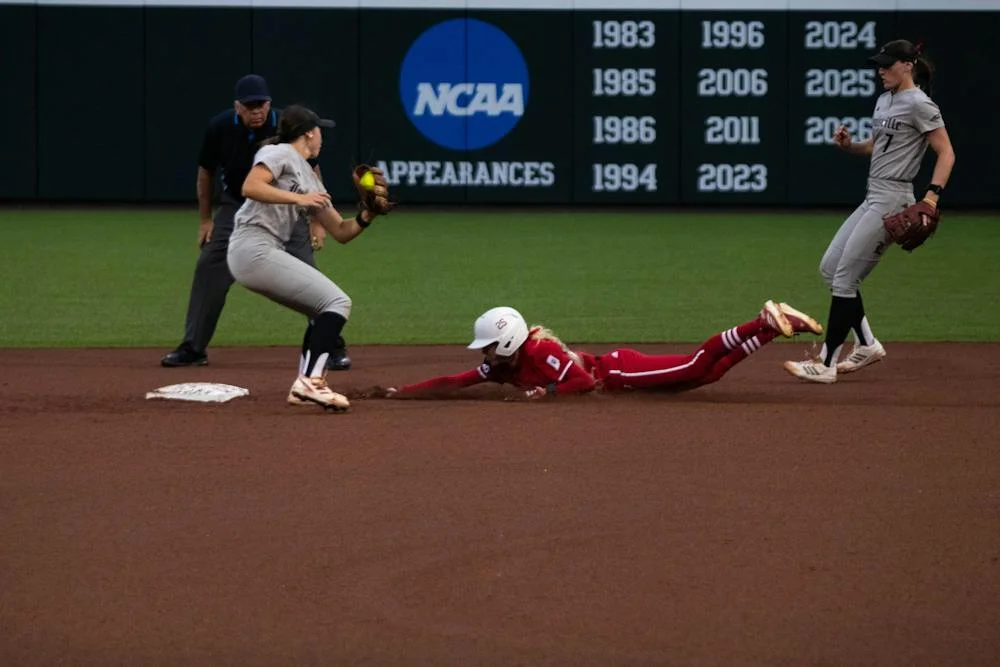
In NCAA softball, obstruction and interference answer different questions. Obstruction concerns the defense improperly hindering a runner or batter; interference concerns an action that denies the defense a reasonable chance to make a play. A collision can also require a separate decision about the player's conduct. Contact alone does not settle all three issues.
This guide uses the 2026–27 NCAA rules book and casebook, checked on October 15, 2026. The examples are explanatory situations, not verdicts on a particular viral clip. To understand a disputed play, first identify the ball, the players' actions and the rule that applies.
Obstruction and interference protect different parts of the play
A runner and a fielder can arrive at the same space for very different reasons. The defender might be playing a ground ball, waiting for a throw or holding the ball for a tag. The runner might be continuing toward a base, avoiding the defender or doing something that hinders a play. Calling every meeting “interference” hides the facts needed for the ruling.
The current NCAA rules book separates those situations through Rules 9.5 and 12.18. It also recognises incidental contact. The useful first question is which player's legitimate action has been affected, followed by how and when it happened.
Obstruction concerns a runner being hindered
For an ordinary running play, obstruction can arise when a defender without possession of the ball, and not fielding a batted ball, impedes a runner who is legally running the bases. It can happen unintentionally. It can also happen without a collision: a runner forced to slow or change route by an improperly positioned defender may be hindered even if the players never touch.
Imagine a runner approaching second while a defender without the ball occupies the route and forces her to make a detour. The important issue is that interruption of her progress. A photograph of players standing near each other is less informative than the sequence showing whether the runner's movement was actually changed.
The remedy also needs context. A fielder-obstruction signal generally allows action to continue under a delayed-dead-ball procedure, with protection assessed according to what the runner should have reached without the obstruction. It is not an automatic award of home or permission to take unlimited additional bases. Watch the umpire's eventual ruling as well as the first signal.
Interference concerns a play being hindered
Interference can be caused by an offensive player, equipment or other people identified in the rules when they deny a fielder a reasonable opportunity on a playable ball. It is not limited to a runner deliberately knocking a throw away. Some interference situations can be unintentional; the precise rule determines what the umpire must judge.
Consider a ground ball and a runner meeting the first fielder trying to field it. That situation raises a different question from a defender standing in the runner's way while waiting for a relay. Establish what the fielder was doing before deciding which side should have yielded. For ordinary offensive interference, a dead ball and an out are central consequences, with other runners placed according to the applicable provision.
Rule 12.14.5 makes the broader point directly: players making contact does not necessarily mean either obstruction or interference occurred. The severity of the fall, the sound of the collision or which team's supporters protest loudest cannot replace the rule's actual conditions.
When a fielder may occupy the runner's route
A defender's position must be considered with possession and the runner's opportunity to reach the base. Rule 9.5.2 allows a defender who has the ball to be positioned between the runner and the base or plate. Before possession, blocking access can be obstruction. The timing matters even when the glove and runner arrive only a moment apart.
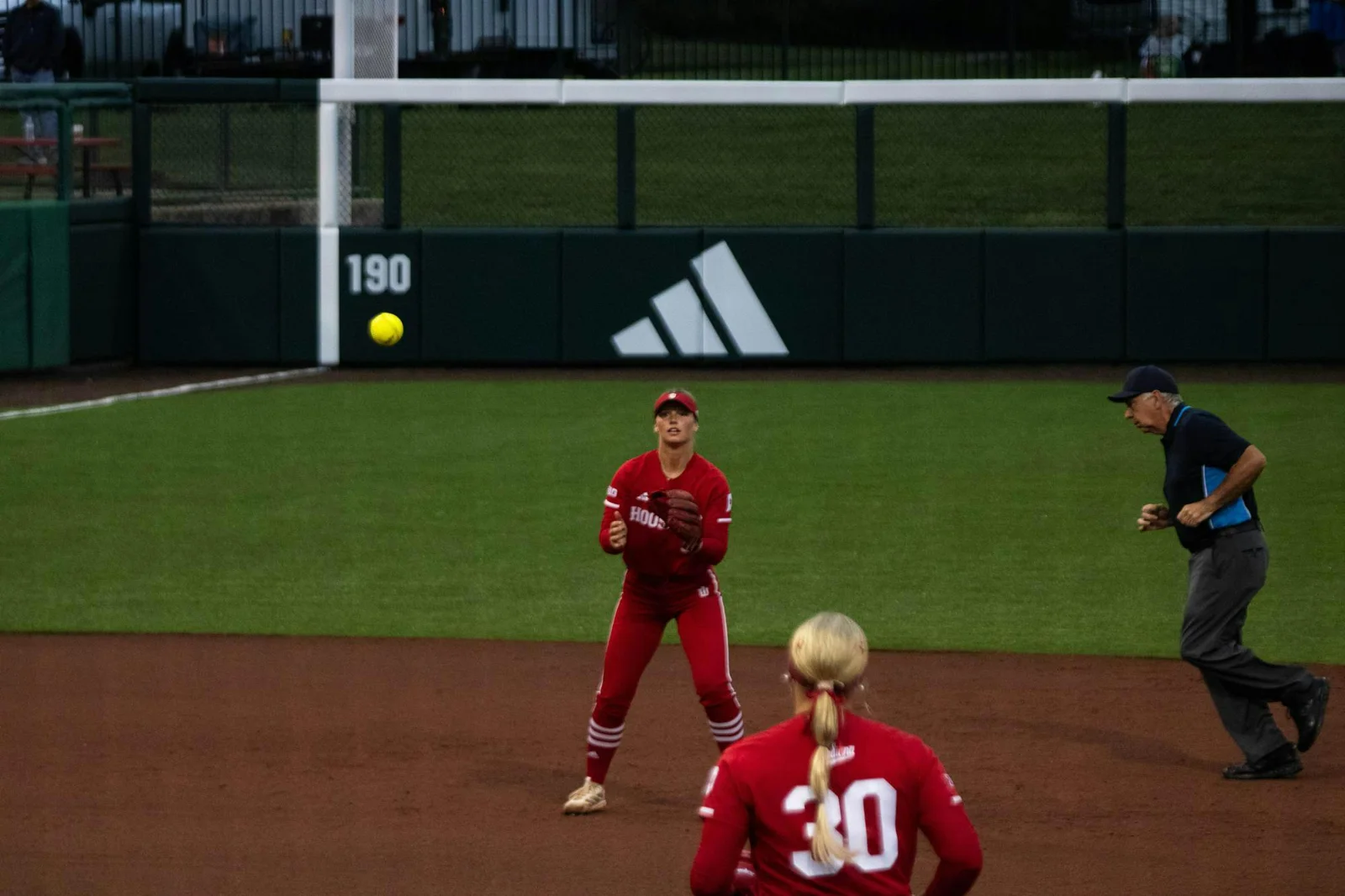
The NCAA casebook gives an important clarification in A.R. 9-12 and 9-13: a runner need not visibly swerve for the defender's position to hinder her. A catcher without the ball can dictate which part of the plate is available during the critical approach. That can affect the chance to score even if the runner continues on the same visible line.
Conversely, a defender being near or touching the leading edge does not make every play an automatic obstruction award. The current interpretation considers whether the position actually affected the opportunity to reach the base. A.R. 9-15 discusses a routine force-play position with no contact, where the runner clearly would have been out and the defender's position had no bearing on the result. Preserve those details rather than reduce the rule to “a foot touched the front, so safe.”
A throw on the way is different from possession
Waiting for a relay does not give the defender the same protection as already holding it. Imagine a catcher blocking a scoring route, hindering the approaching runner, then catching the throw and applying a tag. The later catch does not erase earlier obstruction if that blockage affected the runner's chance. Review the sequence before possession as well as the moment of the tag.
The casebook also distinguishes a catcher reacting to an off-line throw without impeding the runner from contacting the runner before catching it. The rule does not forbid every defensive movement toward an errant ball. It requires a judgment about what the movement did to the runner's opportunity. Fielding a batted ball is another distinct situation, with protection that cannot simply be transferred to someone awaiting a throw.
Nor does every obstruction involving a catcher use the catcher-batter provision. When the catcher acts as a fielder against a runner at home, the relevant analysis is fielder obstruction. The October 2, 2026 corrections also specify a no-warning exception when a defender obstructs while legitimately making a play on a runner returning to a base. An obstruction ruling and whether a warning follows are separate parts of applying the rule.
When a runner's actions become interference
A runner's route is not an unconditional right to displace everyone in it. The relevant protection changes with the play. A fielder making the initial play on a batted ball has a different position from a defender waiting to receive a throw, while a batter-runner approaching first has a particular running-lane provision to observe.
Meeting a fielder who is playing a batted ball
Suppose a ground ball is travelling toward the shortstop and a runner's route crosses the shortstop's opportunity to field it. The runner must give the protected fielder that opportunity. Saying “I was running toward third” does not, by itself, answer an interference question. The umpire must identify the fielder with the reasonable chance to make the play.
That identification matters if two defenders converge. The rules do not give both automatic priority just because each is wearing a glove. Similarly, the first baseman standing elsewhere in the infield is not the relevant fielder merely because the ball passed her general position on its way to the second baseman. Focus on the actual chance to field the ball.
A bobble can change the analysis. In A.R. 12-62, the casebook explains that the first fielder retains protection when a ball knocked down immediately in front remains within reach for a play. If it bounds well away or past the defender, she may instead be recovering a loose ball. Do not use “she touched it once” either to remove all protection or to grant protection indefinitely.
Physical contact is also not the only possible interference. Deliberately distracting action can matter when it prevents the play. On the other hand, merely running past a fielder is not usually interference just because it attracts her attention. The actual rule conditions are more useful than demanding that every runner disappear from the defender's view.
A thrown ball and a running-lane dispute
For a thrown ball, intentional interference is a key distinct provision: a runner being hit does not necessarily establish a violation. A throw that strikes an otherwise appropriately moving runner should not automatically produce the same ruling as the runner deliberately interfering with it.
The home-to-first running lane adds a more specific test. Rule 12.18.1.5.2 addresses a batter-runner outside the lane who interferes with the fielder receiving the throw at first. Being outside the markings alone is insufficient for that ruling; the receiving play must also be affected. The rule notes distinguish this from a defender hesitating, not throwing or making an errant throw.
Be careful with familiar advice about the last stride. The current book limits that lane-exit exception for touching first to games using a single first base. The NCAA's double-first-base change introduced a different configuration for Division I in 2026, with Divisions II and III following in 2027. Check the actual base and applicable exception rather than import a remembered single-base explanation into every play.
Why contact can produce an out and an ejection
An obstruction signal is not permission to retaliate against the defender. Rule 12.14 treats deliberate collisions separately from an ordinary interrupted route. If an obstructed runner deliberately collides with a fielder, the obstruction call is ignored and the runner is called out. If the act is judged flagrant or malicious, the runner is out and ejected.
That explains how an offensive player can lose the benefit of a defensive violation. The first question is whether the defense improperly hindered her. The next is whether she committed a separate act whose effect takes precedence. “The fielder was in the way first” does not complete the analysis when the later conduct meets the collision rule.
The rule does not require every runner to slide. It does require an actual attempt to reach the base and an attempt to avoid a collision when the base is reachable without one. A legitimate slide toward the base can involve contact, while an upright, deliberate collision with great force raises a different issue. Simply dividing plays into “she slid” and “she stayed up” misses those additional conditions.
Sliding is not automatic protection from a misconduct ruling either. The book addresses malicious slides, such as spikes-up action, and slides directed at a fielder when the runner cannot reach the base. The effect depends on the relevant provision and the umpire's judgment, including the stated warning discretion for conduct below the ejection threshold. Do not label every hard slide malicious from the final still frame.
The defense is subject to conduct penalties too. Rule 9.5.6 addresses flagrant obstruction involving excessive force, including pushing a runner off an occupied base to manufacture a tag. Its effect combines the appropriate obstruction remedy with ejection of the offending defender without a warning. Holding the ball does not create a right to force a runner away from a base she legally occupies.
The casebook's collision examples show why closely described facts matter. A slide after an out can raise malicious-contact, retired-runner interference or ordinary-play questions depending on its nature and timing. The runner's status, what the defense could still do and the character of the contact all matter. An out, a base award and an ejection are related possible consequences, but they are not interchangeable names for one decision.
How to assess a disputed play without guessing the ruling
When a clip prompts an argument, put the events in order before choosing a label. A cropped view of the collision can omit the throw, the runner's original approach or an umpire's earlier signal. Watch the whole available sequence at normal speed, then use other angles to answer specific questions rather than treating the most dramatic frame as the entire play.
- Was the defender playing a batted ball, receiving a throw or already holding the ball?
- When did the position affect the runner's access to the base, relative to possession?
- Which fielder had the protected opportunity to make the play?
- Was the runner actually trying to reach the base, and did a separate deliberate or excessive-contact act occur?
- What did the umpires call, and which consequence explains the final runner placement or ejection?
These questions help locate disagreement. Two viewers may agree that a defender hindered the runner but disagree about the later collision. Others may disagree about the instant possession was established. Identifying that issue makes a rules discussion more useful than treating every different outcome as inconsistency. It also leaves room to say that the available angle does not establish a necessary fact.
Check the rule code before comparing two clips
Use the same code and season. The USA Softball rules resource publishes a comparison with NCAA and NFHS precisely because these are distinct rule systems. A youth-tournament ruling, a high-school explanation or familiar baseball terminology should not automatically be applied to a current NCAA softball play.
The NCAA's current rules page provides the book, casebook and updates. Read them together. The October 2026 corrections specifically note that their changes are not reflected in the online book. Checking only an old printed page can therefore miss a relevant correction even when its cover says 2026–27.
For fans watching college games, the most useful habit is to separate the questions: route and possession, opportunity to make a play, then conduct and enforcement. A fair explanation can recognise a defender's initial mistake, a runner's independent obligation and the limits of the footage at the same time. That approach explains more of what happens on the field than an automatic safe-or-out conclusion based on contact alone.
Join the conversation
Share a question or a thought about college softball. Comments are reviewed before they appear. Keep it friendly and on topic.
No comments yet. Start the conversation.
Sign in with Google to leave a comment. Your email address is not displayed.