
NCAA softball replay allows designated calls to be reviewed through a formal process. It does not make every disputed judgment reviewable. A fan needs three pieces of information: whether the game is using an official review system, which part of the play is eligible for review and who has authority to request it.
This guide follows the 2026–27 NCAA rules and published corrections checked on October 15, 2026. It explains the current challenge policy, common limits and the difference between seeing an apparent mistake on television and having a legal route to change the ruling.
Why some college softball games have replay and others do not
The NCAA’s original adoption announcement established an optional national framework beginning in 2021–22. Schools, conferences and tournaments could implement it. That history explains why the existence of NCAA replay rules does not, by itself, mean every regular-season game has the same equipment and review operation.
Competition-specific requirements also matter. The American’s 2025–26 softball policies required review for conference games and recommended it for nonconference games when the host could provide it. That document specified camera and monitor arrangements for that league. These are concrete implementation requirements, not proof that every NCAA school has adopted an identical setup.
The postseason adds another layer. The NCAA’s 2025–26 Division I regional and super-regional bid checklist required hosts to meet replay and connectivity standards. Hosting a championship round therefore involves operational requirements beyond a campus deciding whether to stream a midweek game. Keep the division, event and season attached to such a document when comparing games.
The difference between a broadcast replay and an official review
A broadcaster can replay a slide to explain a close play without an umpire formally reviewing it. A scoreboard can also show a permitted replay. Neither act changes the scorebook or reverses a call. An official review requires the applicable protocol and an eligible question; the word “replay” on a television graphic is not enough.
The current rule book provides for on-site or centralized review operations. A viewer should therefore avoid assuming that the umpire who made the call is simply watching the same living-room feed and reconsidering it informally. The authorized process determines how the available video is used.
For example, a fan may have a compelling clip of a tag. The first question is still whether the game uses review and whether a proper request was made in time. The second is what the authorized evidence establishes. Keeping those questions separate makes it easier to understand why a telecast can discuss a close play that the crew never takes to formal review.
How coaches request and retain challenges
Each head coach begins with two challenges for the game. The important 2026–27 change is that a challenge is retained when the ruling is changed. The NCAA’s final approval notice also confirms that remaining challenges carry into extra innings. There is no automatic new pair when the seventh inning ends.
A simple hypothetical ledger makes the distinction clear. A coach starts with two, successfully challenges a tag and still has two. A later challenge fails to change the ruling, leaving one. Another unsuccessful request uses that last challenge. If the game then reaches the eighth, the coach has no challenges restored merely because the game is longer. Successful retention preserves the existing resource; extra innings do not replenish it.
The request also has a deadline. Appendix G gives the head coach 30 seconds to challenge, with additional requirements tied to the next pitch and the officials leaving the field. The published rules-book corrections clarify the wording connecting those conditions. Coaches must indicate the challenge promptly, before the next pitch, before the pitcher and infielders have clearly vacated their fielding positions and left fair territory, and before the umpires leave the field.
The practical consequence is that waiting for a long television discussion can be costly. A coach needs to identify the eligible question and request review while the opportunity exists. Walking out to debate a judgment is not a substitute for making a clear challenge request. Similarly, the end of a half-inning does not provide unlimited time to decide after everyone has dispersed.
Retention depends on an actual change in the ruling. A result announced as “stands” means the evidence did not establish the required basis to change or confirm the call. It is not a successful challenge merely because the officials also declined to say the original decision was conclusively correct. From the coach’s resource perspective, a challenge that leaves the ruling unchanged has a cost.
That creates a tactical decision without making review a guessing contest. The potential value of changing a crucial out must be weighed against the uncertainty of the available view and the possible need for another challenge later. For viewers, tracking the ledger is more helpful than assuming a coach can repeatedly ask the crew to look until a preferred answer appears.
Which plays can be reviewed
Appendix G contains the complete list. The most useful way to read it is as a set of eligible questions with conditions attached. “A close play happened” is too broad. Ask whether the dispute concerns a tag, a catch, a boundary, a specified kind of contact or another listed issue, then check the limitation attached to that category.
Calls on the bases
Force and tag plays, certain base-touching questions and timing plays are among the reviewable situations. A timing review can determine whether a lead runner touched home before a third out. These are different factual questions: one looks at obtaining a base before an attempted putout, another at the sequence of events across the field. The fact that the scoreboard might change does not tell you which question the crew is reviewing.
On a hypothetical tag at second, identify the instant of the tag and whether the runner had acquired the base. A camera showing the runner’s upper body clearly may still leave the foot and glove obscured. A replay that looks persuasive at full speed can therefore be less decisive when the relevant contact is isolated. That is an evidence problem, not proof that tags are excluded from review.
Leaving early on a pitch has special limits. The NCAA’s 2024 approved modification, reflected in the current book, permits a challenge of an on-field early-departure call or an eligible successful advance. It excludes specified situations, including an out-of-the-park home run, hit-by-pitch, ground-rule double, foul ball, lead-off and certain forced advances such as a walk.
That prevents a fan from treating every scoring play as an opportunity to search for an uncaught early departure. Compare an ordinary successful steal with an out-of-the-park home run: the review route is not the same merely because the runner’s foot can be seen in both clips. A coach must identify the actual eligible category, and an umpire cannot initiate a leaving-early review independently.
Balls in flight and at the boundary
The 2025 approved changes are especially important for infield catches. A called catch on a fair ball in the infield is not reviewable. An infield “no catch” can become a catch with runners aboard only if it produces the third out; with only the batter-runner and no other runners, the review can occur at any time. Outfield and foul-territory catches have broader review availability.
Imagine a short liner with one out and two runners aboard. The umpire rules no catch and the runners respond. That situation is not interchangeable with the same liner and two outs, where changing the ruling to a catch would end the inning. The limitation concerns the original ruling, location, runners and outs together. “They reviewed a catch last game” leaves out the facts that may make the comparison invalid.
Boundary decisions also have defined routes. A ball called fair can be examined for foul status, and home-run questions are included. A ball called foul does not create an unrestricted opportunity to turn any ordinary grounder into a live fair hit; the book specifies permitted changes. A ball above the top of the foul pole has a further restriction on reviewing that aspect. Track the original call before assuming all fair/foul decisions work symmetrically.
Pitches, contact and other limited categories
Pitch-related review includes specified questions such as whether an apparent dropped third strike was caught before reaching the ground and whether a batter is entitled to first base after a hit-by-pitch. That is not a general system for challenging the strike zone. A broadcast strike-zone graphic does not make an ordinary called ball or strike eligible for replay reversal.
Interference needs another distinction. Under the approved changes, certain interference and collision situations are reviewable when no interference was called and the ball remained live. An on-field interference call generally is not reviewable, with exceptions for batter and spectator interference. Obstruction is separately listed. A coach’s preferred label for contact does not replace the need to identify what was called and which review provision applies.
For a collision clip, therefore, ask three questions before arguing the outcome: what did the umpire initially rule, which type of contact is being examined, and does the category allow review in that posture? Those questions can explain a review’s availability without deciding whether a particular runner or fielder was ultimately right. They also keep a rules discussion from becoming a debate based only on how dramatic the contact looked.
When umpires can initiate a review
Some reviews do not require a head coach to spend a challenge. The October 2 corrections identify any-inning authority for malicious or flagrant conduct, recordkeeping issues and reviewable plays that were not properly covered, including conflicting signals from double coverage. These are defined routes, not general authority to revisit any disputed judgment whenever a coach asks.
The safety-related route is particularly distinct from an ordinary safe/out request. The case book’s A.R. 5-25 considers a fight following a hard slide and the use of authorized video to establish participation. That example concerns identifying misconduct, including involvement by players leaving a team area. It does not create an unlimited appeal of every earlier call in the game.
What the inning changes and what it does not
Appendix G also provides a discretionary route beginning in the sixth inning for designated plays when the challenging coach has no challenge remaining. That condition matters. It is inaccurate to summarize the rule as either “umpires can never review without a challenge” or “everything becomes automatically reviewable late in the game.”
Consider a hypothetical ordinary tag play in the fifth inning after a coach has used both challenges. Simply moving that same kind of dispute into the sixth changes the potential crew-chief route. It does not require the crew chief to grant a review, remove the category’s conditions or supply evidence that the camera never captured. A discretionary option remains different from an additional challenge awarded to the coach.
Leaving early on a pitch is the explicit exception: the crew chief cannot initiate that review. A coach cannot recover the missing challenge by asking the umpire to adopt the request as a crew review. The category’s special conditions remain relevant even when the game reaches its final inning or goes beyond regulation.
For viewers, identify the stated reason for the review before counting it against the team. A recordkeeping correction in the second inning, an eligible late tag review and a coach’s challenge can produce similar pauses on screen while using different authority. Knowing the route explains why one pause changes the challenge ledger and another does not.
How a review changes the ruling and runner placement
The evidence standard is stronger than “the other call looks a little more likely.” A reversal requires indisputable video evidence. The ruling can be confirmed, changed or left standing because the available evidence is inconclusive. Listen for that distinction: a call that stands is not the same evidentiary outcome as a call conclusively confirmed correct, even though both leave the original result in place.
Suppose an initial safe call is challenged. One angle shows the glove near the runner while another shows a foot approaching the base, but neither establishes the decisive sequence clearly. The review is not an opportunity to choose whichever outcome feels more probable from the separate clips. The relevant evidence must support a change under the standard. More repetitions of an obscured view do not necessarily make it decisive.
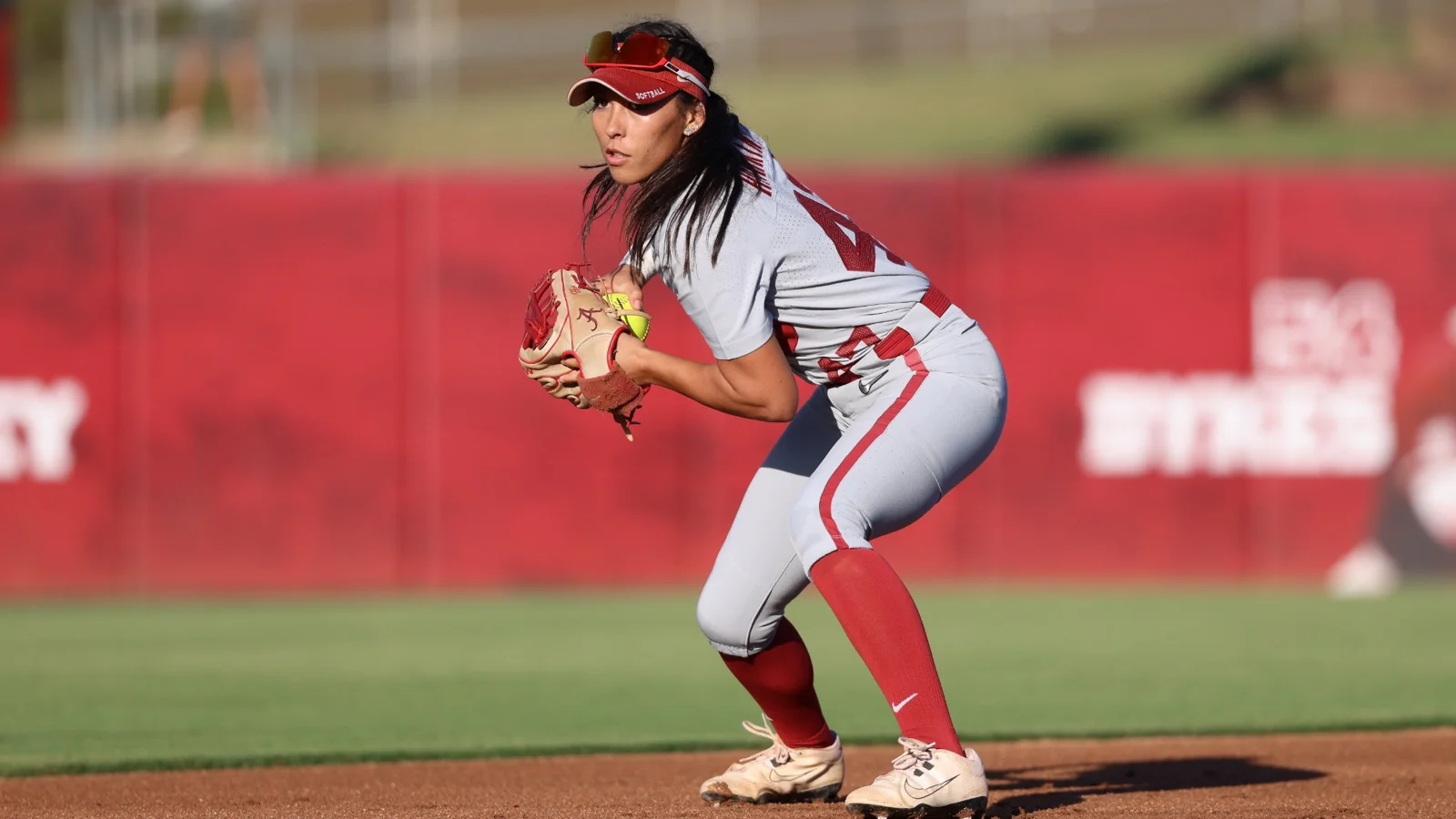
Changing a ruling can create another task: deciding where the runners belong. The NCAA’s review explanation describes applying the rule and crew-chief judgment to reconstruct the situation as if the correct call had been made. The current Appendix G retains that approach. It does not automatically award each runner the farthest base she might conceivably have reached.
That matters when players reacted to an incorrect call. A runner who stopped because a catch was signaled and a runner who continued because no catch was signaled have responded to different information. A correction must account for the appropriate rule and the relevant movement. Watching only the fielder’s glove can miss why the officials then spend time discussing runners and outs.
A challenge also does not automatically open every other call across the diamond. Appendix G addresses reviewable elements at the original base or plate, with a separate challenge ordinarily needed for a call elsewhere. A routine double play has an exception allowing both elements to be reviewed through one challenge. Identify the play’s structure before assuming the crew has ignored another base.
The final ruling is communicated to the head coaches and scorer. It is not an invitation for a new argument over the same reviewed decision: the rules provide for ejection when a coach argues that final decision. A long conversation afterward should therefore not be interpreted as an unlimited second opportunity to challenge the evidence.
Why reviews take time and how to follow them
The 30-second challenge deadline is a deadline to request review, not a promise that the entire review will finish in 30 seconds. The process can involve identifying the eligible element, examining evidence, resolving another reviewable part of the play, placing runners and communicating the result. The length of the pause alone cannot establish whether the original ruling will change.
A useful viewing habit is to follow the sequence rather than repeatedly judge the first angle. Identify the original call, listen for the stated review question and note whether the request came from a coach or the crew. After the decision, check the outs and runner positions as well as the score. A correct reconstruction can change the game state in ways that a brief “safe” or “out” graphic does not fully explain.
There are also rules for the pause itself. Teams may use the permitted huddle arrangements without an automatically charged conference, but must be ready when the umpires return. A defensive delay can produce a ball; an offensive delay can produce a strike. The review is therefore not an unlimited additional timeout after the decision has been delivered.
Stadium video has a separate role. Appendix F permits repeated scoreboard footage at different speeds while a play is under review, with restrictions on the available footage and on further replays after the decision. A stadium stopping the replay is not, by itself, evidence that an angle is being hidden. The video-board operator has rules to follow too.
One further procedural limit appears in the October corrections: when a team has a choice between accepting a play’s result and applying a rule, it cannot request video review after making that selection. The order of decisions matters, just as the original ruling and challenge deadline matter.
For your next game, use the TV schedule and watching guide to find the announced coverage, then listen for how that event administers reviews. Understanding the request, eligible question, evidence standard and resulting game state makes a frustrating pause easier to evaluate. It also allows a useful criticism of a specific decision to be separated from an assumption that replay can correct every judgment on the field.
Join the conversation
Share a question or a thought about college softball. Comments are reviewed before they appear. Keep it friendly and on topic.
No comments yet. Start the conversation.
Sign in with Google to leave a comment. Your email address is not displayed.