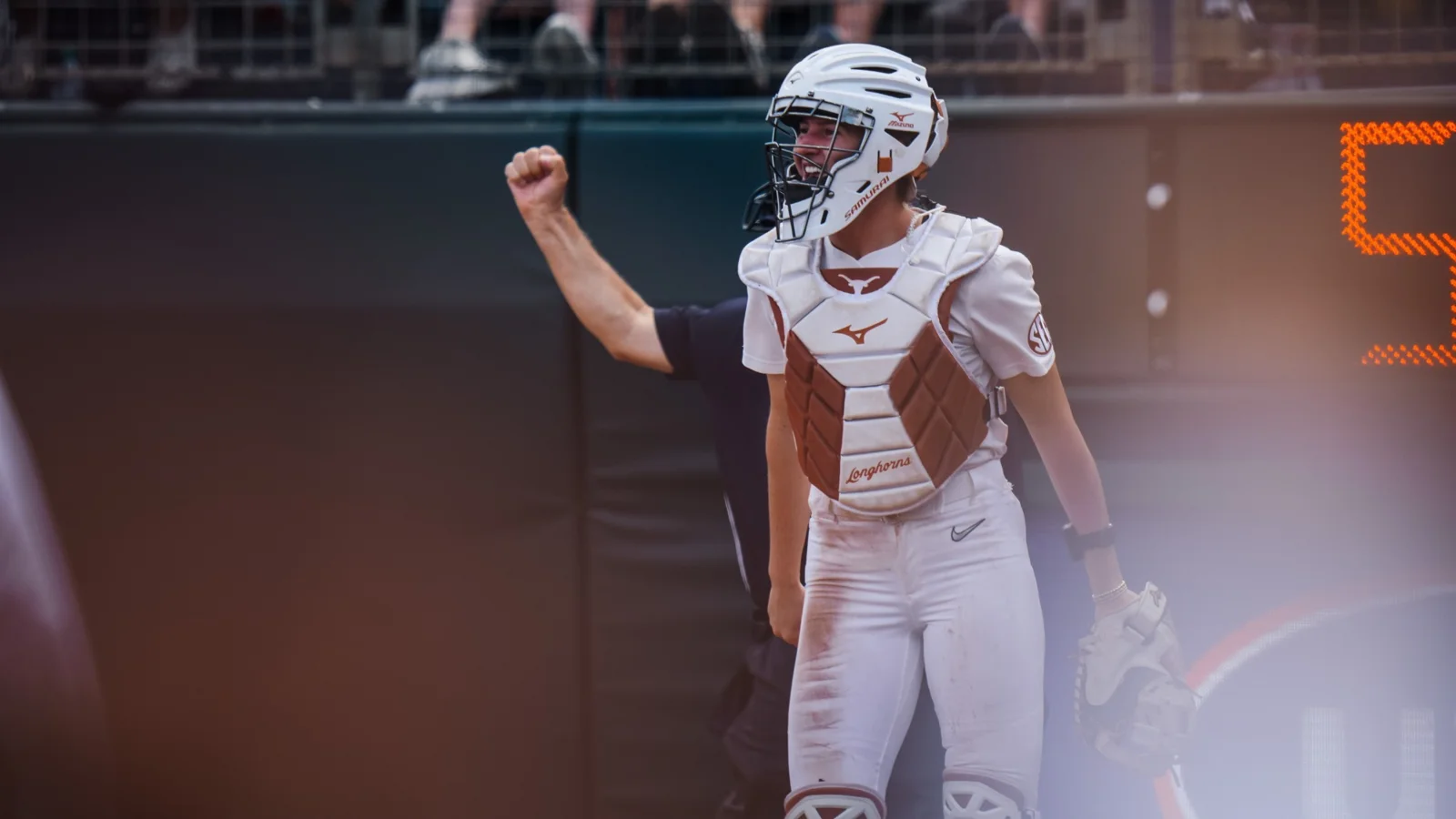
Reese Atwood's Texas career combined a record-setting bat with the responsibility of catching for a national championship program. Her 2024 breakthrough made her one of college softball's most dangerous run producers, and she remained part of the Longhorns' 2025 and 2026 title teams. The important story is how those contributions fit together: offensive production that changed an inning, and a defensive position involved in nearly every pitch.
How Reese Atwood became central to Texas softball
Atwood arrived from Sandia, Texas, and attended Tuloso-Midway High School, according to her official Texas biography. She was already a substantial contributor as a freshman in 2023: 58 appearances, 56 starts, 11 home runs and 43 RBI. That beginning matters because the later breakout did not emerge from a player receiving only occasional at-bats. Texas had already entrusted her with a recurring place in its lineup.
A young catcher has two learning curves at once. The batting assignment demands adjustment to collegiate pitching, while the defensive assignment involves working with the staff and controlling the play around home plate. A career profile should examine those jobs separately before combining them. Offensive records explain part of Atwood's prominence, but they do not by themselves describe everything Texas asked her to do.
The 2024 breakthrough that raised her profile
The completed 2024 Texas statistics give Atwood a .423 batting average, 23 home runs and 90 RBI across 65 games, all starts. Her .500 on-base percentage and .862 slugging percentage show that the season was more than a collection of occasional long balls. She both reached frequently and generated extra bases when she hit.
The change from 11 home runs and 43 RBI as a freshman to 23 and 90 as a sophomore is substantial. It does not tell us precisely which mechanical adjustment caused it, and there is no reason to invent one. It does tell us that a player who had already supplied meaningful offense took on a much larger run-producing role. The strongest evidence of improvement is the production itself.
Her record chase has a concrete moment. On April 27, Texas's game report described a two-out, two-run home run that moved her beyond the previous single-season RBI mark of 66. That was the milestone during the season; 90 was the eventual final total. Mixing the two dates would turn a clear career landmark into an inaccurate game account.
The two-out setting also explains the usefulness of power. A lineup may be one out from wasting a baserunner, and a home run can convert that situation into multiple runs without needing another teammate's hit. That does not make every RBI a measure of individual skill alone: teammates still need to reach for multi-run swings. It shows the relationship between Atwood's ability to drive the ball and the opportunities Texas created ahead of her.
The championship years and the end of her college career
Atwood maintained a major offensive role in 2025. Texas's final season table records a .393 average, 21 home runs and 89 RBI, with starts in all 68 games. Her .504 on-base percentage was slightly above her 2024 mark even though the batting average was lower. That contrast is a reminder to read the whole batting line, rather than treating average as a complete account of a hitter's year.
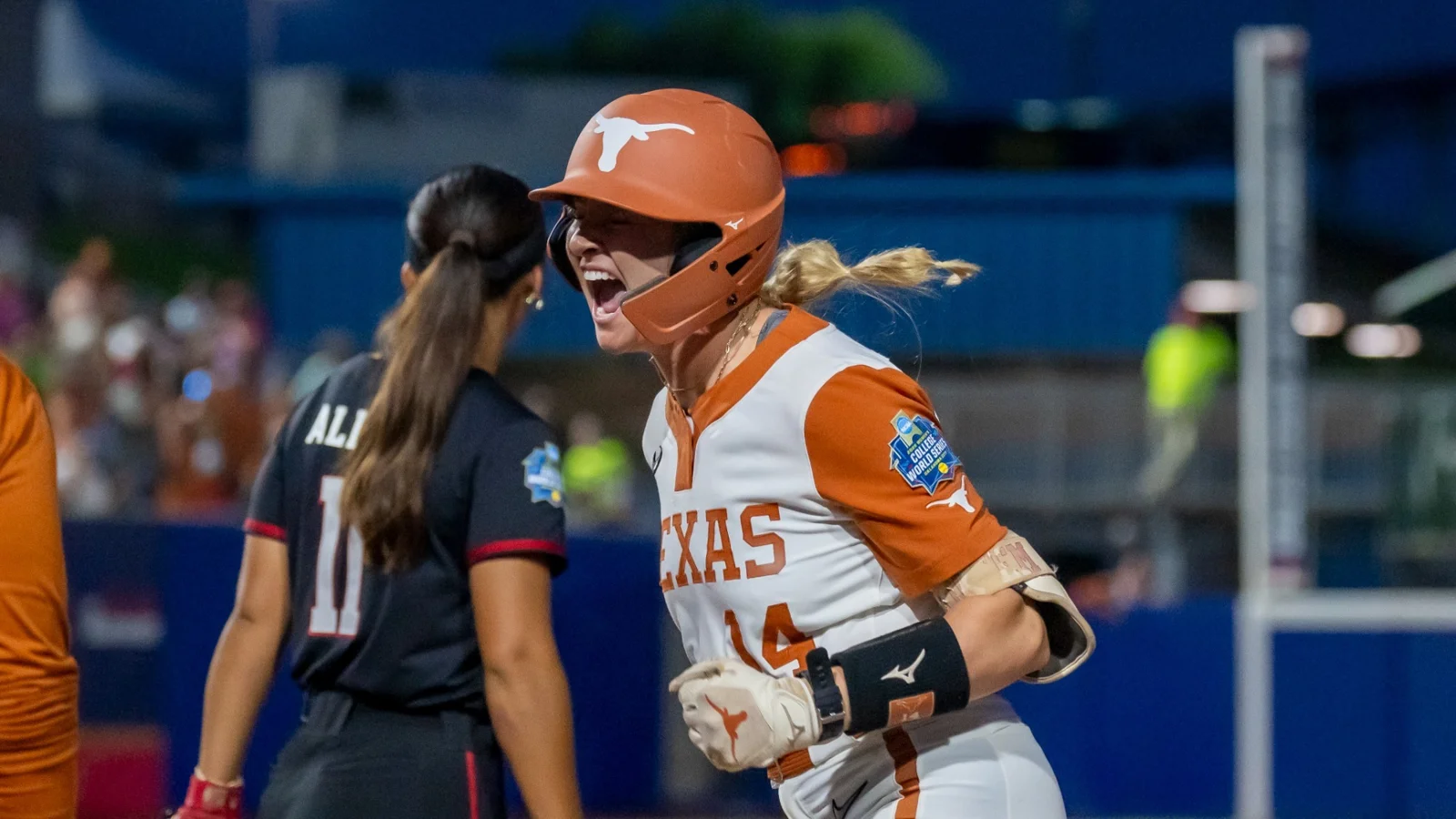
The senior season had a different statistical shape. The completed 2026 school table lists a .326 average, 19 home runs and 61 RBI in 65 games, including 64 starts. Those totals remain substantial, while the rates are below the spectacular sophomore peak. A responsible profile can acknowledge the difference without turning a championship into proof that every personal statistic improved.
Early in that final season, her 59th career home run established a new Texas career mark, documented in the school's February report. That number belongs to the record-breaking moment, rather than the completed career total. It shows how much accumulation she had already achieved before the final spring's postseason began.
Texas won its first NCAA softball title in 2025 and repeated in 2026. The 2026 championship report records the June 4 clincher against Texas Tech, with Atwood catching and contributing a double. Her career therefore includes both individual record moments and the program's first two championships. Neither should be used to erase the other: the records describe her work, while the titles describe the team result that work helped support.
What makes Atwood's offensive value distinctive
Atwood's power forced opponents to make a difficult choice: challenge a hitter capable of clearing the fence, or put another runner aboard for the next Texas batter. That pressure existed before the ball left her bat. It is particularly useful in a lineup that can create traffic, because the cost of a mistake grows when runners are already in scoring position.
Her largest run-producing days demonstrate the ceiling. Texas's May 2024 weekly awards report records nine RBI in a 23–0 victory over Texas Tech. Across that weekend, she collected seven hits, four home runs and 13 RBI. Those numbers document a remarkable stretch, but the margin also matters. Producing nine runs in a rout and producing two in a championship game are different competitive situations; an account of her value needs both.
The sharper postseason example came in the opening game of the 2025 championship series. Texas trailed Texas Tech 1–0 in the sixth inning, and NiJaree Canady had struck out the first two hitters. Texas then created a two-out opportunity. With Kayden Henry and Mia Scott in scoring position, Tech attempted to walk Atwood. On a 3–0 pitch, she swung and singled through the left side, driving in both runners. Texas won 2–1, as documented in the Longhorns' game account and the Red Raiders' report.
That was a single, which is precisely why it belongs in a profile of a power hitter. Atwood did not need a home run to change the game. Two runners had advanced far enough that a ball through the infield could reverse the lead. Her job in that moment was to convert the pitch and the baserunning into runs, rather than produce the most spectacular possible contact.
The unusual count should also be read carefully. Swinging at an attempted intentional walk is a specific response to a hittable delivery, not a universal instruction to abandon a favorable count. The play succeeded because Atwood made contact that served the situation. It would be poor analysis to turn one memorable outcome into a rule that every hitter should follow regardless of pitch location.
Her 2025 season provides broader evidence that she could accept the other outcome, too. The official school statistics show 41 walks against 24 strikeouts and a .504 on-base percentage. Walks kept innings alive and gave the lineup another baserunner when opponents refused to offer a useful pitch. They were part of her offensive contribution alongside the 21 home runs, rather than empty plate appearances between highlight swings.
For a fan watching her at-bats, the interesting question is therefore how the pitcher manages the space around the strike zone with runners aboard. Atwood's record shows both the damage of direct contact and the value of reaching without it. The 2024 rout displays her ability to overwhelm a game; the 2025 series opener displays how a smaller piece of contact can carry much greater consequence.
Why her catching deserves its own evaluation
A catcher who hits in the middle of the order is often described through her batting statistics because those are easy to compare. Atwood also has a direct defensive credential. In 2026, SEC coaches selected her to the All-SEC Defensive Team as well as the All-SEC Second Team. Texas's May 8 awards announcement identifies both selections. The defensive honor deserves its own place in her career assessment.
The relationship with the pitching staff is visible in an earlier postseason example. In her first WCWS start in 2024, Teagan Kavan threw a seven-inning, one-hit shutout against Stanford, striking out eight and delivering 124 pitches. In Texas's game report, Kavan credited staying focused with Atwood while controlling her nerves. That is a documented account of a freshman pitcher finding stability with her catcher on a major stage.
The pitching line remains Kavan's achievement. Her comment adds evidence of a working connection without letting us assign every strikeout to Atwood or claim that Atwood selected every pitch. A battery succeeds through multiple contributions, including execution in the circle, receiving behind the plate and the preparation surrounding both. The useful detail is that Kavan herself identified the connection as part of staying composed.
Receiving and controlling the running game are different tasks
The May 8 report listed a .993 fielding percentage, four runners caught stealing and two pickoffs for Atwood at that point in 2026. These are a dated snapshot before the NCAA tournament, rather than her completed senior-season defensive totals. Each number also answers a different question. Fielding percentage concerns recorded chances and errors; a caught-stealing total concerns particular attempts; a pickoff records an out against a runner away from the base.
A .993 fielding percentage does not quantify how many borderline pitches a catcher helped turn into strikes. Nor can four caught-stealing outs establish a caught-stealing percentage without the corresponding number of attempts. A reader should avoid inventing those missing measures, but can still recognize that the report documents multiple ways Atwood completed defensive plays.
Receiving is a repeated task, even when nothing dramatic happens. A catcher has to handle the pitch that actually arrives and remain ready for the next action. With a runner aboard, keeping a difficult delivery close can be as consequential to the inning as making a spectacular throw. A throwing play then adds another sequence: secure the ball, transfer it, make an accurate delivery and give the covering fielder a chance to apply a tag. Those actions should be watched individually before judging only the final safe-or-out call.
The runner and pitcher affect that outcome too. A runner's jump changes the available time, while the delivery to the plate affects when the catcher receives the ball. An arm-strength label alone therefore leaves out much of the contest. Atwood's documented outs and defensive selection support discussion of her catching, while the missing timing and attempt data set the limit on numerical comparisons with another player.
For Texas fans, the fullest view is to follow an inning from the receiving work to the attempted advance, and then back to Atwood's next plate appearance. Her offensive threat made her conspicuous. The coaches' defensive selection and Kavan's postseason account explain why her place behind the plate also belongs in the story.
Her awards and the move into professional softball
Atwood's honors span several different assessments of a player. Her 2024 Big 12 Player of the Year recognition belongs to the conference chapter of her career. Softball America named her its 2024 National Player of the Year, as identified in the AUSL's signing announcement. That publication's award should be named explicitly, rather than converted into a claim that she won every national player award that year.
The following year brought position-specific recognition: the NFCA Catcher of the Year honor and the 2025 Johnny Bench Award. The SEC's July 2025 announcement confirms the latter. These awards fit a catcher whose offensive production and responsibilities behind the plate were central to a national championship team.
Her senior year added the 2026 NCAA Division I Rawlings Gold Glove at catcher, presented by the NFCA. Atwood and outfielder Ashton Maloney became Texas's first recipients. The NFCA explains that its committee considered fielding statistics and school-submitted video after regional voting. That makes the honor a useful complement to the batting record: its stated evaluation concerns defensive work at a specific position.
She also finished with three NFCA All-America selections: first-team honors in 2024 and 2025, followed by a second-team selection in 2026. An award's team level can change while the player remains nationally recognized. It would be inaccurate to call her a first-team All-American in all three seasons, just as it would be misleading to overlook the defensive award when describing her senior year.
The completed college totals are now settled in her official AUSL biography: a .360 average, 74 home runs and 283 RBI at Texas. Those numbers put the earlier 59th-home-run milestone into its proper place. The record-breaking swing occurred during the final season; the larger total describes the career after its conclusion.
Carolina selected her seventh overall in the 2026 AUSL College Draft, and her professional signing followed on June 7 after Texas won its second title. The timing matters for anyone looking for her next college game. Her Texas playing career ended in 2026, and the next competitive chapter was with the Carolina Blaze.
That chapter already has substantive results. In the 2026 AUSL regular season, Atwood hit .309 with eight home runs and 25 RBI, posting a .405 on-base percentage and .735 slugging percentage across 23 games. She earned Rookie of the Year and All-AUSL Team recognition. These are the Blaze regular-season numbers, rather than a combined total with the separate All-Star Cup competition shown on her player page.
The professional line provides evidence that the college production could translate against a new group of opponents, although a 23-game sample should remain in view. Eight home runs in that schedule demonstrate an immediate power contribution. The next question for fans following her career is how she sustains that offensive role while developing relationships with a professional pitching staff. Texas supplied the record years and championship foundation; the completed rookie season gives that discussion a new, measurable starting point.
Join the conversation
Share a question or a thought about college softball. Comments are reviewed before they appear. Keep it friendly and on topic.
No comments yet. Start the conversation.
Sign in with Google to leave a comment. Your email address is not displayed.