Softball began as an improvised indoor game in Chicago in 1887. The college sport familiar to today's fans emerged through a much longer process: standardized competition, expanding opportunities for women, established university programs and a national championship stage. Understanding those separate developments explains why the Women's College World Series represents a modern sporting institution rather than the beginning of softball itself.
A Chicago indoor game became a sport with its own identity
The origin story is memorable, but it should not compress the following century into one afternoon. Inventing a game, agreeing on rules and creating a sustained college championship are different historical steps. Softball's early history supplies the first of them; the institutions and opportunities that followed explain how it became recognizable as the sport we watch.
The 1887 origin story belongs to a different version of the game
USA Softball's official history places the beginning at Chicago's Farragut Boat Club in November 1887. Yale and Harvard alumni had gathered around news of their football game. George Hancock developed an indoor baseball game using a tied boxing glove as a ball, a stick as a bat and chalk to mark the playing area.
That account describes an improvised activity with equipment and surroundings unlike a present-day college diamond. It is useful to recognize the relationship to baseball without treating the first game as a complete modern fastpitch contest. The later sport acquired its own competitive expectations, equipment and institutions.
The indoor setting also matters. A game adapted to a limited space could reach participants through gyms and smaller playing areas. USA Softball describes its subsequent outdoor adaptation and spread. That history suggests why adaptability was part of the game's appeal, although an origin account cannot establish a single cause for every later increase in participation.
For a college fan, the key distinction is between an ancestral game and the organized competition descended from it. The same broad sporting name can cover versions played with different rules and purposes. A recreational variant should not be treated as evidence for how an NCAA pitcher, catcher or baserunner operates today.
Standardization made competition easier to organize
The next major step was organizational. The Amateur Softball Association, now USA Softball, was founded in 1933. Its official history describes a fragmented sporting landscape and the adoption of shared playing rules and consistent national competition. The organization later adopted the USA Softball name in 2016.
Shared rules make a sporting network easier to sustain. Teams need to know what equipment is acceptable, how a game is conducted and which decisions an umpire should enforce. Without that common foundation, an event can be a contest between local customs as much as between players. Standardization helps make competition portable across communities.
That amateur framework was important to softball's wider development, but it was not the NCAA college championship. The two organizations have different responsibilities. Nor was the broader sport exclusively a women's college game: softball includes men's and women's competition and different playing formats. The university women's fastpitch pathway developed within that larger history.
When asking when softball became popular, therefore, identify the setting. Early community spread, organized amateur competition and the national visibility of college softball occurred through different mechanisms. The 1887 origin and 1933 organizational milestone explain part of the story; women's access to sustained college opportunities explains another.
Women's opportunities shaped the college pathway
A sport can exist for decades without its participants receiving the institutional support needed to compete regularly. Women's softball history makes that distinction visible. Community teams and amateur tournaments established that women played seriously; colleges still had to decide whether to provide organized teams, coaching, travel and a meaningful competitive season.
The NFCA's historical account by Lacy Lee Baker describes both sides of that development. It notes women's participation in the 1933 national softball championship and contrasts later competitive opportunities with educational settings where play days or student-organized contests offered much more limited support.
College softball had a history before the NCAA championship
That NFCA account dates the first Women's College World Series to 1969 in Omaha, with nine teams. College players were pursuing a national title before the NCAA created its own softball championship. Treating 1982 as the birth of college softball would erase those earlier teams and the work that made the tournament possible.
The practical difficulty is captured in Baker's account of Arizona State coach Mary Littlewood's early championship experience. Littlewood described a $500 budget shared across the three sports she coached, shared uniforms and fundraising to reach the tournament. The account illustrates constrained resources; it should not be generalized into an identical budget for every university.
For a player, organized opportunity involves more than permission to pick up a bat. It means a coach can develop skills across a season, opponents can be scheduled and travel can actually happen. Those conditions shape the quality and continuity of competition. An early team's results therefore sit within a different institutional setting from a modern program's extensively scheduled campaign.
The NCAA's official timeline identifies June 23, 1972 as the signing of Title IX, which prohibited sex discrimination in education programs or activities receiving federal financial assistance. The law's scope extended beyond athletics, while its effect on sporting opportunities became a major part of the college story.
Change was neither instant nor uncomplicated. The NCAA's 2022 report on women in college sports describes the development of regulations in 1975 and athletics policy interpretation in 1979. It also recognizes growth under the Association for Intercollegiate Athletics for Women, or AIAW, during the 1970s and the organization's closure in 1982.
This sequence matters because the athletes and institutions did not move from no competition to the NCAA in one clean step. Earlier organizers created championships, women's college programs built their own histories and changes in educational opportunity helped expand the conditions for participation. The later NCAA tournament inherited a sporting tradition as governance changed.
The Women's College World Series gave the sport a national center
A national championship gives a college season a destination and a common comparison point. Teams may build their reputations in different conferences and regions, but the final event brings those histories together. In softball, the WCWS became that recurring stage while its governance, location and facilities evolved.
The first NCAA championship marked a governance transition
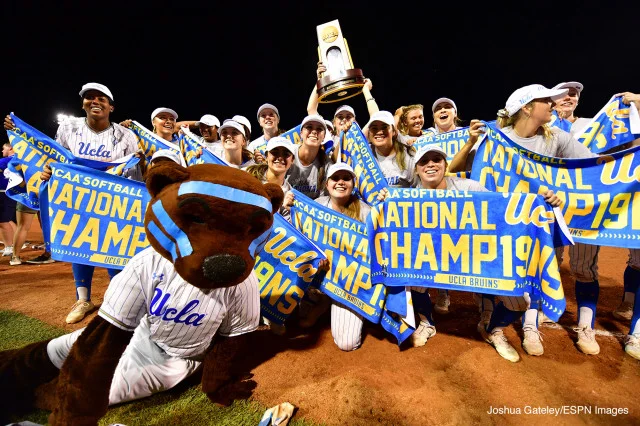
The NCAA's official tournament history identifies 1982 as the first Division I women's softball championship. UCLA, coached by Sharron Backus, defeated Fresno State 2-0 in eight innings in the championship game at Omaha and finished 33-7-2.
The word "NCAA" is essential to that milestone. College softball already had championship competition, and the transition did not erase its earlier history. The NCAA's separate AIAW historical results list Texas A&M as the 1982 Division I champion in Norman, defeating Oklahoma State in the final games. Those results belong to a different governing competition in the same year.
This can confuse fans reading an old team's championship claims. The answer is to preserve the event's identity. An AIAW title is a real achievement, but it should not be silently added to an NCAA championship total. Similarly, a list beginning with NCAA play in 1982 is a list with a defined institutional boundary, rather than a complete account of every earlier college tournament.
The UCLA result also reminds us that a championship game is an actual contest, not just a line in a trophy count. Its eight-inning length places the title decision beyond the regulation seven innings. The final score describes that particular game; it should not be used to make unsupported claims about every team's offense or pitching in an era.
Oklahoma City became the recurring championship stage
The NCAA venue chronology is precise: Omaha hosted from 1982 through 1987, Sunnyvale, California, from 1988 through 1989, and Oklahoma City from 1990 through 1995. The 1996 event moved to Columbus, Georgia, in conjunction with the Atlanta Olympics. The championship returned to Oklahoma City in 1997.
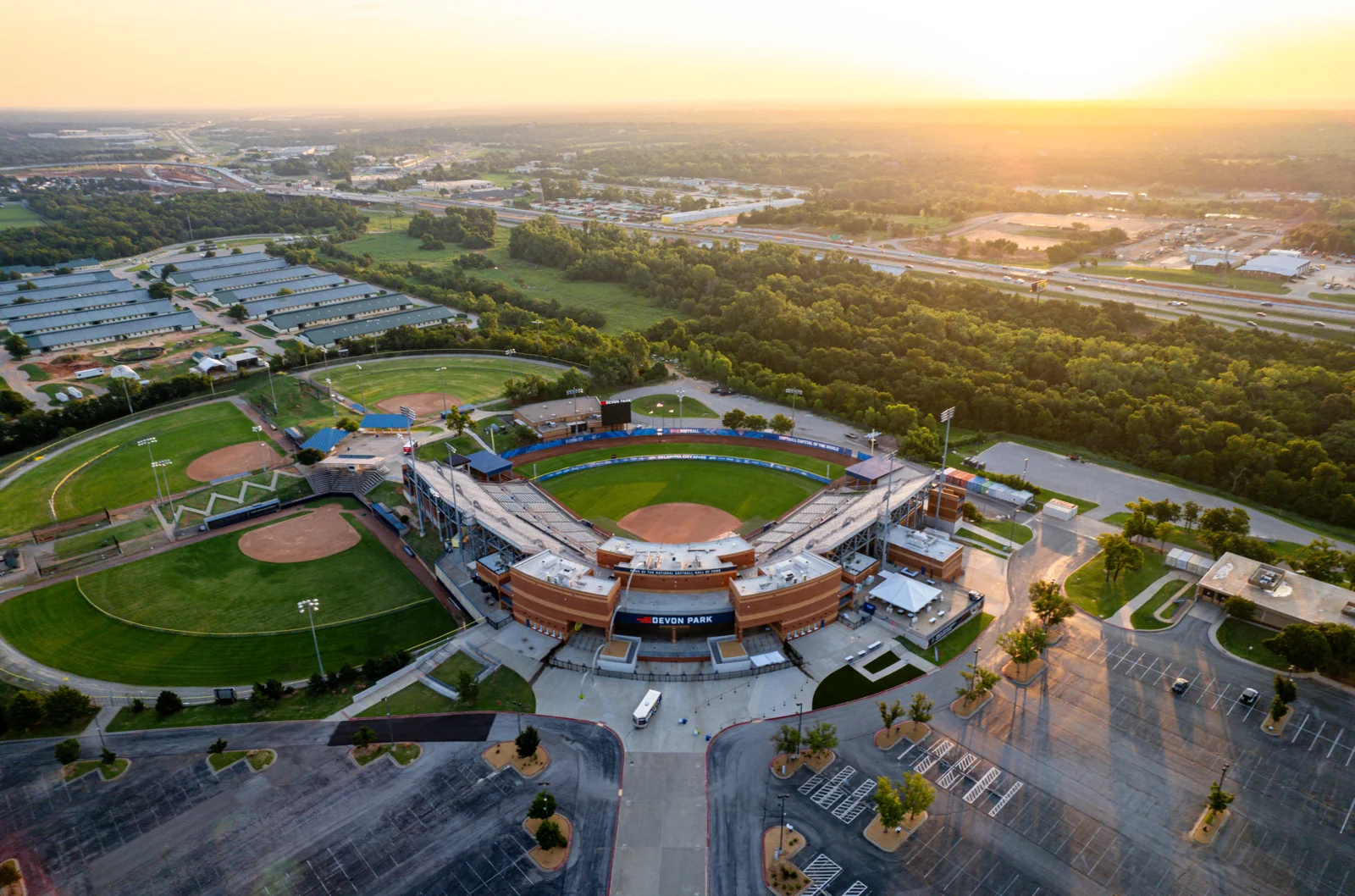
That sequence explains why Oklahoma City is closely associated with the sport without claiming it hosted every college championship. The earlier Omaha and Sunnyvale years and the Columbus exception are part of the record. They also show why the college tournament's location should not be confused with the host city of an international event.
USA Softball's venue information places the complex in Oklahoma City's Adventure District since 1987 and dates its transition to the Devon Park name to May 6, 2024. The facility's presence predates its first NCAA WCWS. A modern name on a map does not mean the championship tradition began when that name was adopted.
A recurring venue gives fans a recognizable destination, but the physical experience can still change. USA Softball documents renovations including an upper deck adding 4,000 seats. Facilities, media space and entrances form part of the infrastructure around the competition. Those changes support a larger event without changing the identity of the earlier games played there.
For a fan arriving today, the setting therefore carries several layers of history: earlier college championship locations, the Oklahoma City tradition and subsequent venue development. Reading those layers separately makes the familiar WCWS backdrop more meaningful than a simple claim that the event has always been the same.
Television and international stars expanded the audience
A strong college competition and a wider public audience reinforce each other, but they are not the same historical measure. Athletes can become familiar through international events, while televised university games give viewers a recurring season to follow. The useful question is how those settings connect without confusing their results.
College careers and Olympic careers reinforce different parts of the story
Softball made its Olympic debut at Atlanta 1996. The Australian Olympic Committee's chronology records its absence from London 2012 and Rio 2016, return at Tokyo 2020 held in 2021, and another absence at Paris 2024. The official LA28 sport page confirms its return for 2028, with the competition in Oklahoma City.
Those Olympic interruptions did not define whether college softball existed. The university season and NCAA championship belonged to a separate competition. The distinction is especially helpful for new fans who encounter the sport during an Olympic tournament and then assume its entire competitive calendar follows the four-year Games cycle.
Lisa Fernandez supplies a concrete connection between the two stages. Her UCLA biography documents a 1990-93 college career with national championships in 1990 and 1992, followed by Olympic gold medals in 1996, 2000 and 2004. Those are two college titles and three Olympic titles, not five NCAA championships.
A familiar player can give a viewer a reason to investigate the university story behind her. That connection helps explain how individual careers can bridge audiences. It does not prove that an Olympic appearance caused a particular college attendance increase, and it does not make a national-team roster equivalent to an NCAA team or tournament field.
A larger audience changes how fans follow the season
Modern broadcast figures offer a dated measure of visibility. In its June 9, 2026 audience report, ESPN said the WCWS averaged 1.6 million viewers across 16 games on its networks, up 20 percent from 2025. The Texas-Texas Tech finals averaged 2.2 million, and Game 2 averaged 2.5 million across ESPN and ESPNU.
Those figures describe different samples. The whole WCWS average, championship-series average and one game's audience should not be exchanged as if they were the same number. They also are not a count of every unique person who followed softball worldwide. Their value is in showing substantial measured demand for a specific broadcaster's completed college event.
For the viewer, wider coverage creates the possibility of following a developing season instead of discovering two finalists at the end. Conference games, regional tournaments and super regionals provide context for the players who arrive in Oklahoma City. A team's strengths and limitations become clearer when its postseason performance is connected to that earlier work.
Access still depends on the actual game and service. A televised event does not imply that every regular-season game is free or carried on the same channel. Use the current TV schedule and viewing guide to match a specific contest with its listed outlet. History explains the growing stage; current listings explain how to follow it.
Reading softball history makes today's college game easier to understand
The most useful history separates questions that a short origin story can blend together. When was the game invented? When did shared rules make broader competition possible? When did women gain stronger college opportunities? Which organization awarded a championship, and where was it played? Each question identifies a different part of the sport's development.
That method improves how fans evaluate a university's past. A program's early national championship may belong to a pre-NCAA competition. A venue may have operated before the WCWS arrived. An internationally famous player may have completed a substantial college career before entering the Olympic stage. These distinctions add detail to the achievement instead of diminishing it.
It also encourages a closer reading of games. UCLA's digitized box-score archive provides access to NCAA-era results beginning in 1982. A box score can identify the actual contest behind a championship memory: who pitched, who reached base and how a result developed. That evidence is more useful than assuming every title was won in the same fashion.
The NCAA statistics and records hub offers another boundary check by separating divisions and different types of historical records. A career total, season record and WCWS-only performance measure different samples. The publication's coverage date also matters when a new season has changed a record that an older volume still lists.
For today's fan, the connection is practical. Use the current schedule to find a contest and the scores page to follow its result, then place the performance within its own season and competition. A modern college game has its own sporting value while also belonging to a tradition shaped by players, coaches, organizers and institutional change.
This account, reviewed on October 1, 2026, follows the route from an early indoor game to a visible college championship. The route is not a straight line of uninterrupted growth. It includes constrained opportunities, changing governance, different championship cities and recurring international absences. Remembering those details makes the current game richer: the crowd, the college uniform and the national stage all have histories of their own.
Join the conversation
Share a question or a thought about college softball. Comments are reviewed before they appear. Keep it friendly and on topic.
No comments yet. Start the conversation.
Sign in with Google to leave a comment. Your email address is not displayed.