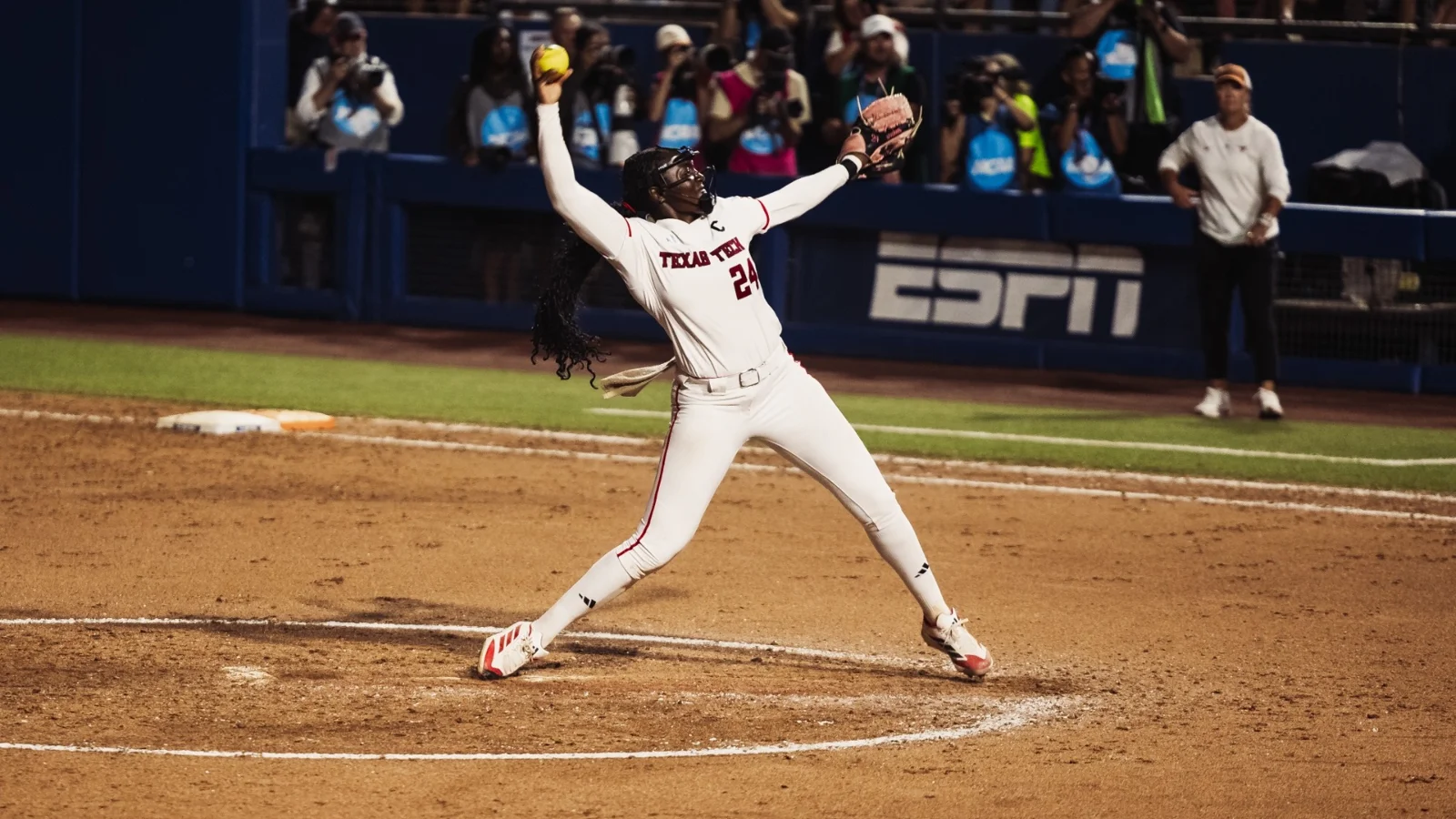
The top college softball pitchers of 2026 should be judged on the season they actually delivered. That means looking beyond a January watch list, a spectacular radar reading or a single elimination game. This is an editorial assessment of leading NCAA Division I women's pitchers and important championship performances, rather than an official numbered national ranking. The useful comparison is how each pitcher combined run prevention, outs, workload and impact against the opposition she faced.
What a 2026 pitcher comparison should measure
First establish the season and the statistical cutoff. A preseason list describes expectations, while a May award announcement can contain numbers recorded before the Women's College World Series. Neither automatically provides final-season statistics. The NCAA statistics portal is a useful starting point, but its displayed date matters as much as the column heading. Use a final school table when discussing a completed season, and label earlier snapshots honestly.
Also check who is being ranked. A recruiting list for the class of 2026 concerns a different population from pitchers competing in the 2026 college season. Division I, Division II, Division III and professional softball have distinct schedules and opponents. This article stays within Division I women's college softball. It does not turn a high-school prospect list into a college leaderboard or treat an athlete's later professional performance as part of her NCAA season.
A great rate needs a meaningful workload
ERA measures earned runs relative to innings, with softball comparisons framed around seven innings. Strikeouts per seven innings offer another rate-based view. The NCAA statistics policies identify the relevant softball categories and qualification requirements. Do not confuse a very low rate in a small role with the challenge of carrying a staff across a full schedule. Both performances can be valuable, but they answer different questions.
Workload needs context too. A large innings total tells us that a team repeatedly trusted a pitcher; it does not prove that every inning had the same difficulty. Look at opponents, starts and relief appearances, walks allowed and whether the pitcher could escape traffic without surrendering the decisive hit. Strikeouts are especially useful because they remove the need for a ball-in-play defensive result. Command helps prevent a dangerous lineup from receiving free opportunities.
Wins belong in the discussion, but should not control it. Run support, bullpen decisions and defense can affect a pitcher's record. A one-run defeat can contain excellent pitching, while an easy win can hide a less efficient outing. The same caution applies to trophies: a national player award can reward hitting as well as pitching. Identify the awarding organization and what the honor recognizes before using it as evidence for a pitching-only comparison.
The shortlist below therefore considers honors, workload, run prevention and postseason responsibility together. It gives special attention to pitchers who shaped the national title race, while keeping a team's finish separate from an individual's quality. Readers looking for team standing can use our college softball rankings; that is a different question from which arm most effectively handled its assigned job.
The award-winning aces who set the standard
Jordy Frahm, NiJaree Canady and Karlyn Pickens belong in a serious 2026 discussion, but their cases are not identical. Frahm supplied two-way value and high-leverage relief, Canady remained central to Texas Tech's title challenge, and Pickens combined swing-and-miss ability with a different workload from her previous season. Their established reputations provide context; the evidence below identifies what actually happened in 2026.
Jordy Frahm and Nebraska's two-way value
Frahm won the 2026 USA Softball Collegiate Player of the Year. At the May 26 announcement, the organization listed a 19–4 record, 1.15 ERA, 225 strikeouts in 163⅔ innings and 12 saves. Those are explicitly the announcement's pre-WCWS figures, not final-season totals. The honor recognizes an overall player; Frahm's hitting should not be silently converted into evidence that she won a pitching-only national award.
Her relief role is especially important to the comparison. A pitcher who can start a major game and then close another gives a coach more options than the starts column alone reveals. Nebraska's updated senior-season account credits her with the school's 12-save record, a 16-strikeout, one-hit regional shutout against Grand Canyon and a ten-inning complete game with nine strikeouts against Arkansas at the WCWS.
Those outings describe range: overpowering a regional opponent, protecting advantages and sustaining a performance beyond regulation against another contender. That combination matters when assessing trust and responsibility. It also explains why a pitching review needs more than a starts leaderboard. Frahm's two-way workload made her overall season distinctive, while her work in the circle stands on its own evidence.
NiJaree Canady and Texas Tech's championship challenge
Texas Tech's completed 2026 biography lists Canady at 29–7 with a 1.87 ERA, 253 strikeouts and a .169 opponent batting average. She made 46 appearances, including 31 starts, earned Big 12 Co-Pitcher of the Year recognition and was named to the WCWS All-Tournament Team. The school lists her on the NFCA second team and on the D1Softball and Softball America first teams; those are distinct selections.
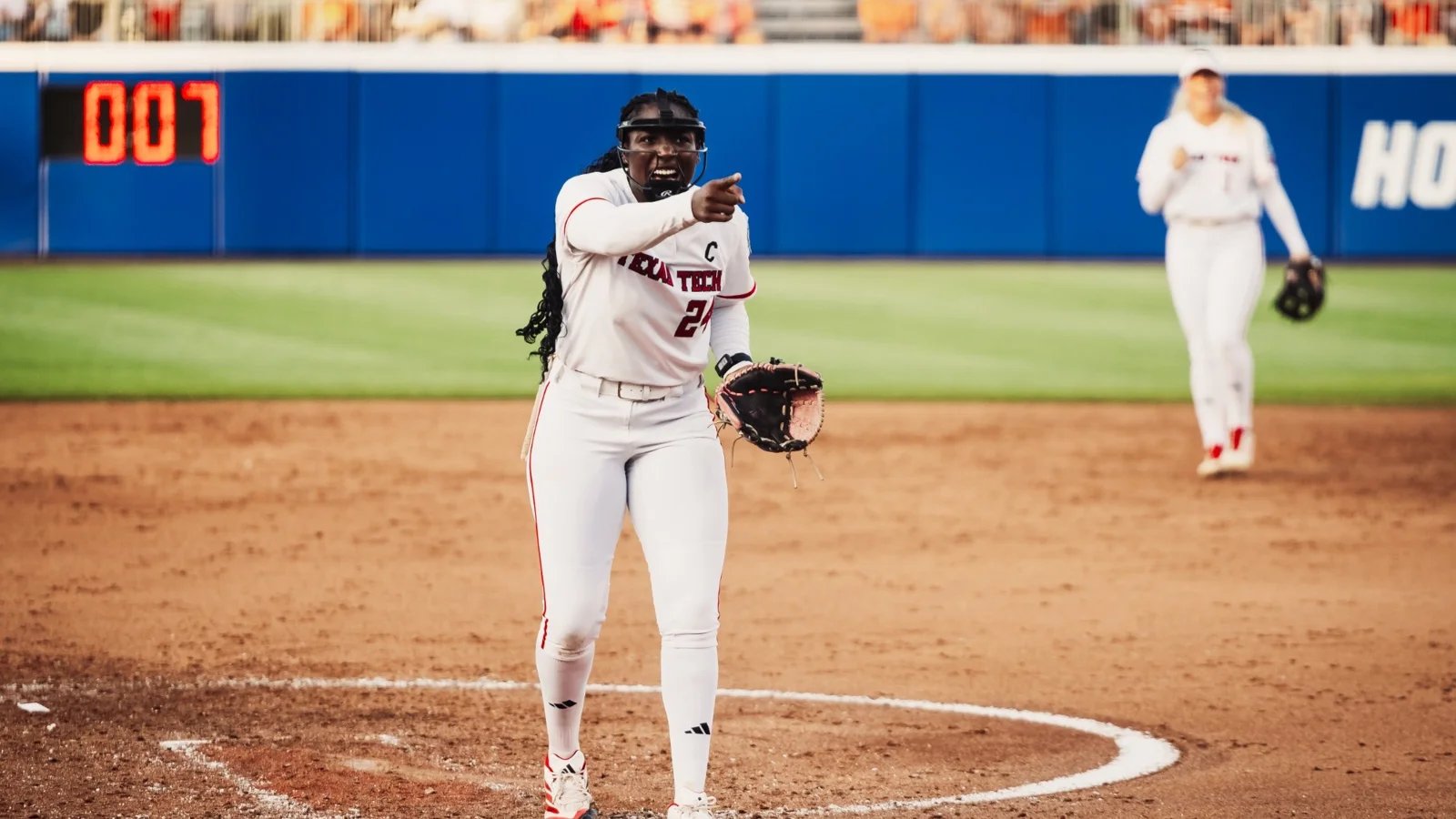
Her case is strengthened by the postseason responsibility behind the aggregate line. Texas Tech's June 2 finals preview credited her with all four Red Raider wins in Oklahoma City entering the championship series. That preview used earlier statistics. The final biography above should control the completed-season totals, while the preview explains how the team reached its last series.
Canady's reputation should neither protect her from comparison nor erase a demanding season. A higher ERA than in another year does not automatically make a pitcher ordinary. Look at the schedule, volume of appearances and leverage of the outs she obtained. Conversely, a famous name does not justify substituting past dominance for present evidence. The 2026 line and the route to the finals are substantial enough to assess directly.
Karlyn Pickens and Tennessee's strikeout threat
Tennessee's final senior-season biography records 148 innings, 194 strikeouts and a 1.70 ERA for Pickens, with 17 starts across 34 appearances. That works out to about 9.18 strikeouts per seven innings, calculated from those school figures. Her ten-strikeout complete game against Georgia in the super regional opener and seven-inning, nine-strikeout regional outing against Virginia provide concrete postseason examples.
The workload is essential. Do not attach her 2025 innings total, radar record or conference award to the 2026 line. Her biography separates those years, and a fair assessment should do the same. The 2026 numbers show sustained strikeout ability in a role with fewer starts than a conventional full-season workhorse might accumulate.
Pickens was also the first overall selection in the 2026 AUSL college draft. That signals professional interest and belongs in career context. It does not settle an NCAA-season comparison by itself. Her college performance remains a combination of actual run prevention, workload and postseason assignments, rather than a ranking automatically inherited from the draft.
Championship pitching is also about roles and depth
A shortlist that stops at the most recognizable aces misses how championships are won. A staff needs effective innings before its best-known pitcher enters, and sometimes it needs a starter to return in relief after a heavy assignment. The 2026 title race offered clear examples. Those roles deserve examination alongside season-long rates, because they show how individual ability becomes a workable tournament plan.
Texas and the value of getting the last outs
Texas's championship report records a 4–1 win over Texas Tech on June 4, completing a second consecutive national title. Citlaly Gutierrez started the clincher, and Teagan Kavan finished it with two perfect innings and five strikeouts. Kavan's final six outs explain why closing can be every bit as consequential as starting. Gutierrez's work gave Texas a platform from which those outs could decide the championship.
The important distinction is contribution rather than celebrity. If a starter keeps an opponent within reach, the offense has time to change the game. If a reliever then shuts down the remaining opportunities, a lead becomes a trophy. Giving all credit to the last pitcher erases the work that made the finish possible; giving all credit to the starter ignores the difficulty of protecting the outcome. An evaluation should account for both.
Kavan's strikeouts in that finish had a specific practical effect: five of the six outs did not require a fielded ball in play. With so little time for Texas Tech to respond, that removed opportunities to exploit a defensive mistake or find a gap. It is a concrete form of dominance, rather than a vague claim that a player “wanted it more.” The performance belongs in a 2026 discussion because the box-score result and the stakes are identifiable.
Gutierrez belongs in the same championship conversation as a role player whose assignment mattered. That does not require calling her the country's best season-long pitcher. It requires recognizing that a staff can win through complementary work. A review of top arms can distinguish the strongest full-season case from a crucial tournament contribution without diminishing either one.
Use our Texas team page for the program's schedule context. When comparing Kavan across years, check that any roster biography or statistics table really belongs to 2026. Older pages can still prominently display 2025 achievements, and a record from a previous title run should not be pasted into the new season's assessment.
Alabama and the demands of the tournament road
Jocelyn Briski's season has a particularly strong institutional award case. Alabama's updated biography lists her as the 2026 D1Softball Pitcher of the Year and SEC Pitcher of the Year. Those organizations should be named; neither title should be relabeled an NCAA national pitching award. Her 2026 workload included 37 appearances and 29 starts.
The postseason detail supports the honors. The school credits her with a complete-game, one-hit shutout against LSU to open super regional play, followed by three scoreless relief innings for a save in the next game. At the WCWS she earned complete-game wins against UCLA and Nebraska. These are specific examples of a pitcher handling both the front end and the final portion of important contests.
That sequence is valuable because tournament opponents get repeated opportunities to adjust. A pitcher who can remain effective through a complete game and return in another role offers tactical flexibility. It does not mean that she can be used indefinitely or that a later defeat invalidates everything before it. Briski's season should be read as a body of work: league recognition, repeated trusted assignments and major postseason wins.
For Alabama, the comparison is therefore more substantial than a single highlight or a name on a preseason list. Briski supplied evidence against demanding opponents at the point when the schedule became least forgiving. Fans can debate where to place that case relative to Frahm, Canady, Pickens and Kavan, but excluding it would leave a major part of the 2026 pitching story unexplained.
How to compare these pitchers without flattening their seasons
Canady and Pickens offer the cleanest comparison within this shortlist because both schools publish completed 2026 pitching summaries. Pickens finished with the lower ERA, 1.70 against Canady's 1.87; Canady produced 59 more strikeouts and appeared in 12 more games. Those facts point in different directions. The smaller ERA describes run prevention per unit of pitching, while the larger strikeout total describes accumulated outs. Neither erases the other.
| Completed 2026 school summary | ERA | Strikeouts | Appearances / starts |
|---|---|---|---|
| NiJaree Canady, Texas Tech | 1.87 | 253 | 46 / 31 |
| Karlyn Pickens, Tennessee | 1.70 | 194 | 34 / 17 |
The role difference is striking. Subtract starts from appearances and Canady had 15 nonstarting appearances; Pickens had 17. That is an arithmetic description of their school summaries, rather than a claim that every relief appearance involved the same situation. Canady was used as a starter in roughly two-thirds of her outings, while Pickens started exactly half. A season built around repeated starts asks a pitcher to navigate a lineup from its first plate appearance. A season with more frequent relief work also asks her to enter somebody else's game, potentially with runners already aboard.
Pickens' 194 strikeouts across 148 innings translate to about 9.18 per seven innings. That gives her swing-and-miss production a useful scale: more than nine outs in a regulation game's worth of pitching, on average, came without a ball put in play. Her strikeout total was smaller than Canady's, but it would be poor evaluation to treat the difference as 59 extra instances of superior pitching without knowing the workload behind it. Tennessee's completed-season profile supports the rate; Texas Tech's Canady profile supplies the separate totals.
Frahm adds a different kind of comparison. Nebraska's May 26 award report had her at 234 strikeouts against 30 walks, alongside 12 saves. That school snapshot is later in its statistical accounting than the USA Softball figures discussed above; neither is presented here as her final season line. The combination describes a pitcher who could suppress free baserunners and also finish games. For a coach protecting a narrow lead, preventing the walk matters because a runner can reach scoring position without the opposing lineup first solving the pitcher with a hit.
Briski's 29 starts in 37 appearances lean toward a sustained starting role, yet her LSU super regional also included a save. Kavan's last two innings against Texas Tech demonstrate the other end of the spectrum: six perfect outs to finish the championship. The point is not that finishing automatically outweighs starting. Texas needed Gutierrez to keep the game reachable before Kavan could close it, just as Alabama needed Briski to absorb substantial early-game work before her relief value became relevant.
Maya Johnson deserves a place in the wider comparison too. Belmont's ace won the 2026 Portolite/NFCA Division I Pitcher of the Year. The NFCA reported her concluded season at 28–3 with a 0.78 ERA and 397 strikeouts in 215⅔ innings, about 12.9 per seven. That combines a lower ERA and a higher strikeout total than the Canady and Pickens school lines above, without proving that every opponent or assignment was equivalent. Johnson's complete-game road wins over Georgia and Mississippi State give the case concrete evidence beyond her conference label. Her season asks a serious evaluator to examine the whole schedule rather than dismiss a pitcher because Belmont attracts fewer prime-time broadcasts. The NFCA honor recognizes a different winner from D1Softball's Briski selection, so neither should be recast as the single official NCAA pitching award.
For a fan choosing a pitcher to build around, Canady's repeated starts and championship-round path, Pickens' strikeout rate, Frahm's control and two-way contribution, Briski's starter-to-finisher flexibility, and Kavan's title-deciding execution are distinct answers to distinct softball problems. A useful 2026 discussion lets those differences stay visible. The strongest judgment explains the assignment and the evidence, instead of making the trophy or a single column carry the entire argument.
Join the conversation
Share a question or a thought about college softball. Comments are reviewed before they appear. Keep it friendly and on topic.
No comments yet. Start the conversation.
Sign in with Google to leave a comment. Your email address is not displayed.