
Buying Women's College World Series 2027 tickets starts with two decisions: which part of the tournament you want to attend, and how much uncertainty you can accept before the teams qualify. A listing that says “WCWS” can cover a single session, an entire tournament package or hospitality with a seat. Those are different purchases. This guide explains how to compare them without confusing an advertised resale offer with an official price or an announced ticket release.
Start with the official 2027 ticket status
As checked on October 1, 2026, the NCAA ticket hub identifies Devon Park in Oklahoma City and offers registration for 2027 information. It does not provide a complete, confirmed 2027 price table. Its single-session card says tickets are coming in the fall. However, the same page contains June 3–10 date cards alongside an introduction stating June 3–11. June 3 is the consistent starting date; verify the final event dates before committing to nonrefundable travel.
There is also a difference between a release window and an appointment. “Fall” does not tell a buyer the hour a sale opens, which sections are included or whether a presale has eligibility conditions. Put those questions on your checklist rather than filling the blanks with last year's experience. An account created ahead of time, a working payment method and a clear session preference will help when the actual offer arrives. None of those preparations requires treating a pending release as available inventory.
Do not infer the full purchase schedule from a generic frequently asked question. Event pages can combine current product cards with broader advice that applies across years. When their timing differs, use the live 2027 offer and its terms as the buying authority. Save the confirmation for the specific product you purchase. A screenshot of an overview page cannot substitute for an order that spells out the session, section and delivery method.
Official tickets and marketplace listings answer different questions
Start from the NCAA hub when looking for the primary offer or official hospitality. A third-party marketplace may display a 2027 event before every official option is public. That tells you that the marketplace has a listing. It does not establish that a general sale has begun, that the displayed amount is the original face value or that every advertised package has identical coverage. Read the actual ticket description instead of judging the product by the event name alone.
For a buyer, the useful distinction is evidence. An official release answers who is selling the original product and what it includes. A resale order answers which ticket a seller is offering, its delivery conditions and the amount you will pay that seller through the platform. Either route needs scrutiny. Even an appealing price is poor value if the listing covers the wrong session, separates your group's seats or cannot be delivered in the way your itinerary requires.
Registering for information is a sensible first move, but registration is not a reservation. Treat your plans as provisional until a completed order confirms the tickets you need. Fans who want to support one school should be especially cautious about making a large early commitment: a trip to the national championship is easier to plan than a guarantee that a particular team will still be playing when you arrive.
Choose the sessions that match the softball you want to see
The NCAA's Division I championship page lists the 2027 event window as June 3–11. That is the championship window, not a promise that one ticket provides admission on every date. A ticket session is a product with its own coverage. Before buying, identify the session number or label, the scheduled start and the games included. The complete 2027 ticket-to-game map needs confirmation from the released offer.
Opening-round coverage versus the championship series
The WCWS uses double elimination to identify its championship-series contenders. The 2025–26 championship manual shows the familiar best-of-three finals and conditional games. Use that structure to understand buying choices, while waiting for the actual 2027 grid. The opening phase is the better fit if you want to see more of the field. The finals concentrate the stakes into a confrontation between the two survivors.
These experiences reward different kinds of fans. Early tournament coverage offers the chance to compare pitching approaches, defensive speed and lineup construction across several contenders. It is attractive to a neutral fan who enjoys the sport regardless of which school advances. Finals tickets suit a buyer who wants to watch a title decided, accepts a narrower selection of teams and is comfortable planning around the possibility that a deciding third game will not be required.
Conditional games deserve a separate question at checkout: what happens to this particular ticket if the game is unnecessary? Do not assume another platform's policy applies or that the word “finals” means three guaranteed games. Also distinguish an unnecessary game from a delayed game. One concerns whether the contest occurs; the other concerns when it occurs. Read the offer's provisions for each situation before calculating value per game.
All-session packages and the limits of a team-specific plan
An all-session label is useful only after you inspect its boundaries. Ask whether the package includes the championship series, conditional sessions and the same seat throughout. Check whether hospitality is bundled or sold separately, and whether the order issues individual session tickets. The appeal is continuity: you can follow the tournament's story without repeatedly shopping for the next round. The tradeoff is paying for coverage you may not use if you attend only a weekend.
A team follower has a different problem. In October, no fan can buy certainty that a school will reach Oklahoma City or survive to a particular session. Even after the field is set, the bracket can send a team down another path. Plan around the amount of softball you would enjoy after an early exit. If the answer is “very little,” a smaller initial commitment may fit better than a tournament-wide purchase.
There is no universally best package. Compare the sessions you can realistically attend, not the maximum number advertised. A working parent who can make two evenings and a neutral fan staying through the final out have different needs. Write those needs down before opening seat maps; otherwise a visually impressive package can distract from the simple question of whether it covers your actual trip.
Build a budget without mistaking a resale quote for a face value
There is no verified 2027 primary-price table to reproduce here. A marketplace amount is a seller's offer at the time you see it. It can help you understand what that particular option costs, but it should not be reported as the NCAA's standard admission price. Likewise, an inexpensive ticket for one session does not establish the cost of attending the championship series or the whole tournament.
Build the budget from the outside in. First decide your total limit for the trip. Reserve money for lodging, travel, meals and transport to the park; then see what remains for admission. Fans who begin with the most attractive seats sometimes discover that they have bought a ticket they cannot comfortably afford to use. A cheaper seat on a practical itinerary can provide more actual softball than a premium seat combined with travel you have to cancel.
Hospitality deserves its own line in that calculation. It is an additional experience with specific inclusions, rather than a synonym for a better view of the field. Evaluate what you will use: a meal, a place to spend time before the game or another stated benefit. Compare the package price with ordinary admission plus the extras you would otherwise purchase. The result depends on your party's priorities, not on how prominently the package appears on a sales page.
Compare the same seat, session and total checkout cost
Vivid Seats describes its all-in pricing as including service and delivery charges. That is helpful, but compare the final total for your actual quantity, including any applicable taxes. Check whether an amount is per ticket or for the whole group. A four-seat purchase should be compared with another four-seat purchase, not with the cheapest single seat visible in a search result.
Consider a purely hypothetical example: two offers total $160 and $180 for a pair of tickets. The first covers one session and the second two sessions you can attend. The smaller checkout amount is still less spending, but the second may provide better coverage for your plan. These figures are an illustration, not quoted 2027 prices. The point is to compare cost against usable admission rather than sorting every listing by a headline number.
Then examine what happens if plans change. StubHub's buyer guidance separates cancellation from postponement and directs buyers to the applicable order policy. A school's elimination is a different situation: the tournament session can still take place. Do not budget on the assumption that disappointment with the matchup creates a refund right. Read the specific conditional-game and schedule-change terms before paying.
Save the order description, total and delivery promise together. Those details make later questions easier to resolve, especially when a package title is broad. Avoid assuming that you can recover the entire purchase by reselling unused sessions; a listing is an offer to another buyer, not a guaranteed sale. A sound budget works even if you keep every ticket you purchased.
Seats, parking and travel change the value of a ticket
Devon Park is at 2801 NE 50th Street in Oklahoma City, according to USA Softball's venue information. The address gets you to the complex; it does not establish where a WCWS visitor may park in 2027. Keep admission, parking and transport as separate planning questions. Check the event's current instructions before choosing a route or assuming that a stadium ticket includes vehicle access.
Decide what matters from your seat
Closer is not automatically better for every softball fan. A low position can emphasize velocity, the speed of a throw across the diamond and the reactions around home plate. An elevated view can make defensive positioning, outfield routes and the shape of the whole field easier to follow. Decide what you enjoy watching, then compare the actual seating map and listing details. Do not pay a premium merely because a seat sounds close without checking its angle.
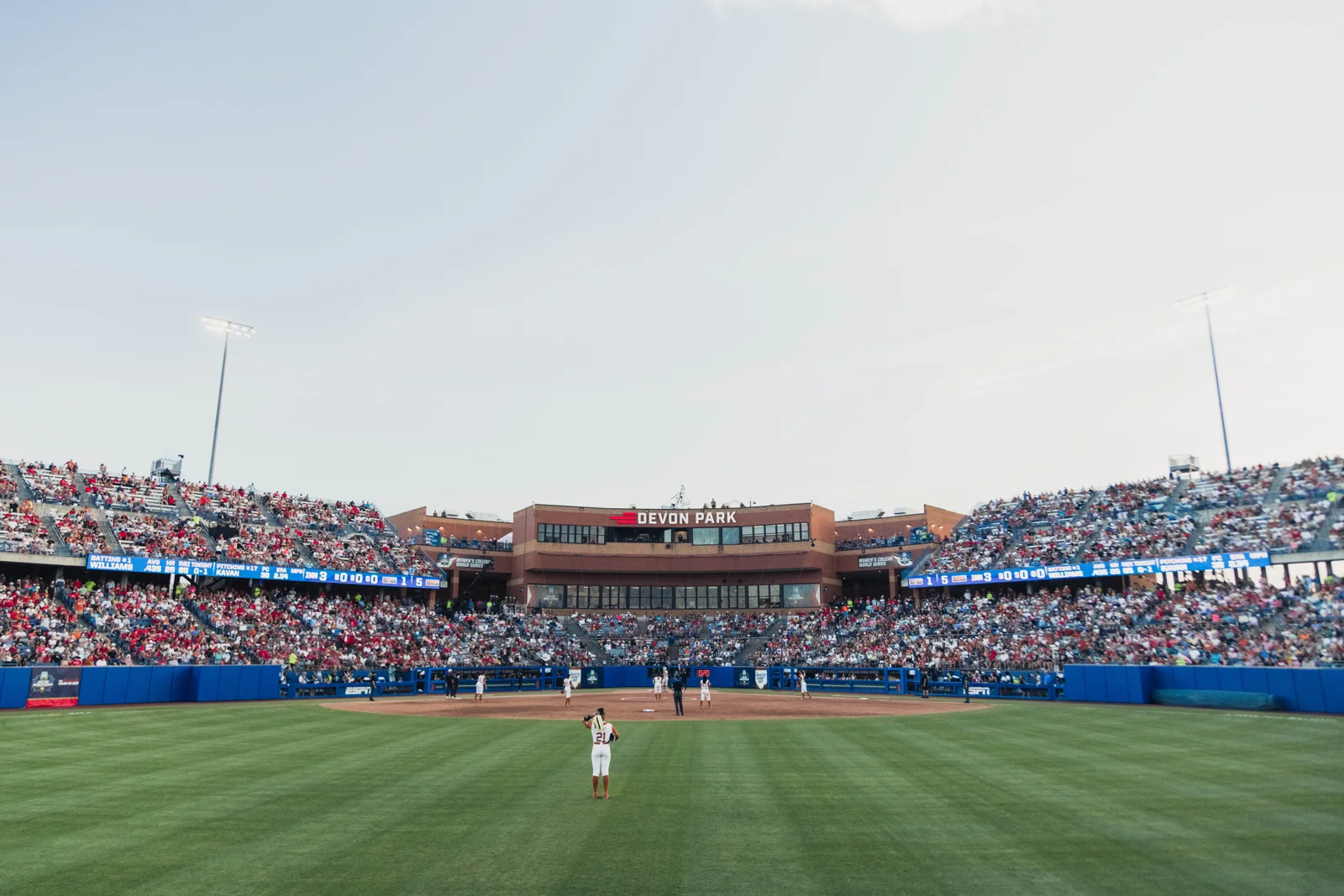
For a group, adjacency can matter more than a small difference in row. Confirm whether every seat is together and whether any restrictions appear in the description. For accessible admission, work with the event's ticket seller and venue before making a purchase that depends on particular access. USA Softball provides accessibility information and a contact on its venue page; that is the starting point for confirming needs, not proof that a specific resale seat meets them.
Comfort is also personal. Consider stair use, the amount of time you expect to spend seated and whether your party can manage a long session. Verify bag rules and re-entry for the specific championship rather than importing a policy from another event at the same park. A good seat loses practical value if the rest of the visit does not fit your family's needs.
Keep travel flexible until the field and first pitches are set
Use Visit OKC's WCWS planning hub to orient your trip, then verify the event details tied to your purchase. A hotel near an attraction is not necessarily the easiest base for reaching the park. Compare total transport time and cost alongside the room rate. Ask how you would get back after a late finish, not just how you would arrive before the first pitch.
If your itinerary depends on a particular school, read lodging and travel change conditions carefully. A ticket to a continuing tournament session may remain usable even after your team is eliminated, while your reason for staying has changed. That is a personal planning risk. It is better to know the cost of changing a reservation before a dramatic loss than to discover it while leaving the stadium.
Leave breathing room around arrival and departure. A published first pitch is a start time, not a promised finish time, and a conditional game can affect the amount of softball left to play. Until the 2027 session grid and transport arrangements are confirmed, avoid building an itinerary that works only if every detail follows an assumed timetable.
A practical purchase sequence for 2027
Begin by choosing the kind of visit you want: a short look at the opening field, several days following the bracket or the championship series. Set a total trip budget and identify who needs adjacent or accessible seating. Then register through the official hub for the relevant release information. These steps give you a decision framework before inventory and prices start competing for your attention.
When an offer becomes available, read the product description all the way through. Confirm the year, venue, session coverage, seat location, party quantity and complete amount. Check delivery and conditional-game terms. If one of those details is unclear, resolve it before purchase; an attractive seat map cannot tell you whether the order fits your travel dates. Choose the package that answers your requirements rather than one that simply looks like the most comprehensive option.
After ordering, verify the account that will hold the ticket. The NCAA's linked AXS mobile guide tells users to sign in with the email used at purchase. Follow the access instructions associated with your own order, especially if tickets were bought for another person or transferred later. Establish access before the trip, and confirm that the person approaching the gate can display the valid ticket in the required system.
Do not rely on a purchase receipt alone as an admission credential. A confirmation email, a marketplace order and the usable mobile ticket serve different purposes. Know where to find each, and keep the seller's support route available if delivery needs attention. Prepare your phone for the day: a charged battery, working login and the requested application are small details that prevent avoidable trouble at the entrance.
If you later need another session, check the official release and any current NCAA Ticket Exchange options before comparing other offers. Its existence is not a promise of WCWS inventory on a particular day. Apply the same coverage and total-price checks to the second purchase as to the first. Buying quickly after a team's win is understandable; buying the wrong session is still costly.
Finally, recheck the bracket, first pitch, venue instructions and transport immediately before attending. Share the plan with your party so everyone understands which admission they hold. If the trip does not work out, use our TV schedule and watching guide when the actual broadcasts are listed. The best purchase is one that gives you the softball you want, at a total cost you understand, with enough flexibility for a tournament that has yet to unfold.
Join the conversation
Share a question or a thought about college softball. Comments are reviewed before they appear. Keep it friendly and on topic.
No comments yet. Start the conversation.
Sign in with Google to leave a comment. Your email address is not displayed.