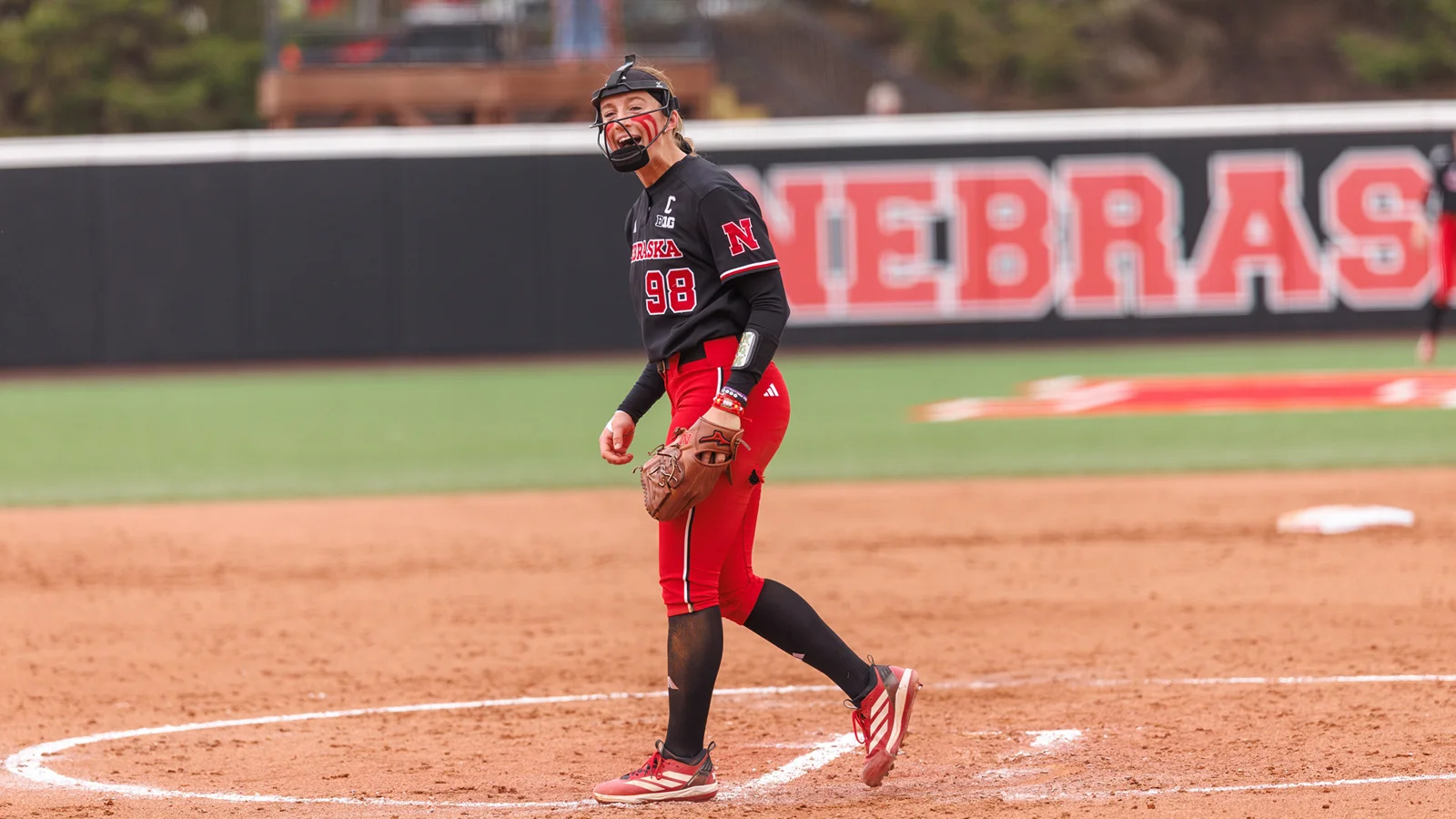
The 2026 college softball awards have several different winners because they recognize different things. Nebraska's Jordy Frahm won USA Softball's collegiate player award, the NFCA Division I player award and the Honda Sport Award for softball. Belmont's Maya Johnson won the Portolite/NFCA Division I pitching honor, while Alabama's Jocelyn Briski received D1Softball's pitching award. A useful awards guide names the organization, explains the scope and keeps season honors separate from the Women's College World Series.
Which organizations give college softball's major awards
There is no reason to compress every “Player of the Year” headline into one unnamed trophy. USA Softball, the National Fastpitch Coaches Association, the Collegiate Women Sports Awards and specialist publications have their own honors. Conferences add league awards, while a tournament can recognize its outstanding performer. The awarding body's name is part of the result, as essential as the athlete's school and the season.
The USA Softball award hub describes a narrowing process from a preseason watch list to 25, ten and three finalists. Its voters include previous winners, coaching representatives and media members. Crucially, the published policy says voting concludes after the top-ten vote to keep postseason play from influencing the regular-season award. The announcement occurs near the WCWS, but that does not make the WCWS the voting sample.
That timing explains a common fan disagreement. An ace can deliver the best performance in Oklahoma City after the selection has already been determined. Her tournament performance may strengthen her broader season résumé, but it cannot retrospectively change a ballot that was closed under a different rule. The question “who had the best WCWS?” should receive its own answer rather than being used to rewrite a regular-season honor.
The NFCA's 2026 announcement identifies separate player and pitcher awards. It also describes selection by the Division I All-American Committee, with one head coach representing each of its ten regions, and eligibility tied to first-team All-America recognition and the athlete's head coach being an NFCA member. Those are stated award conditions. They should not be replaced with the assumption that every honor is selected by the same national fan vote.
The Honda Sport Award introduces another distinction. Nebraska's Honda finalist announcement explains that administrators at more than 1,000 NCAA member schools vote, with each institution receiving a vote. The softball winner becomes eligible for the broader Collegiate Woman Athlete of the Year and Honda Cup. Winning the softball award therefore does not mean automatically winning the overall, cross-sport Cup.
These distinctions give a fan a better way to read a résumé. An overall player award can reward two-way value. A pitching award concentrates on work in the circle. A coach-selected honor and a publication's editorial selection can disagree without one becoming imaginary. Read the exact award before deciding what the disagreement says about the athletes.
This guide concerns the completed 2026 NCAA Division I women's season. Division II and Division III have their own honors; high-school recruiting rankings and professional awards belong to different competitions. Our team rankings also answer a different question. A ranked team can contain an award winner, but a poll position is not an individual trophy.
The 2026 national winners and what their honors recognize
The most useful winner list pairs the athlete with the precise honor. Frahm's overall-player recognition, Johnson's pitching awards and Briski's separate publication honor describe distinct assessments of the same college season. They provide a starting point for evaluation, rather than a single ranking that can be reconstructed by counting the headlines.
| 2026 honor | Winner | College |
|---|---|---|
| USA Softball Collegiate Player of the Year | Jordy Frahm | Nebraska |
| NFCA Division I Player of the Year | Jordy Frahm | Nebraska |
| Honda Sport Award, softball | Jordy Frahm | Nebraska |
| Portolite/NFCA Division I Pitcher of the Year | Maya Johnson | Belmont |
| Softball America Pitcher of the Year | Maya Johnson | Belmont |
| D1Softball Pitcher of the Year | Jocelyn Briski | Alabama |
Jordy Frahm's player-of-the-year recognition
Nebraska announced Frahm's USA Softball award on May 26. The NFCA named her its Division I player winner on May 27, and Nebraska's June 11 announcement confirmed the Honda softball honor. The dates matter because the first two announcements preceded the completed WCWS, while the Honda release could describe the finished season.
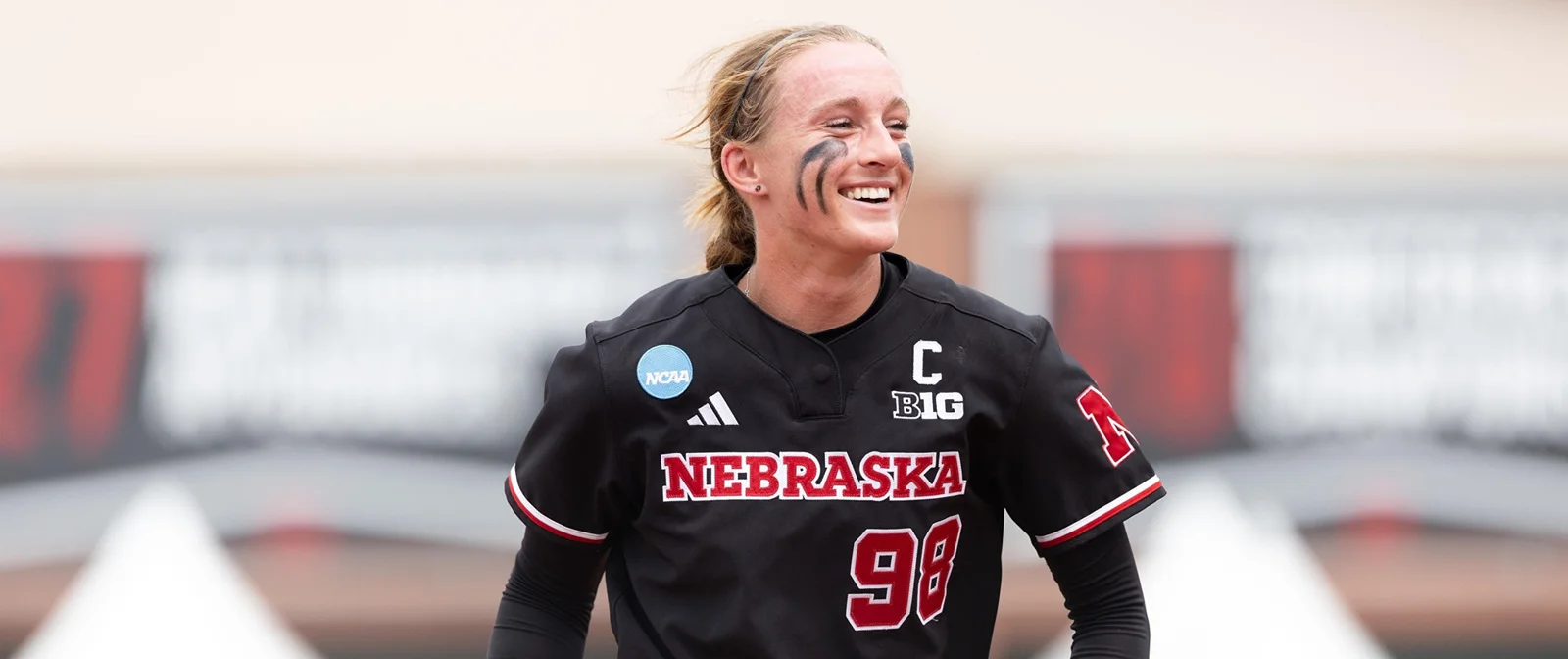
That June 11 school account records a final 21–6 pitching record, 1.37 ERA, 251 strikeouts against 33 walks and 12 saves. At the plate, Frahm hit .403 with 20 home runs and 51 RBI. These are completed-season figures from the school, not the earlier statistical snapshots embedded in the May awards releases. They show why an overall player honor fits her case: Nebraska received substantial production both in the circle and in the batting order.
Two-way value is more than putting two impressive lines next to one another. A pitcher who also supplies middle-order offense changes how a coach can construct the lineup and cover innings. Her team does not have to choose between an effective arm and an important bat whenever both roles can be accommodated. The exact deployment still depends on the lineup rules and the game situation, but the value is broader than a pitching-only rate.
The final figures also describe different forms of pitching contribution. Strikeouts and a low ERA explain effectiveness; saves show that some of the work involved protecting games already in progress. A player award can recognize that range alongside offensive production. It would be misleading to remove the hitting component and then claim the award proves that Frahm was selected as the nation's best pure pitcher by every organization.
The NFCA's historical winner table calls the 2025 player winner Jordy Bahl and the 2026 winner Jordy Frahm. They refer to the same Nebraska athlete's consecutive recognition under the names used in the respective seasons. A searcher encountering both names should check the year rather than mistakenly treating them as two different players. This is relevant to the award record, without requiring speculation about private circumstances.
The national pitching honors and their separate winners
Johnson won the Portolite/NFCA Division I Pitcher of the Year. The May 27 release described her concluded season at 28–3 with a 0.78 ERA and 397 strikeouts in 215⅔ innings. Missouri Valley Conference coverage also confirms her Softball America pitching honor. These are named national awards, not honors limited to Belmont's conference.
Johnson's statistics explain why her case deserves attention beyond the most televised programs. A smaller conference label does not make 397 strikeouts disappear. At the same time, evaluating a pitcher across conferences should consider the schedule and the innings behind a rate. Her award supplies an institutional judgment; a fan comparing her with another ace should still examine what that ace was asked to do and against whom.
Briski received D1Softball's Pitcher of the Year recognition, recorded in Alabama's official biography. The school lists 37 appearances and 29 starts in 2026. That role placed her repeatedly at the front of Alabama's pitching plan, and her résumé belongs in a discussion of the major arms of the season. Her honor should be credited to D1Softball, while Johnson's NFCA and Softball America awards retain their own names.
The disagreement creates a useful softball question: how should an evaluator balance rate dominance, workload and opposition? It does not authorize inventing a consensus trophy that neither organization awarded. Fans can prefer one case, but the official record of who won each honor is already specific enough to report accurately.
Conference honors and postseason recognition answer different questions
A league's awards narrow the field to its members, while a tournament honor narrows the evidence to a particular event. Both can be prestigious without being national season awards. The 2026 results give fans several concrete examples of why the labels matter, especially when comparing players whose schools faced different conference schedules.
League awards describe a conference race
Katie Stewart of Texas was the SEC Player of the Year, while Alabama's Jocelyn Briski won SEC Pitcher of the Year. Frahm's Nebraska résumé includes Big Ten Pitcher of the Year. These are separate conference competitions, so one athlete's winning a league honor does not imply that the voters ranked her above every player outside that league.
The Big 12 supplied a particularly useful contrast. Its May 6 awards announcement named Arizona's Sydney Stewart Player of the Year and gave the pitching honor jointly to Oklahoma State's Ruby Meylan and Texas Tech's NiJaree Canady. Sydney Stewart and Texas's Katie Stewart are different athletes at different programs. Mixing those names would change the winner, not merely the spelling of the citation.
The co-pitching award also illustrates why a league evaluation can recognize different forms of value. The Big 12 release lists Meylan with 115⅔ innings in conference play, compared with Canady's 68⅓. It credits Canady with a 1.54 conference ERA and Meylan with 1.57. Those are conference-schedule numbers, not completed national-season statistics. Their proximity in ERA alongside the different workloads creates a real discussion about efficiency and how many outs a pitcher supplied.
That comparison is richer than assuming a tie means the voters could not decide. A pitcher who prevents runs across more innings addresses a substantial staff need; one who produces a slightly lower rate over a different role also has a strong case. The award announcement does not publish each voter's reasoning, so the role comparison here is an editorial interpretation of the disclosed statistics, rather than a reconstructed ballot.
The Big 12 states that coaches voted on season awards and could not vote for their own players. Knowing that procedure helps a reader understand the institution behind the result. It still does not establish a national conversion formula between an SEC, Big Ten and Big 12 honor. For program context, use our SEC page and Big 12 page, while preserving the scope of each award.
The WCWS Most Outstanding Player is a tournament honor
Texas pitcher Teagan Kavan was the 2026 WCWS Most Outstanding Player, as documented in the school's championship report. Her WCWS line was 4–1 with a 1.47 ERA, two saves and 30 strikeouts across 33⅓ innings. That is a tournament performance, not her full-season pitching line.
Her closing assignment in the clincher makes the recognition tangible. Kavan delivered two perfect innings with five strikeouts as Texas beat Texas Tech 4–1 on June 4. The last six outs completed the championship, while the earlier work of Citlaly Gutierrez helped put Texas in position to finish it. Tournament honors can recognize the decisive concentration of performance without claiming that one player did every job herself.
Kavan's award and Frahm's player honors therefore belong beside each other rather than in a contradiction. One recognizes an outstanding WCWS; another was determined through a season-award process with a published voting cutoff. The different answers become clearer when the dates and assignments remain attached to the names. Removing those labels makes the 2026 story less accurate and less interesting.
How fans should read a 2026 awards résumé
Read Frahm's award stack as evidence of broad agreement about her overall contribution, rather than proof that every organization awarded her every category. Her player honors recognize a season that combined pitching and offense. Johnson's pitching awards and Briski's D1Softball honor describe different assessments focused on the circle. Kavan's WCWS distinction describes a decisive tournament. All four cases can be reported together without merging their criteria.
Florida State shortstop Isa Torres supplies another major national answer. The Seminoles' May 27 announcement confirms her as D1Softball's 2026 National Player of the Year. That honor belongs to Torres, while Frahm retains her USA Softball, NFCA and Honda softball awards. Comparing a shortstop's offensive and defensive contribution with a two-way pitcher's value requires an evaluator to decide how much each job matters. The different selections show why “national player winner” needs the awarding body's name. They do not turn Torres into a USA Softball winner or Frahm into D1Softball's selection.
All-America selections add another layer. The NFCA's 2026 announcement named 54 athletes from 30 institutions across three teams. It identified Frahm's unanimous first-team Joan Joyce Utility/Pitcher selection and Oklahoma's Kendall Wells as the Diamond Sports/NFCA Division I Catcher of the Year. A position-specific team selection recognizes an assignment; it is not automatically the same thing as finishing in a numbered national player ranking.
That distinction is particularly useful when discussing two-way athletes and catchers. A utility/pitcher slot allows an evaluator to recognize combined work. A catcher honor focuses attention on an athlete selected at that position. The names and roster slots help explain what the selection represents. A generic statement that somebody was “an All-American” leaves out information a fan needs to compare two résumés properly.
Likewise, finalist status has to remain attached to the correct award. Frahm won the Honda softball award and reached the overall Honda Cup's top three. The 2026 Honda Cup went to UCLA basketball player Lauren Betts. A softball article that calls Frahm the Cup winner because she won her sport would change a confirmed cross-sport result. The progression from sport winner to overall finalist is part of the achievement, not a detail to omit.
For a pitching debate, use the award as one piece of evidence and then return to the work. Johnson's low ERA and large strikeout total make a rate-and-production case. Briski's repeated starting assignments belong in a workload-and-opposition discussion. Frahm's final line includes closing as well as starting value, while her batting production strengthens the overall-player case. Kavan's final six championship outs make the tournament argument concrete. These are different forms of excellence worth watching for in the next season.
Timing remains especially important when reading the numbers beside the trophies. A May release can show a correct snapshot that differs from June's final school account. The difference does not require choosing whichever figure makes the athlete look better. Label the date, preserve the scope and compare like with like where the records allow it. A final stat line can explain the completed season without pretending it was available when an earlier ballot closed.
Fans following the next award race can use the games today page and watching guide to see the performances that build a résumé. Watch lists are useful introductions; they are not future results. The 2026 winners above are confirmed outcomes with named awarding bodies. Their differences make the season easier to understand when the numbers, roles and voting windows stay visible.
Join the conversation
Share a question or a thought about college softball. Comments are reviewed before they appear. Keep it friendly and on topic.
No comments yet. Start the conversation.
Sign in with Google to leave a comment. Your email address is not displayed.