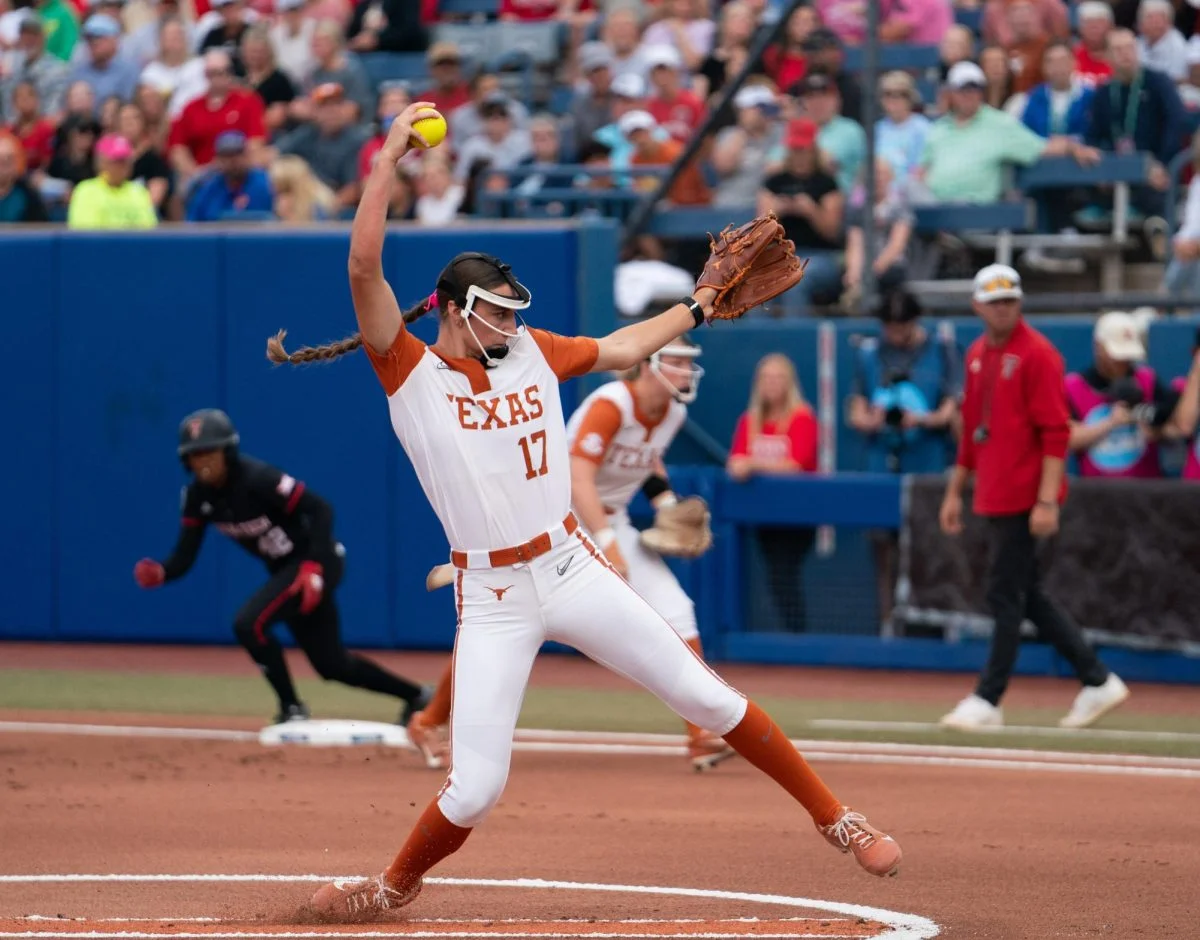
College softball limits conferences and the time between pitches, but those are separate systems. Seven conferences does not mean only seven interruptions can occur, and a 20-second pitching rule does not promise that every stretch of a telecast will contain a pitch. Understanding who is talking, why time was granted and which allowance applies makes the pauses easier to follow.
This guide explains the NCAA's 2026–27 rules as checked on October 31, 2026. It concerns college softball rather than a high school rule remembered from a different competition.
Why a pitch clock does not eliminate every pause
The viewer's question is understandable. During the 2026 Women's College World Series, a fan discussion about timeouts asked why teams seemed to meet so often and whether substitutions explained some of the breaks. Replies mixed references to NCAA and high school rules. That is evidence of a real question, not evidence that a particular college team exceeded its allowance.
The key is to identify what a rule measures. Time between pitches, opportunities for a coach to consult with players and the overall time you spend watching are related experiences, but they are not the same count. A rule can shorten one routine without prohibiting a legitimate stoppage elsewhere.
Think about watching the pitcher prepare for the next delivery. That is one kind of interval. Seeing the umpire suspend play so an issue can be handled is another. The NCAA rulebook's suspension-of-play provisions recognize justified stoppages while rejecting requests that are obvious delay tactics. A hand raised by a player and a suspension actually granted by an umpire should not be treated as identical events.
There is still room to debate entertainment value. A fan may reasonably find repeated consultations frustrating even when the conferences are permitted. But deciding whether a sequence feels slow is different from demonstrating an illegal conference. The latter requires the right rules, the right category and enough information to know what has already been used.
Start with the two conference allowances, then the shorter timing requirements. That order explains why a game can contain several legal conversations while still enforcing a limit on an ordinary pitching sequence.
The two conference allowances a team must track
In this context, a conference means a consultation during the game, not a league such as the SEC or Big 12. The accounting belongs to each team. It helps to picture two lines on a ledger rather than a single timeout counter attached to the scoreboard.
Conferences involving a coach or other team representative
Rule 6.12.1 gives each team seven charged conferences involving team representatives in regulation, offense and defense combined. It is not seven offensive plus seven defensive. Nor is it an allowance reserved only for the head coach's visits to the pitcher.
For an illustrative ledger, five defensive conferences and two offensive conferences spend the same team's seven. The change from fielding to batting does not create a fresh seven. That is a useful detail to retain late in a close game: a coach deciding whether to consult with a hitter may be working with a budget already used on defense.
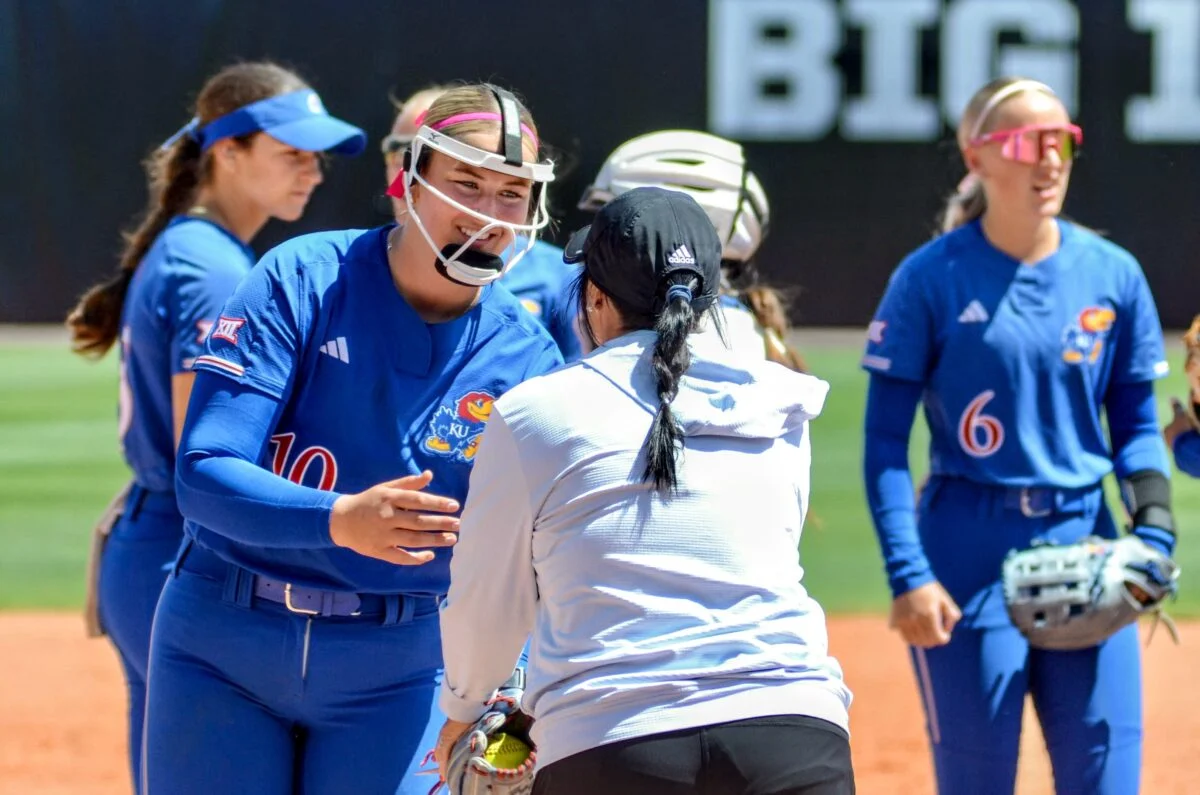
Player-to-player conferences have a separate count
Each team also has seven charged player-to-player conferences in regulation, separate from the representative allowance. The absence of a coach therefore does not make every delayed conversation unlimited. Conversely, a brief exchange that does not delay play should not automatically be counted as a formally charged conference by someone watching from home.
Suppose the catcher and pitcher use a charged player conference after a difficult sequence. Record it on the player line, not automatically on the coach line. If a coach later requests a charged consultation, that uses the other category. Counting both as indistinguishable mound visits obscures why the umpire may permit one after the other.
Half-inning limits and extra innings
The overall totals are constrained by half-inning rules. Regulation allows one charged offensive conference, normally one defensive conference and up to two player-to-player conferences per team per half inning. A pitcher entering who has not yet pitched in that half can provide an additional defensive-conference opportunity, but it still uses the overall representative allowance.
Extra innings change the accounting. Each half inning provides one representative conference and one player conference; unused regulation allowances do not carry over. The casebook's A.R. 6-28 confirms that a pitching change does not create another defensive conference in extras.
Consequently, a total alone cannot settle a dispute. Knowing that a team has used only three conferences in the whole game does not prove another is available in the current half inning. You need both the ledger and the local limit. This explains why two superficially similar visits can produce different responses at different points in the game.
When both teams talk during the same timeout
A television shot can make one stoppage look like two independently requested timeouts. If a team is charged with a representative conference, both sides may hold consultations, including with runners away from the vicinity of their bases. The opportunity to talk during the existing break does not mean every visible group must be entered as a separate charged event.
Player-only defensive conferences have a different boundary. Base runners cannot simply leave the vicinity of their bases to join an offensive huddle without the conference consequences in Rule 6.12. The casebook's A.R. 6-32 distinguishes the batter: the batter may consult the third-base coach during that defensive player conference, provided the batter is ready for the restart.
Picture a runner at second while the catcher speaks with the pitcher. The batter and third-base coach can be visible in another conversation, yet the runner's permitted movement is a separate issue. Counting the number of conversations on the screen would miss that distinction. The original reason play stopped and the roles of the participants matter more than how many people are speaking.
This also explains why the end of a meeting matters. The other team may use time already available, but that is not permission to demand a fresh break after the original consultation has finished. Watch who returns to position and whether the umpire is ready to resume, rather than assuming every group receives its own independent block of time.
For a spectator, a careful description might be that both teams consulted during the defense's conference. That reports what is visible without claiming that both spent an allowance. A stronger allegation requires the umpire's accounting and the applicable conditions; a camera cut alone cannot supply them.
How the 20-second pitching rule and 12-second readiness rule work
The timing sequence applies a shorter routine to ordinary preparation. It does not erase the provisions for a properly granted conference or an umpire-administered stoppage. Once the game is ready to proceed, however, both sides have obligations; pace is not exclusively the pitcher's responsibility.
When the timing starts and what players must do
Under current Rule 10.18, the pitcher has 20 seconds from receiving the catcher's return to separate the hands and deliver the pitch. The batter and catcher must occupy their respective boxes within 12 seconds after the pitcher receives the ball in preparation to pitch, or after the umpire calls play. The 2026–27 changes document identifies that 12-second requirement.
Do not read 12 seconds as 12 seconds remaining on a display that begins at 20. Elapsed time and remaining time describe the same countdown from opposite directions. For example, 12 elapsed seconds leaves eight on a 20-second display. That arithmetic can explain why a hitter is expected to be in position while the visible clock still has time left.
Older search results can create another confusion. A 2024-season interpretation hosted by the NFCA refers to 10 seconds. Its date matters: that historical figure should not override the current 12-second rule. When two explanations disagree, compare their seasons before deciding an umpire is applying the wrong number.
What a timing violation changes in the count
The current effects distinguish the participants. A catcher timing violation makes the ball dead and awards a ball; a batter timing violation makes it dead and assesses a strike. A pitcher timing violation is an illegal pitch with a delayed-dead-ball signal, so its handling follows the illegal-pitch provisions rather than a universal assumption that all subsequent action immediately vanishes.
Consider two simple count examples, with no other violation involved. At 3–1, a ball awarded for the catcher's timing violation produces ball four. At 0–2, an assessed strike for the batter's timing violation becomes strike three. Neither result requires a normal pitch to cross the plate. That is why recognizing who violated the sequence can matter as much as noticing that time expired.
There is also a specific exception for intentionally violating the timing rule to walk a batter without pitching. The corrections updated October 2, 2026 specify runner advancement instead of awarding that ball, with a warning and an ejection for a second offense. Deliberately repeating violations is therefore not a substitute for understanding the prescribed procedure.
Some stoppages do not spend the conference allowance
A consultation taking place during an existing administrative stop is not necessarily a newly charged conference. The rules provide for uncharged discussions during specified injury, ejection, protest and substitution administration. The conditions matter, including readiness to resume and, in some situations, where base runners remain.
The casebook's A.R. 6-21 gives a concrete example: a coach makes substitutions and exchanges the catcher's wristband insert during the administration. The consultation need not be charged when the team is ready once the umpire finishes those responsibilities. The example explains why a meeting visible during a change does not prove that another timeout was spent.
The sequence is significant. A properly communicated change followed by conversation while the umpire administers it is different from requesting a strategy meeting and only later announcing a change. For a spectator, it may be impossible to hear which happened. That is a reason to seek the umpire's explanation, not a reason to assume the hidden conversation supports whichever team you favor.
Injury attention also has its own purpose and supervision. A long pause is not evidence that someone is pretending to need care, and a brief television view cannot establish the medical facts. The relevant spectator question is how play resumes once the authorized process is complete.
Replay huddles still require a prompt restart
The NCAA's approved 2026 changes permit teams to congregate during a review without automatically charging a conference. Once the umpires return, both teams must be ready: defensive delay can add a ball, while offensive delay can add a strike.
Thus, a review can explain both an extended pause and several conversations, yet the restart remains regulated. Do not add all the review's duration to a coach's conference count. For which decisions can be reviewed and how challenges work, use our NCAA softball replay guide. Here, the important distinction is the opportunity to talk during a review versus the obligation to proceed afterward.
What happens when a team uses too many conferences
An unallowed conference is not simply one more harmless entry on the ledger. Rule 6.12 directs the umpire not to permit conferences beyond the applicable limits and provides for an immediate administrative ejection of the representative or player who initiates an unallowed conference. That consequence is different from adding a ball or strike for a timing violation.
The casebook's A.R. 6-30 makes the initiator important. After an offensive conference has already been used in the inning, a batter later runs to the coaching box to confer again. In that example, the batter is ejected. Remembering only that an excess meeting means a coach is ejected misses who actually initiated this particular violation.
For a hypothetical comparison, a hitter who is late taking the box presents a timing issue; a hitter who initiates another prohibited consultation presents a conference issue. Both may look like delay from the stands, but the rule being enforced and the consequence are different. An explanation should identify the actual conduct before naming the penalty.
This is also why the high school rule mentioned in a comment thread should not be carried across to the college game. A remembered fourth-visit pitching-change rule does not replace NCAA 6.12. If a discussion moves between competitions, establish the governing rules again before comparing the rulings.
The practical benefit of keeping the categories straight is precision. Instead of saying an umpire punished a team for talking, describe the limit that applied, whether it had already been used and who initiated the additional conference. That makes the decision understandable without inventing motives for either side.
How to follow the next game without counting every huddle
You do not need to keep a second scorebook to enjoy a college softball game. When a pause seems confusing, use a short sequence of questions:
- Who prompted it? Distinguish a coach or other representative, players consulting with each other, and an umpire handling an issue.
- Why was play stopped? A charged consultation, a substitution and a video review can all produce conversations while following different accounting.
- What is the local limit? A regulation total does not override a half-inning limit, and extra innings use their own allowances.
- What happened at the restart? The permission to talk during existing time does not remove the duty to be ready afterward.
Then separate observation from inference. Saying the catcher and pitcher met twice reports something you may have seen. Saying the umpire failed to enforce a limit requires knowing whether each meeting was charged, what else had occurred and which exception might apply. A clipped highlight often leaves those details outside the frame.
The same discipline helps with pace complaints. Identify the part you would change: ordinary preparation, the number of tactical interruptions, administration or the review process. That produces a more useful discussion than treating every quiet moment as the same problem. A legal conference can still feel excessive to a viewer; an inconvenient delay can also serve a necessary game function.
For the next live game, our college softball viewing guide helps distinguish services before you follow the game's actual watch listing. Keep the current NCAA rules hub available when an explanation needs checking. Following the cause of a stoppage is usually more revealing than counting every group of players the camera shows.
Join the conversation
Share a question or a thought about college softball. Comments are reviewed before they appear. Keep it friendly and on topic.
No comments yet. Start the conversation.
Sign in with Google to leave a comment. Your email address is not displayed.