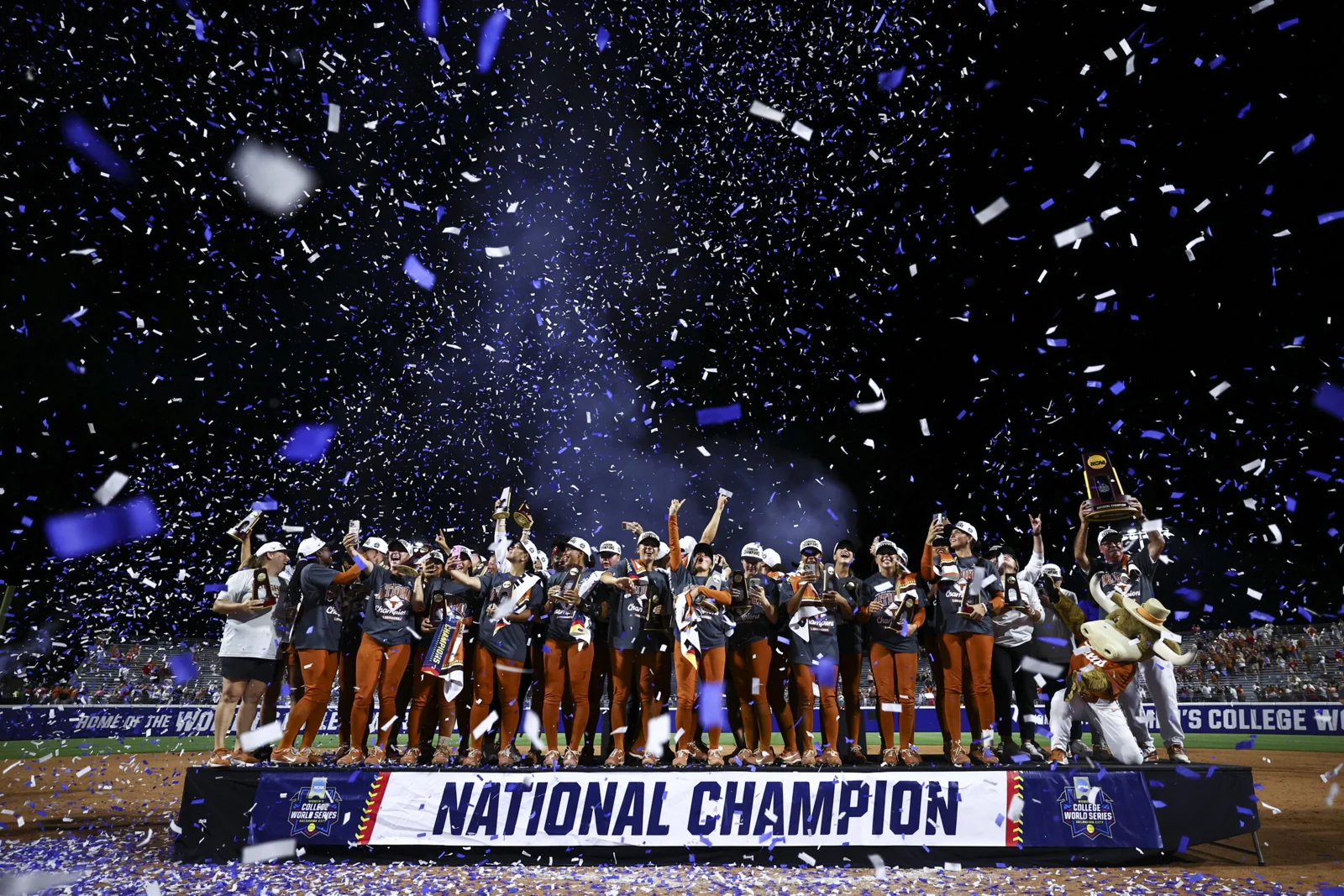
The NCAA Division I softball tournament begins with 64 teams. Sixteen regional winners advance to eight super regionals, and those eight series winners reach the Women's College World Series. To follow a school through that journey, you need three different pieces of information: its place in the bracket, the rules of its current round and its next confirmed game time.
This guide explains how those pieces fit together, including selection, seeding, hosting and the conditional games that can extend a weekend. The format baseline is the NCAA's currently linked 2025–26 championship manual; future dates are labeled separately. Information was checked on October 15, 2026, before the 2027 field and individual tournament matchups had been announced.
The NCAA tournament starts with 64 teams, not eight
The Women's College World Series is the last stage of the national championship. Reaching it requires winning through two earlier rounds. The NCAA's Division I championship hub describes that progression, while its linked prechampionship manual supplies the field size and formats.
| Stage | Teams at the start | How a team advances |
|---|---|---|
| Regionals | 64 across 16 sites | Win a four-team double-elimination bracket |
| Super regionals | 16 across eight sites | Win a best-of-three series |
| WCWS bracket play | Eight in Oklahoma City | Survive double elimination to become one of two finalists |
| WCWS championship series | Two | Win two games against the other finalist |
That table counts teams, not a fixed number of games. A regional may need its extra final, a super regional may finish in a sweep, and the championship series may require a third game. A tournament schedule therefore contains both definite fixtures and possible fixtures. Treating every line as guaranteed produces an inaccurate viewing plan.
Conference tournaments sit before this national bracket. A conference championship can determine which school receives that league's automatic NCAA berth, but an SEC or Big Ten tournament game is not an NCAA regional game. Keep the event name attached to a result, particularly in May when conference and national postseason coverage appear close together.
Division matters as well. A search for a softball bracket can return Division I, Division II or Division III competition. This guide concerns the Division I women's championship. Check that label before using a downloaded bracket or applying the 64-team structure to a different event.
For a fan following a single school, the first meaningful destination is its assigned regional. Oklahoma City becomes a confirmed destination only after the team wins its super regional. Our 2027 Women's College World Series guide covers that final-stage setting and its detailed bracket; the sections below focus on earning a place there.
How teams are selected, seeded and assigned a host
Selection answers whether a school is in the field. Seeding organizes its place among the participants. Hosting determines where games will be played. They are connected decisions, but a fan should check each separately. A school can qualify without hosting, and a nationally seeded team still has to win its regional.
Automatic qualifiers and at-large selections
An automatic qualifier takes its conference's designated berth. The at-large field consists of other teams chosen by the NCAA committee. Losing a conference tournament therefore does not necessarily end a contender's season; that school can still be selected at large. Conversely, an automatic qualifier does not need to win a second argument about whether its resume deserves one of the discretionary places.
The number is season-specific. The 2026 field announcement reported 31 automatic qualifiers and 33 at-large selections. The August 2026 committee report approved 32 automatic-qualifying conferences for 2027. In a 64-team field, that leaves 32 at-large places. Reusing the previous year's 31/33 split would misdescribe the next selection process.
The current manual also requires an at-large candidate to have at least a .500 record against Division I opposition. Eligibility is only the starting point: the committee weighs the record against schedule difficulty, significant results, head-to-head and common-opponent evidence, and player availability. RPI is an evaluation resource, with KPI and Diamond Sports Rankings also available; none is a button that automatically selects the field.
When comparing two bubble teams, ask what their wins represent. A strong percentage against a modest schedule and a lower percentage against difficult opponents pose different selection questions. Open the actual results behind a team's RPI position before equating its ranking with a guaranteed berth. That is an analytical comparison, not a substitute for the committee's announcement.
There is also an approved 2027 scheduling change: once a conference tournament begins, a game its member plays outside that tournament will no longer count toward NCAA selection. That matters when reading late-added games and debating whether a final extra result can improve a school's resume.
National seeds are different from regional seed positions
Beginning in 2026, the NCAA seeded the top 32 teams nationally in groups of four, while continuing to identify the top 16 by overall rank. The published national bracket uses four sets of seed labels from 1 through 8. Its group pairings match 1 with 8, 2 with 7, 3 with 6 and 4 with 5, with geographic placement within the groups and the same-conference regional restriction applied.
That expanded system makes the label beside a team especially important. An overall national seed, a numbered group on the large bracket and a team's position within its four-team regional are different references. Read the national top-16 list and the bracket legend before interpreting a small number beside a school as its overall national rank.
For a concrete example, Nebraska's 2026 regional preview described the Huskers as the No. 4 overall NCAA seed, Louisville as the regional No. 2 and Grand Canyon as the regional No. 3. It also reported Nebraska at No. 1 in the NFCA and USA Softball polls. All those labels could be correct simultaneously because they described different lists and different scopes.
The practical consequence is simple: compare like with like. A poll No. 1 does not automatically own the national No. 1 route. A regional No. 2 is not necessarily the second-best team in the country. And the move to 32 seeded teams did not expand the tournament beyond 64 participants.
Hosting depends on more than a place in a poll
The top 16 received the opportunity to host in the 2026 selection announcement, subject to the hosting process. A successful bid involves real event preparation. The NCAA's preliminary-round checklist requires budget and facility information, operational contacts and lodging arrangements. It also specified a visible action clock and double first base for 2026 hosts.
Those requirements explain why a ranking discussion cannot by itself confirm a venue. A host must accommodate visiting teams and stage championship competition, including the necessary review and broadcast operations. The August report added approved replay-connectivity and public-address review-announcement requirements for 2027, another reminder that hosting is an operational assignment as well as a competitive advantage.
For travel, wait for the actual site announcement and the host's tournament information. A school's regular-season home schedule does not establish that it will stage a regional, and a regional hosting assignment does not guarantee that the same school will still be playing the following weekend.
Reading a regional bracket one game at a time
A regional's defining rule is double elimination: a team stays alive until its second loss. Its next opponent depends on results elsewhere at the site. Use the game numbers as connecting instructions, rather than assuming the two opening winners will play a one-off final.
The winners' path and the elimination path
The following sequence follows the NCAA regional format. Seed numbers in the first two rows refer to positions within that four-team regional. This table explains the bracket; the host's announced schedule supplies the actual dates and start times.
| Game | Matchup | What changes |
|---|---|---|
| 1 | Regional No. 2 vs. No. 3 | Winner to Game 3; loser to Game 4 |
| 2 | Regional No. 1 vs. No. 4 | Winner to Game 3; loser to Game 4 |
| 3 | Winners of Games 1 and 2 | Winner reaches final unbeaten; loser to Game 5 |
| 4 | Losers of Games 1 and 2 | Loser eliminated; winner to Game 5 |
| 5 | Game 4 winner vs. Game 3 loser | Loser eliminated; winner reaches final with one loss |
| 6 | Game 3 winner vs. Game 5 winner | Can decide the regional or force Game 7 |
| 7, if needed | The same two finalists | Winner advances; loser eliminated |
Imagine Team A winning its opener and Game 3. It reaches the final at 2–0, having avoided an elimination game. Team B loses its opener, then wins Games 4 and 5. It arrives at the same final at 2–1, having already played an extra game. Both have two victories, but their positions are unequal because B has used its available loss.
There is a third common route. Team C wins its opener, loses Game 3 and recovers in Game 5. It also reaches the final at 2–1. An opening victory helped C, but its later defeat removed the unbeaten advantage. To understand the final, count losses in this regional, not just whether a school won on opening day.
These paths explain why pitching depth becomes visible quickly. A coach entering Game 5 must win immediately while also considering the innings a surviving team could need afterward. A second reliable pitcher can change those options. That is a workload observation, not a claim that one style of staff is guaranteed to advance.
What an if-necessary final actually means
If the unbeaten team wins Game 6, its opponent suffers a second loss and the regional ends. If the one-loss team wins, both finalists now have one defeat, so Game 7 is required. The extra game gives neither school a fresh spare loss: its loser is eliminated.
A team that loses its opener must therefore win four straight games to advance: Games 4, 5, 6 and 7. A team that loses Game 3 after winning its opener needs three straight: Games 5, 6 and 7. An unbeaten regional champion can finish with three wins. These are different routes to the same next round, not different standards for who counts as the winner.
The 2026 Lincoln Regional supplies a straightforward completed example. Nebraska beat South Dakota 4–1, then Grand Canyon 2–0 and 1–0. The final victory gave Grand Canyon its second regional loss, ending the event without Game 7. GCU's own game account records a 2–2 regional finish. Had GCU won that first final instead, another game would have been needed; that is a hypothetical explanation, not an additional 2026 result.
A conditional game is also different from a postponed game. The former exists only if a preceding result requires it; the latter is an already-needed contest whose timing has changed. Check the host update before assuming that an empty broadcast slot means cancellation or that every advertised final session will include two games.
Super regionals follow the bracket into a best-of-three series
After regionals, the NCAA does not rank the sixteen survivors again and assign them new opponents. The published bracketing policy pairs regional winners according to their original positions. The top-16 paths are arranged so that, if those seeds all advance, the overall No. 1 meets No. 16, No. 2 meets No. 15, and so on.
An upset changes the school occupying a place on that route. It does not open a fresh draw. Arizona State demonstrated that distinction in 2026: the Sun Devils won the regional hosted by overall No. 15 Texas A&M and moved into a super regional against overall No. 2 Texas. They did not inherit Texas A&M's seed number or receive a new opponent based on how impressively they had played.
The super regional itself begins at 0–0. A regional loss does not carry into the series, and the first team to win twice advances. In the 2026 Austin series, Arizona State won the opener 4–1, Texas answered 4–3, and Texas won the deciding game 5–0. Winning Game 1 created an advantage, but it did not settle the series.
That repeated-opponent format makes adjustments easier to track than during a four-team regional. Watch whether a hitter begins laying off the pitch that beat her the previous day, whether a pitcher attacks a different part of the zone and whether a coach changes the timing of a relief appearance. Those are useful viewing questions; a final score alone cannot establish which adjustment caused the outcome.
Confirm the host separately from the matchup. Nebraska's 2026 selection announcement explicitly said it would host a super regional if it won its regional. That is the kind of school-specific confirmation a traveling fan needs. A bracket prediction or a familiar stadium name is weaker evidence than the actual hosting announcement.
Once a team earns its second super regional win, it has qualified for the WCWS. That next stage has its own double-elimination bracket, followed by a separate best-of-three championship series. Record the round alongside a team's win-loss tally: a 1–1 super regional and a 1–1 WCWS position create different next-game situations.
The 2027 schedule: round windows versus confirmed game times
A round window tells you which part of the calendar to reserve. A game listing tells you when a particular matchup is scheduled to start. The first can be available months before the second. For 2027, keep those two levels of certainty separate when planning a trip or adding a television reminder.
Published dates for regionals, super regionals and the WCWS
The future-dates table in the NCAA manual lists the following 2027 windows. The current championship hub independently lists the WCWS dates and Devon Park in Oklahoma City. These were the published dates checked on October 15, 2026.
| 2027 round | Published window | Still needs its own announcement |
|---|---|---|
| Regionals | May 21–23 | Field, sites and game assignments |
| Super regionals | May 27–30 | Qualifiers, hosts and each series schedule |
| Women's College World Series | June 3–11 | Eight participants and detailed game listings |
The four-day national super regional window does not mean every matchup is a four-day series. The existing format schedules a potential three-game series across three days, with different sites using different portions of the overall window. A sweep removes the need for a third contest.
There is a pending format issue worth keeping in view. The August 2026 report supported a four-day regional concept to reduce doubleheaders but gave it no implementation date. It also discussed moving WCWS conditional semifinals to Tuesday. Those discussions do not confirm a revised 2027 daily schedule. Recheck the next championship manual and official event updates before assigning those possible games to a travel itinerary.
The same caution applies to Selection Sunday. A published 2026 show time or channel is historical information. The materials above do not establish the 2027 show's broadcast appointment, so this guide does not copy one forward.
Check the time zone, broadcast and conditional games
Read a listing as a complete entry: round, game number, opponents or placeholders, date, time zone and outlet. A national bracket can use Eastern time while a host-school release uses its local zone. For example, Nebraska's May 16, 2026 update set the following day's regional final for 2 p.m. Central, equivalent to 3 p.m. Eastern.
That release also said the television assignment would follow after the day's games finished. It is a useful real example of a start time being known before the outlet. A fan should not assume that yesterday's ESPN channel, streaming service or login requirement automatically applies to the next game.
Use the college softball TV schedule to locate the current listing and the watching guide to understand access. Check the specific game with the host or broadcaster before purchasing a service. Neither the tournament's date window nor the word ESPN establishes a free live stream.
Finally, recheck after an elimination result or a weather update. A conditional game can become unnecessary; a required game can be delayed. A screenshot taken earlier in the weekend cannot tell you which of those changes has occurred.
A practical way to follow your team's tournament route
Start by marking the school's regional and the regional paired with it for supers. That gives you a useful second set of games to watch: those results determine the next possible opponent. You can follow a contender's path without assuming either regional favorite will survive.
During the regional, keep a small record of the team's current-round wins and losses and the game it enters next. “Won today” is less informative than “won Game 5 and must now beat the unbeaten finalist twice.” Match the final result on the scores page to the bracket before deciding whether the team has advanced, stayed alive or been eliminated.
Then look beyond the pitcher credited with the win. Check how many innings each member of the staff actually worked and whether another pitcher supplied important outs. Nebraska's 2026 regional clincher, for example, included five innings from Alexis Jensen and a save by Jordy Frahm. A win-loss column alone would not describe that shared assignment.
Workload is context for the next game, not a diagnosis. A pitcher appearing twice has not necessarily thrown more pitches than one who completed a long outing, and an observer cannot infer an injury from a coaching change. Use the box score and confirmed team information to frame questions about available options, rather than declaring a staff exhausted from appearances alone.
When the round ends, reset the competitive question. A regional champion has earned a place in a super regional, where the job is now to beat one opponent twice. The host, game times and viewing assignments should be checked again. A team page such as the Nebraska schedule helps keep the school's fixtures together, while the bracket explains the consequences of each result.
If you are attending, retain the actual session description with the ticket and revisit the host's updates after schedule changes. If you are watching remotely, confirm the next listed game and its outlet rather than reusing the previous stream. Those habits turn a complicated postseason chart into a sequence of clear decisions: who can play next, what the next win achieves and when that game is actually scheduled.
Join the conversation
Share a question or a thought about college softball. Comments are reviewed before they appear. Keep it friendly and on topic.
No comments yet. Start the conversation.
Sign in with Google to leave a comment. Your email address is not displayed.