The ESPN/USA Softball poll, NFCA coaches poll, D1Softball Top 25 and NCAA RPI are different rankings. They do not share a single voting panel or a common method. Knowing which one you are reading is the first step toward deciding what a team's position actually tells you.
Our Top 25 rankings page supplies the available dated list. This guide explains the sources behind college softball rankings, the difference between judgment and calculation, and how to use both when following NCAA women's Division I teams.
Start with the ranking's name, date and subject
Before comparing two numbers, complete the sentence: this team is ranked in this position by this source for this edition. “No. 12 nationally” leaves too much unsaid. A school could occupy different positions in a coaches poll, an editorial ranking and RPI because each applies a different way of evaluating the same season.
The competition level also matters. The NFCA's directory separates Division I, II and III rankings and links to other levels of the sport. Those lists do not offer interchangeable opinions on one pool of schools. They evaluate separate groups. Check that a search result concerns NCAA women's Division I before placing it beside a list of those teams.
| Source | Kind of ranking | What to ask |
|---|---|---|
| ESPN/USA Softball | Voting poll of Division I teams | Where does this panel put the team? |
| NFCA/GoRout | Coaches poll of Division I teams | How do the coaches rank the field? |
| D1Softball | Publisher's editorial Top 25 | What order does this outlet favor? |
| NCAA RPI | Results-and-schedule index | How does the record compare in context? |
Next, distinguish a release date from a results cutoff. One says when the list appeared; the other says which games belong in it. Reading an old table today does not update its record column. If a score page shows one more win than a poll, first check whether that game finished after the poll's stated cutoff.
The USA Softball archive also distinguishes preseason, weekly and final editions. Its 2026 preseason table labels the historical record column 2025. That record provides background for a forecast of the new season. It is not a claim that the team has already played those games in 2026. Similarly, a final 2026 ranking remains an assessment of that completed season when readers return the following winter.
For a meaningful comparison, choose editions that cover approximately the same games. Comparing one source before a weekend series with another after the series can exaggerate their disagreement. A team's position when a game was played is also a different piece of information from its position several weeks later. Both can be relevant, provided the date is clear.
This is especially useful when discussing ranked wins. Say whether the opponent was ranked at the time or appears in the latest edition. The first describes how the matchup was viewed then; the second adds what happened afterward. Keeping those labels explicit gives other fans something concrete to assess instead of asking one unexplained number to stand for an entire season.
Who makes the ESPN, NFCA and D1Softball rankings?
The source label identifies who takes responsibility for the order. A poll displayed by a broadcaster, a school or a statistics site does not become a new poll each time it is republished. Follow the attribution back to the producer, especially if a screenshot leaves out the heading or date.
ESPN/USA Softball and the NFCA coaches poll
The ESPN.com/USA Softball Collegiate Top 25 combines coaching representatives with national and local media who cover Division I softball. USA Softball lists its regular-season release time as Tuesday at 11 a.m. Central. That makes it a recurring assessment, rather than a ranking that changes automatically after every final out.
The 2026 NFCA/GoRout Division I coaches poll identifies 31 head coaches as voters, one representing each Division I conference. The publisher and season matter when describing that panel. “Coaches poll” identifies the voting group; the sponsor's name helps identify the edition but does not turn the poll into a numerical performance model.
Read points and first-place votes separately. Points represent the accumulated voting total; they are not runs scored, wins or a strength-of-schedule score. First-place votes count ballots putting the team at the top. The two columns describe different aspects of support. In the 2026 USA Softball preseason edition, Texas and Texas Tech shared first with 611 points despite receiving different numbers of first-place votes.
Raw point totals also need their own poll's scale. Texas finished first in the final 2026 NFCA poll with all 31 first-place votes and 775 points. That total cannot be compared directly with a point total generated by a different voting pool. Compare positions and the distribution of support within the same source before trying to interpret the size of a gap.
A tie should remain a tie when you repeat the list. Likewise, “receiving votes” means a team collected support outside the numbered Top 25; it does not establish an official No. 26 position. If a table supplies no previous numbered position for a newcomer, describing it as entering the poll is more accurate than inventing a numerical climb.
D1Softball's editorial Top 25
D1Softball publishes its own team order under a staff byline. Its May 5, 2026 Top 25, for example, identified Oklahoma as its regular-season leader. Treat that as D1Softball's editorial assessment. It is not another name for the NFCA ballot, and the website's separate RPI coverage does not make its Top 25 a computer-generated RPI list.
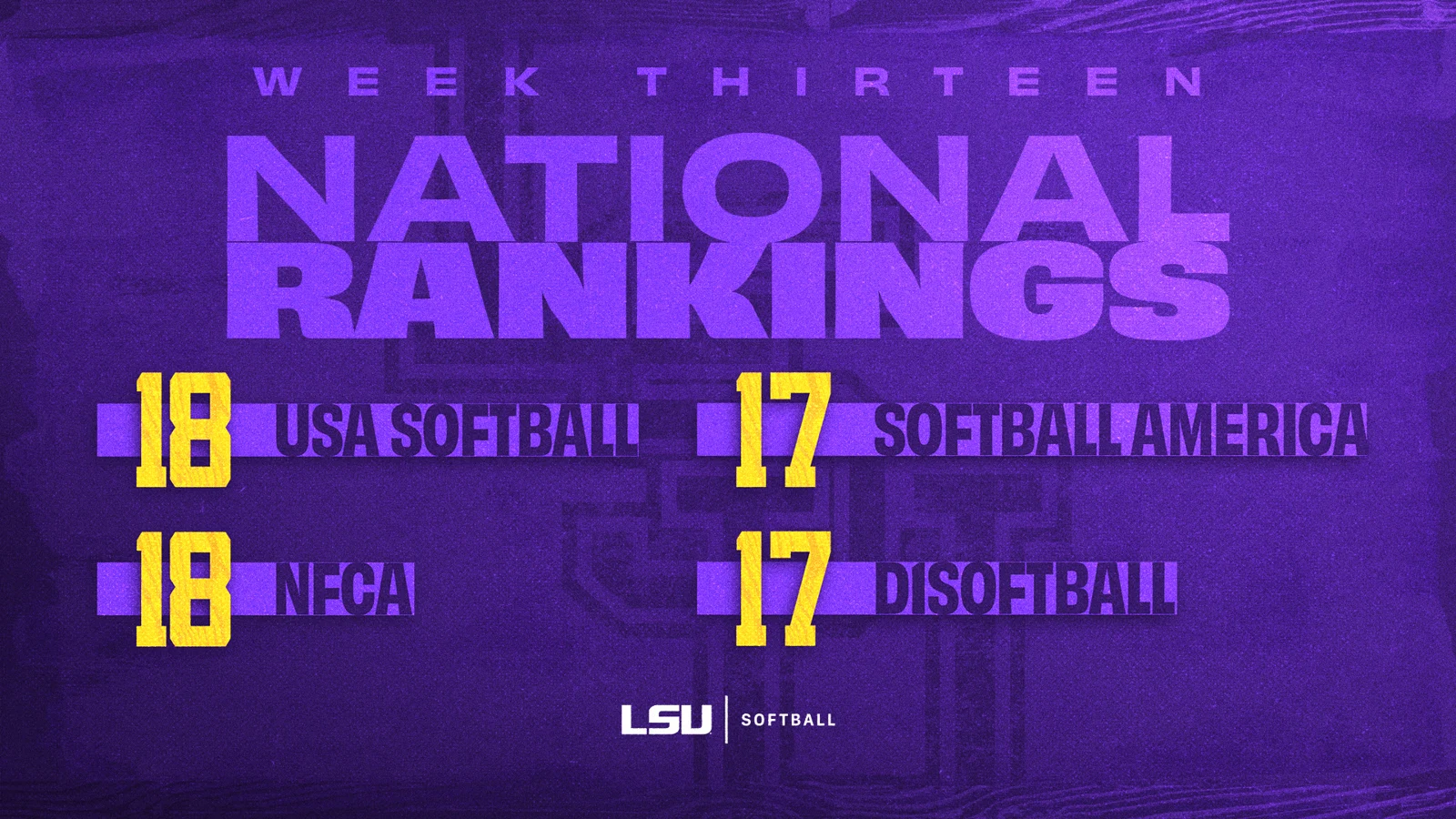
A clear example comes from LSU's May 5, 2026 rankings announcement. The Tigers were No. 18 in ESPN/USA Softball and the NFCA poll, No. 17 in D1Softball and Softball America, and No. 11 in RPI. The school reported these positions together because they described different assessments of one team, not four different teams or competing versions of the same table.
When the lists disagree, inspect the games and the explanation accompanying each edition. One ranking might better match your view of a team's pitching depth or recent opponents, but preference is not proof that another source has miscalculated. Avoid averaging the positions and presenting the result as an official consensus. An average of ordinal positions conceals how each list was produced and says nothing about the actual distance between neighboring teams.
What RPI measures and why a strong record is not enough
RPI stands for Rating Percentage Index. Its central idea is that a team's record needs the context of the opposition behind it. Winning eight out of ten games does not describe an identical achievement against every possible schedule. RPI gives schedule-related results a mathematical role instead of asking voters to assign a place.
The 2025–26 NCAA Division I softball manual describes the basic components as 25 percent the team's winning percentage, 50 percent opponents' success and 25 percent opponents' schedule strength. It also lists bonuses for wins against the top 75 and penalties for losses against teams ranked 227 or lower. The simple three-part calculation therefore should not be presented as a complete reconstruction of the published NCAA figure.
A hypothetical illustration, before adjustments: Team A has inputs of .800 for its own winning percentage, .500 for opponents' success and .500 for opponents' schedule strength. The weighted result is .575. Team B's inputs are .700, .600 and .550, producing .6125. These are invented inputs to illustrate the arithmetic, not ratings assigned to actual schools.
Team A wins a larger share of its own games, yet Team B has the higher value in this simplified example. That is why sorting teams by winning percentage cannot reproduce RPI. It also explains why another team's results can matter: opponents remain part of the comparison after the game against your school has ended.
Be equally careful with the difference between a rating and a rank. A rank tells you the order after values have been compared. It does not tell you whether neighboring teams are separated by a large or tiny numerical difference. A move from 30th to 25th is five places, but it is not evidence of a five-percent improvement or a five-percent change in the chance of winning tomorrow.
Read opponent quality and venue alongside the number
Strength of schedule and RPI belong beside each other, not in the same column. LSU's May 5 announcement separately reported RPI, overall schedule strength and nonconference schedule strength. The distinction is practical: playing difficult opponents describes the challenge, while the team's results describe what it did with that challenge. Neither an easy schedule nor a hard one tells you the outcome by itself.
Look at the distribution of the wins. A record built mostly against lower-ranked opponents raises a different question from a similar record containing several strong opponents. The NCAA manual's evaluation categories include records against different RPI bands and average RPI of wins and losses. Those details let a reader move beyond one overall number to ask where the convincing results actually came from.
Venue adds another layer of context. Our RPI page includes home, road and neutral-site records where supplied. Open the schedule behind those splits: ten road games are not ten identical tests, and a neutral-site tournament may involve several opponents in a short period. Those are reasons to investigate the results, not permission to invent a home-field adjustment to the official formula.
For softball specifically, examine how pitching responsibility was distributed. A win driven by an ace's complete game answers one question; repeatedly winning with multiple pitchers answers another. Innings, strikeouts, walks and opponent quality can help you assess that difference. They do not transform RPI into a prediction of which pitcher will be available or effective in the next game.
Why rankings disagree as the season develops
The evidence available in January is different from the evidence available in May. Evaluating a ranking fairly means asking what could reasonably be known when it appeared. A preseason expectation can be sensible at the time and still look very different from the final order after a full season of games.
Preseason expectations, weekly movement and final polls
A preseason poll necessarily precedes the new spring's results. Returning production provides useful background, but it does not automatically describe the new lineup. Departures can change who catches, who supplies extra-base hits and how many dependable innings remain in the circle. Incoming talent adds possibilities before it adds college results for that team.
As the season develops, ask whether the team is answering those questions. A short stretch of low ERAs deserves examination alongside innings and opponents. A high batting average against one weekend's pitching is encouraging, but it does not establish that the offense can sustain the same production against every staff. These are useful analytical checks, not a claim that every poll uses identical statistical weights.
Weekly movement is also relative. An unbeaten weekend does not guarantee a rise if other teams produce stronger cases, while one loss does not logically erase everything that preceded it. Examine a series as well as its most dramatic game. Winning two of three against a difficult opponent can reveal more than the isolated final score that circulates most widely.
The difference between the final regular-season poll and the final season poll is particularly important. Nebraska led the May 12, 2026 NFCA edition; Texas led the June 9 final edition after the NCAA tournament. Those are separate assessments at different stages. A later result adds evidence to the season's story, but it does not make an earlier dated ranking an attempt to describe games that had not happened yet.
A poll position is not an NCAA tournament seed
The NCAA selection process considers several kinds of evidence. Its 2025–26 softball manual identifies records, schedule strength, player availability, head-to-head results and results against common opponents among the considerations. RPI assists that evaluation; it does not automatically assign the bracket. The relevant committee's decision is a separate product from a media or coaches poll.
The 2026 examples make the distinction concrete. Nebraska was first in the NFCA's May 12 poll but held the No. 4 NCAA seed. Alabama was third in that poll and the No. 1 NCAA seed. A fan discussing the bracket needs the seed; a fan describing the coaches' order needs the poll position. Replacing one with the other changes the meaning of the statement.
Selection rules can also change between seasons. The NCAA's August 2026 report records a policy effective for 2027 selection: after a conference tournament begins, games played outside that tournament by a member of the conference will no longer count for selection purposes. A published record and the set of results relevant to selection therefore require attention to the applicable season's rules.
For a bubble-team argument, identify the evidence that existed when the field was chosen. A June final ranking incorporates tournament results that the selection committee did not yet have in May. Using that later list to explain an earlier seed reverses the timeline. Instead, compare the dated records, opponents and available players, then state which parts of the case you think deserved more weight.
Top 25 teams, Top 100 players and the ranking you actually need
“College softball Top 100” is an ambiguous request. It might mean individual college players, a recruiting class or the first hundred schools in a team ranking. Adding “ESPN” does not resolve that ambiguity. The ESPN/USA Softball product discussed here is a team Top 25; it should not be relabeled as a player Top 100 or used to imply that an unrelated list belongs to ESPN.
D1Softball's 2026 preseason D100 explicitly concerns players. Its separate preseason mid-major D100 narrows the field further. A position on either player list is not the school's position in the team Top 25. Even within one publisher's coverage, the subject and comparison group can change.
Individual comparisons introduce questions a team poll does not answer. How much weight should a two-way player receive for contributing in the circle and at the plate? How should an everyday catcher compare with a pitcher carrying a large workload? Does the list reward completed production, project the coming season or evaluate future potential? A useful player ranking explains those choices instead of suggesting that a batting average and an ERA can simply be placed on the same scale.
Our independent Top 100 college softball players of 2026 evaluates the completed college season. It is our editorial list, with its own stated approach, rather than a reproduction of D1Softball's preseason D100. Readers comparing them should expect differences in both timing and judgment. A recruiting-class list is another category again: its year identifies a cohort, not necessarily the college season being evaluated.
Counting how many highly ranked players a school has can suggest individual talent, but it does not settle the team order. Those players still need to fill complementary roles, stay available and perform against the actual schedule. A list of stars does not by itself establish defensive coverage, pitching depth or the production of the rest of the lineup.
Choose the resource by the question you want answered:
- Where is my team in the poll? Use the ESPN/USA Softball table and read the edition date.
- How does its results-based position differ? Open the Top 25 versus RPI comparison, then inspect the schedule behind the gap.
- Which players had the strongest individual seasons? Choose a player list that states its season, population and evaluation criteria.
Keep the publisher's own label when sharing the answer. A generic “AP Top 25” label borrowed from another sport, an unlabeled screenshot or a search phrase containing “Top 100” is not enough to identify a softball ranking. The original source, the relevant date and the object being ranked give you a much firmer basis for the next conversation.
Join the conversation
Share a question or a thought about college softball. Comments are reviewed before they appear. Keep it friendly and on topic.
No comments yet. Start the conversation.
Sign in with Google to leave a comment. Your email address is not displayed.